Showing posts with label Pemberton. Show all posts

Friday, March 13, 2020

2020-21 State Aid: Closer to Equality?

Note, this was written before Coronavirus. It was accurate back in February, but the parts about aid gains are inaccurate now because the $336 million in new revenue was cancelled.

Updated state aid disparities are here.  The 2020-21 deficit for underaided districts will be $1.9 billion.

2020-21's state aid distribution is the fourth year of New Jersey's attempt to bring equality to NJ's K-12 state aid through the combination of increasing the overall state aid package and redistributing Adjustment Aid from overaided districts to underaided districts, with Phil Murphy's proposed $491 million increase the largest increase NJ's schools have gotten since the 2011-12 Great Recession rebound year, but with the new aid focused on NJ's most severely underaided districts.

I admit that back in the 2016-2017 gubernatorial campaign, I had doubts about Phil Murphy's commitment to state aid equality, but the 2020-21 budget, which cuts Adjustment Aid by $155 million, puts those doubts to rest.

Starting with Chris Christie's final budget in 2017-18 and including 2020-21, New Jersey has now redistributed $307 million in Adjustment Aid.  The combination of that $307 million plus $1.3 billion in new state aid has dramatically reduced the number of districts who are severely underaided, from 50 districts with deficits over $4,000 a student in 2016-17, to only fifteen in 2020-21.
To put it in terms of what percentage of their state aid districts are receiving, we went from a recent peak of 141 districts getting less than 50% of their state aid in 2016-17, to only three getting less than 50% in 2020-21: Atlantic City, South Hackensack, and Cumberland County Vo-tech.

Looking at all districts, if New Jersey can provide the money promised in Phil Murphy's February 25th budget speech, the median district is only underaided by $331 per student, a recent low.  Back in 2016-17 and 2017-18, the median deficit was over $500 per student.  The median district now gets 88% of its SFRA aid target too, a recent record, compared to the median district getting less than 85% four years ago.

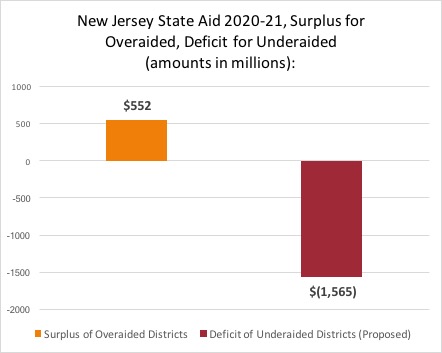
Despite the $491 million proposed infusion of aid into the underaided districts, their deficit only shrank by $220 million, from $1.78 billion in 2019-20 to $1.56 billion for 2020-21, due to the dynamic nature of district needs and the constant increase of Adequacy Budgets.


The Overaided:

There are 216 overaided students, with a total of 324,154 students, down from 342,275 in 2019.  The overaided districts have a surplus of $552 million. ($1612 per student, weighted average)


  • There are twelve districts with surpluses over $4,000 per pupil, with Asbury Park at the most overaided, at $8,138 per pupil.
  • There are ten districts with a surplus of $3,000 to $3,999 per pupil.
  • There are 34 districts with a surplus $2,000 to $2,999 per pupil.
  • There are 61 districts with a surplus of $1,000 to $1,999 per pupil.
Weymouth Township in Atlantic County will get 527% of its recommended state aid, or $1,319,479 when SFRA says it only needs $309,300, making it the most overaided in percentage terms of operating districts.

Cape May Point is non-operating (it has only three students), but it gets 927% ($16,339 versus
$1,975). Cape May Point, has a $3,837,923 Local Fair Share and is among the districts that should get $0 aid at all and undergo involuntary consolidation. 

I exclude Interdistrict Choice money from my comparisons because Interdistrict Choice money is outside of SFRA, but if I included Choice money, Deal would be NJ's most overaided, receiving over 1,000% of its recommended state aid.

I will now profile specific state aid information for three overaided districts, Asbury Park, Pemberton, and Jersey City.

Asbury Park Starts to Meet Reality

Asbury Park has long been ridiculously overfunded and overaided.  The fact that Asbury Park was literally America's highest-spending district among K-12s with more than 500 students and was academically in NJ's bottom 5%, is one of several pieces of evidence that the premise of Abbottism where exceptionally high-spending can be transformative is wrong.

Some Democrats acknowledge that excessive spending has failed in Asbury Park, but Asbury Park became the Republican poster child for Abbott waste, and the favorite Republican talking point to argue that NJ needed to change state aid.

S2 has already lowered Asbury Park's state aid from $55.4 million to $44.6 million, from 2016-17 to 2020-21. In dollars per student, Asbury Park's state aid has fallen from $24,258 to $20,965 per student.


Yet, since S2 is lowering Asbury Park's state aid, it's disappointing to see Republicans condemn all of the $155 million in Adjustment Aid redistribution, without any attempt to have a nuanced view.

EG, Assemblyman Brian Bergen provides an example of this anti-conservativism.  Although most districts in Bergen's District 25 are gaining state aid, Bergen condemns all redistribution
MORRIS PLAINS, N.J. – Gov. Phil Murphy’s proposed spending plan has nearly 200 school districts across the state losing $155 million in aid. Assemblyman Brian Bergen, who represents parts of Morris and Somerset counties as part of the 25th legislative district, which is losing more than $3.7 million, wants the governor to fully fund schools. 
“Only 64 percent of schools are getting increases, the rest will remain flat or continue to lose millions as part of a failed school funding formula that is hurting districts across the state,” said Bergen (R-Morris). “Among the towns I represent, there are five school districts facing a cut of more than $3.7 million and this is on top of what they lost last year.”
If Republicans are supposed to be the defenders of state taxpayers, why are they implicitly condemning redistribution which saves state taxpayers tens of millions a year, including normalizing education spending in NJ's most inefficient district?

The Pemberton State Aid Issue

Pemberton is not a high-profile district, it has consistently been one of New Jersey's most overaided districts, with a surplus of $36 million ($7900 per student) in SFRA's first year of 2008-09 and still possessing a $18.2 million surplus, the sixth most, ($4,248 per student), in 2019-20.

Pemberton made state headlines this March because it was the subject of an error by the Department of Education where the DOE used 2018 data on a district's total tax rate and therefore missed that Pemberton now had an above-average tax rate and had therefore reached S2's exemption from Adjustment Aid cuts for Abbott SDA districts.

Although much was made of the DOE's error and it made New Jersey give an an additional $2.2 million to Pemberton (so Pemberton's state aid surplus is $4,152 per student), the real mistakes are:


  • The New Jersey Supreme Court's rigid & artificial division of low-income districts into Abbotts and non-Abbotts, where the only difference is that Abbotts were ranked as DFG A or B according to the 1980 Census and also had the Department of Community Affairs's "urban status."  (See the "The Abbott List Has Always Been Unfair")
    • Pemberton's continuing inclusion on the Abbott list, despite the fact that it was placed in DFG CD after the 1990 Census
      • SFRA and S2's continuation of various privileges for Abbotts.


Regarding the last point, S2 created difference standards to protect Adjustment Aid for Abbotts and non-Abbotts.

This is the Abbott threshold for Adjustment Aid preservation that applies to Pemberton, even though Pemberton doesn't meet the NJ Supreme Court's Abbott standard anyway.
(2) An SDA district that is located in a municipality in which the equalized total tax rate is greater than the Statewide average equalized total tax rate for the most recent available calendar year and is spending above adequacy as calculated pursuant to section 1 of P.L.2018, c.67 (C.18A:7F-70) shall be subject to a reduction not to exceed the amount by which the district is spending above adequacy multiplied by the corresponding percentage included in subsection b. of this section

And this is the threshold for Adjustment Aid preservation in non-Abbotts.

(3) A school district, other than an SDA district, that is located in a municipality in which the equalized total tax rate is at least 10 percent greater than the Statewide average equalized total tax rate for the most recent available calendar year and is spending at least 10 percent below adequacy.

Moreover, Pemberton's taxes are only trivially above New Jersey's average, so there is no "municipal overburden" issue.

New Jersey's average equalized tax rate is 2.276.

Pemberton Township has a 2.293 tax rate and Pemberton Borough has a 1.909 tax rate, and residents of both towns get "free" PreK for their kids.

So multiple articles and tweets were published after the Department of Education made a mistake with Pemberton's state aid, but Abbottist jurisprudence and S2 are where the substantive mistakes lie.

Jersey City's Economic Boom

Powered by its surging tax base, income, and upward tweaks to the Local Fair Share formula, Jersey
Jersey City's tax base is now equal to suburbs usually
considered to be wealthy.
City's Local Fair Share grew from $474 million to $522 million (+10%) which is $16,960 per student, which is the same as districts often considered "wealthy," such as South Orange-Maplewood, Freehold Township, Glen Rock, Sparta, Parsippany, and Metuchen.

To put it another way, Jersey City has only 2.3% of NJ's K-12 students, it has 2.7% of the tax base.

Jersey City, unlike the suburban districts above, has poorer students, so it does get Equalization Aid ($91.4 million for 2020-21), but its tax base is growing so quickly that in only two years it will be ineligible for Equalization Aid and that Equalization Aid will become Adjustment Aid that is then eliminated.

Note: although Jersey City's state aid has been cut by $86 million in the past four years, its tax base growth has been more rapid than its Adjustment Aid cuts, hence, it has become more overaided, not less.

Adequacy Budget for Equalization AidLocal Fair ShareAmount of Equalization AidTotal K-12 AidAdjustment Aid
2017-18$584,758,085$370,261,455$214,496,630$410,404,292$151,554,542
2020-21$613,543,941$522,089,435$91,454,506$324,393,336$185,321,537


The Overaided Surplus has Shrunk by Less than the Adjustment Aid Reduction

The overaided districts have a total surplus of $551,589,097, which is lower than 2019-20's $640 million surplus, although the reduction is less than $155 million in lost Adjustment Aid.  

The steady rebound of Adjustment Aid despite four years of losses 

Why?  Local Fair Share growth and further enrollment loss.  

This is because S2 bases the cut on Adjustment Aid on the "state aid differential" for the upcoming school year, 2020-21.  When the DOE calculated state aid for 2020-21, they must have originally had overaided districts with a $707 million surplus, and then reduced that by 23%, in accordance with the stipulations of S2.

Again, Jersey City's tax base growth merits special attention.  From 2019-20 to 2020-21, Jersey City'sLocal Fair Share grew from $474,039,468 to $522,089,435 (+$48 million), while its Adequacy Budget fell from $623 million to $614 million. As Jersey City's Equalization Aid fell, it was converted to Adjustment Aid, which then became subject to S2's 23% reduction requirement.

Note, although the surplus is $551.6 million, not all of that is subject to redistribution, due to provisions in S2 that protect vo-techs and Abbotts (like Pemberton) and non-Abbotts with higher-than-average taxes.

The Underaided

Phil Murphy's budget was developed in February 2020, before the coronavirus outbreak hit New Jersey and the rest of the USA.  The revenue projections the FY2021 budget proposal were built on are no longer accurate and cuts are a possibility, but I shall discuss how Phil Murphy's budget proposal would have affected underaided districts anyway.

There are 375 underaided districts, up from 370 in 2019-20. The underaided districts have 1,018,824 students.  As mentioned earlier, their total deficit is $1.56 billion.

  • There are 44 districts with deficits between $1,000 and $1,999 per pupil.
  • There are 34 districts with deficits between $2,000 and $2,999 per pupil.
  • There are 23 districts with deficits between $3,000 and $3,999 per pupil.
  • There are fifteen districts with deficits more than $4,000 per pupil.
The districts with the largest deficits in dollars per student in 2020-21 are:

DistrictDeficit Dollars PPDistrictDeficit Dollars PP
EDGEWATER PARK-$3,823PLAINFIELD CITY (A)-$4,609
TRENTON-$3,895ATLANTIC CO VOC.-$4,729
MERCHANTVILLE-$3,907DOVER (VICTORY GARDENS)-$4,752
MANVILLE-$3,948PASSAIC COUNTY VOC.-$5,033
BRIDGETON (A)-$3,951BOUND BROOK-$5,184
RIVERSIDE-$4,057FAIRVIEW BORO-$5,464
MANCHESTER REG-$4,103HI NELLA-$5,658
FREEHOLD BORO-$4,384LINDENWOLD-$5,877
DOVER TOWN-$4,525CUMBERLAND CO VOC.-$8,167
NORTH PLAINFIELD-$4,552ATLANTIC CITY-$9,087

For some of the above districts, the deficits remain large due to some combination of steady (weighted) enrollment growth combined with income loss or tax base erosion.

But to focus on the good news, the districts who were the most severely underaided in 2016-17 have made steady gains, with the important exception of Atlantic City.


DistrictDeficit Per Pupil in 2016-17Gain in Dollars Per Student for 2017-18Gain in Dollars Per Student for 2018-19Gain in Dollars Per Student for 2019-20Gain in Dollars Per Student for 2020-21Deficit Per Pupil in 2020-21
Dover-$6,558$417$776$868$1,453-$4,525
Guttenberg-$6,645$511$1,337$392$916-$2,888
Ridgefield Park-$6,740$491$1,764$290$432-$1,439
Atlantic City-$7,270$816$700$1,718$2,685-$9,087
Hi Nella-$7,302$427$817$981$1,712-$5,658
Atlantic Co Voc-Tech-$7,529$733$2,213$888$1,439-$4,729
Passaic Co Voc-Tech-$7,551$520$1,302$914$1,625-$5,033
Fairview Boro-$7,625$630$1,951$937$1,676-$5,464
Freehold Boro-$8,243$0$1,890$851$1,282-$4,384
Manchester Reg-$8,698$653$1,830$850$1,074-$4,103
East Newark-$8,716$397$514$464$646-$2,203
Bound Brook-$9,836$865$2,289$1,013$1,591-$5,184


--------


Friday, January 27, 2017

Three Cheers for Pemberton!

Tony Trogone of Pemberton:
Doing the Right Thing

The State Senate Education Funding Committee's hearing at Kingsway Regional had a great deal of emotional testimony from parents and administrators of underfunded school districts who demanded a redistribution of Adjustment Aid.

I will write more of that soon, but I wanted to highlight the surprising testimony by Pemberton's Superintendent.

The Pemberton is actually NJ's second most overfunded district (after Jersey City), with over $26 million in excess aid, or nearly $6,000 per student.

At the hearing, Pemberton's superintendent said that Pemberton was ready to lose Adjustment Aid:


Pemberton Township is one of the so-called overfunded districts and stands to lose millions if it's adjustment aid is eliminated. That's no easy pill to swallow, but township school officials say it's still preferable to Gov. Chris Christie's proposal to scrap the funding formula altogether and give all districts a flat per-pupil amount. 
Doing so would likely result in significant aid increases for many underfunded districts, but Pemberton Township would stand to lose $52 million [this is erroneous, the amount is $26 million] , well over half of its $83 million in annual aid. 
Superintendent Tony Trongone made the trip to Kingsway to testify in favor of his district, which has large populations of students from military families serving on Joint Base McGuire-Dix-Lakehurst, as well as substantial populations of students from poor families. Most of the township is also in the protected Pinelands Reserve, which limits its ability to grow its tax base. 
Despite those challenges, Trongone supports Sweeney's approach and said the district has spent several years trying to reduce its reliance on Adjustment Aid. 
"We've been waiting for this shoe to drop. The district has been fiscally prudent for when this time has come," he said, adding that he believes there is also a moral obligation to support fairness for school districts like Delran and Chesterfield that have been shortchanged. 
"I want to do everything I can for Pemberton. But I know we have to look at the bigger picture," Trongone said.

The source of this quote is from this Burlington County Times article (which has some errors in it)

Pemberton's Mayor has also come out in acceptance of losing Adjustment Aid.  I now feel bad about calling Pemberton an "aid hoarder."  

Wednesday, May 25, 2016

The Abbott List Has Always Been Unfair


One theme of my blog is how the 31 Abbott districts aren't the 31 poorest districts in New Jersey.  The relevance of this argument is that by forcing the state to maintain Abbott aid privileges, the Education Law Center and New Jersey Supreme Court are exacerbating funding inequities by allowing less-poor Abbott districts to get tax relief and state benefits that New Jersey's poorest districts and poorest children don't get.

Some groups, like the Education Law Center, never acknowledge the unfairness of the Abbott list, but others acknowledge that unfairness exists but imply that the unfairness has only recently
Source, Star-Ledger: May 16, 1997

developed - often pointing to Hoboken and Jersey City's gentrification.

However, the unfairness and arbitrariness have always been there. The Abbott districts have, as a class, never represented New Jersey's poorest districts.

Yes, in 1990, most of the future Abbott districts were underequipped, understaffed, and had inadequate facilities, but so were numerous other non-Abbott districts.  Governor Jim Florio was rightfully deeply concerned about the divide between New Jersey's poorest and richest and thus in May 1990, proposed a law called the "Quality Education Act" that would have cut aid for affluent districts, made them pay for teacher pensions, raised taxes overall, and used the savings and tax increases to increase aid for all middle-income and poor districts.

Unlike the later Abbott regime, Florio's original Quality Education Act was sensitive to the state's budget situation and would have brought the poorest districts up the 60th percentile in spending, not to effectively the 90th percentile as the Abbott II decision ordered, but, critically,  Florio's original QEA also made no distinction between urban poor districts, suburban poor districts, and rural poor districts and treated all poor districts equally.

Unfortunately for the future of funding fairness, Chief Justice Robert Wilentz and the New Jersey Supreme Court intruded in June 1990 with the Abbott II decision, which gave special aid rights to urban poor districts that were not to be shared by non-urban poor districts or even many densely-populated small districts that any reasonable person would nonetheless consider urban.

Source, DOE, State Aid Summaries
The NJ Supreme Court constitutionalized special funding rights for a starkly-defined list of urban districts and thus superseded the original intentions of Jim Florio and overrode common sense.  Even if someone believes that an urban poor district is needier than an equally poor non-urban district, the Abbott approach created a sharp line between the 31st neediest district and the 32nd neediest district.  As Abbott privileges grew during the 1990s and the state's budget situation worsened after 2001, what was originally an aid ledge grew into an aid cliff.

An Obsolete List from the Start

The Education Law Center had gathered 20 figurehead plaintiffs for the Abbott lawsuit, one of whom, Raymond Abbott of Camden, gave his name to the lawsuit and the class of districts created from it.  The 20 student plaintiffs, however, only were from four districts.  The "Abbott Remedy" however, was meant to apply to all urban poor districts.  The NJ Supreme Court gave the legislature some leeway in what districts would receive the Abbott remedy, but it created the guidelines and gave its own list of what districts should receive the "Abbott Remedy."

The Abbott list may look arbitrary around its edges, but there was a method to its creation.  It was the
overlap of districts who had DFG A or B classification by the Department of Education and "urban" municipality classification by the Department of Community Affairs (minus Atlantic City).  The problems were that the source material was outdated and the classifications for DFG status and "urban municipality" status were themselves, inevitably, arbitrary.

Herein lies the obsolescence and unfairness of the Abbott list:

The DFG classification the Wilentz Court "used extensively" was made in 1984 and based on 1980 census data.  By the time the Abbott II case was written in 1990, the DFG classification had become out of date and there were certain districts who had fallen socioeconomically in the preceding decade and others who had risen.

Had the Abbott list been compiled after the update of the DFGs after the 1990 census and had the criteria for inclusion stayed the same, many plausibly urban districts would have been Abbottized.  North Bergen, Guttenberg, Kearny, Bayonne, Wallington, Carteret, Fairview, Dover, and Lakewood would have become Abbotts since by 1990 they were in DFG B whereas in the 1980s they were in in higher DFGs.  North Bergen had been in DFG C, Guttenberg had been in DFG E, Kearny had been in DFG C, Bayonne had been in DFG C, Wallington had been in DFG E, Carteret had in DFG C, Fairview had been in DFG C, Dover had been in DFG D, North Bergen had been in DFG C, Lakewood had been in DFG C.  (I got the old 1980s DFG classification through an OPRA request. I've put the list online.)


Chief Justice Robert Wilentz
believed it was better
to give massive aid
increases to a few districts
than smaller aid increases to
a greater number of districts.


Yet DFG classification was not the sole determinant of Abbott status. If it had been, the Abbotts might have just been all the districts in DFG A, but the NJ Supreme Court left off 35 (1980) DFG A districts, including impoverished/low-tax base towns including Buena Regional, Pinelands Regional, Bass River Township, East Newark, Paulsboro, and National Park Boro.

The second half of Abbottization was to have been classified as "urban" in early 1980s by the Department of Community Affairs.

The purpose of this Department of Community Affairs classification was originally to determine what municipalities could get special urban aid.  Since state aid was involved, the classification process was political, the definition expansive, and some towns were classified as "urban" a reasonable person would call "suburban" or "rural" such as Pemberton, Millville, and Howell.

There appear to have been size minima and public housing requirements for Department of Community Affairs "urban status," so very poor and relatively dense DFG A and B districts like Little Egg Harbor, Beverly City Woodlynne, Lawnside, National Park and East Newark were excluded from the Abbott list.  Since the NJ Supreme Court embedded the Department of Community Affairs list into Abbott classification, the Abbott list automatically excluded small districts.

(I have made OPRA requests of the Department of Community Affairs and Department of Education for the  1980s list "urban municipalities," but they say they do not have the list.  Nonetheless, the urban program still exists under the NJ Redevelopment Authority's "eligible municipalities."  Judge Wilentz said there were 56 towns on the list, but there are now 66.  Harrison (Hudson Cty) is off the list, so is West Orange, so there has been some change to it.)

Society was Never "Disintegrating" in Pemberton Township and Burlington City

In his sweeping Abbott II holding, Chief Justice Robert Wilentz had wrote that he was ordering money to urban poor districts because they are the districts where society is "failing abysmally, dramatically, and tragically."

He wrote the children of the Abbott districts:

live in poverty. Their cities have deteriorated and their lives are often bleak. They live in a culture where schools, studying, and homework are secondary. Their test scores, their dropout rate, their attendance at college, all indicate a severe failure of education. While education is largely absent from their lives, we get some idea of what is present from the crime rate, disease rate, drug addiction rate, teenage pregnancy rate, and the unemployment rate. 

Yet this description did not fit all of the "urban" towns that became Abbotts.

Journalism has always been sparse on the medium-sized Abbott districts, so this Philadelphia Inquirer article from 1990 about Burlington City and Pemberton, "Life On The List Of Poorest Schools," is fascinating because sheds rare light on how haphazard the Abbott list list was from the start.

Burlington City and Pemberton's own teachers, parents, and administrators rejected that Wilentz' belief that "society is failing" in Abbott districts applied to them:

But visits to schools in the Pemberton and Burlington districts, and interviews with teachers, administrators, students and parents there, found a different picture. Although everyone looked forward to the prospect of more money, hardly anyone said the two school systems were so bad off they needed the state to come running to the rescue. 
"I am certain that nobody thought about Burlington City when they made this ruling," said Carl Johnson, assistant superintendent in that district. ''We'd love to have the money, and we need to stop asking our taxpayers for it . . . but I don't feel we're an impoverished district." [my emphasis]

According to the Inquirer article, in 1990, Burlington City was "mildly depressed urban area," but was able to spend above the state's average and had a declining student population, so hardly one of acute need. Pemberton Township was entirely rural to a reasonable observer, had stable families and lacked the "environment of violence, poverty and despair" that Wilentz said dominated in the seven cities that he did purport to study.
Both Burlington City and Pemberton's officials welcomed more money, but they disagreed that they were providing anything other than a "thorough and efficient education." 
"We're included in this decision because there's a limit on our (taxable property) and because of the demographics of the town," said Johnson, Burlington's assistant superintendent. "This is not based on our performance or the education we provide."

In justifying why Wilentz was excluding so many poor districts from the "Abbott Remedy," Wilentz said of the other DFG A and B districts "their socioeconomic status is not as compelling; furthermore, there is no direct substantive evidence on this record of their failure to provide a thorough and efficient education."

Society wasn't failing in Pemberton and Burlington City and neither were the school districts.
In Pemberton, administrators took offense at the suggestion that their academic performance was sub-standard. "The thing about us," said High School No. 2 principal Robert Holmes, "is that we do a lot with a little."
A few statistics illustrate the gap between the academic programs in the deeply depressed city schools, and at Pemberton and Burlington.
At Camden's Woodrow Wilson High, for instance, the dropout rate was 58 percent, according to a 1980 state study; at Newark's Central High, the rate was 55 percent. At Pemberton, last year's official dropout rate was 5.3 percent; Burlington City's rate was 3.7 percent - better than the state average of 4.9 percent. 
Last year in Jersey City high schools, 54.6 percent of freshmen passed the state-mandated math proficiency exam, which all students must pass before they can graduate; in Camden the passing rate was 53.6 percent. At Burlington City last year, 87.3 percent passed the math exam; at Pemberton, 84.2 percent passed.

Robert Wilentz had said in Abbott II decision that "Thorough and efficient means ...the ability to
Abbottist Reasoning:
If you've seen seven Abbotts
you've seen 'em all,
so one size fits all. 
participate fully in society, in the life of one's community, the ability to appreciate music, art, and literature, and the ability to share all of that with friends."  Wilentz wrote and yet one Burlington City mom was very proud that Burlington City already offered art and music.

"You can't equate us with Moorestown, it's true, but you can't equate us with Camden either. Our school system is excellent in my mind. The kids have music once a week, and art once a week, and there are computers in all the classrooms. We don't lack for anything."

Burlington City was not the only future Abbott to have above-average spending, in fact, only 22 of the future-Abbotts were below average in spending. (see Star-Ledger, "CAMPBELL KEEPS EYE ON SCHOOL AID DEBATE," October 9, 1989)

The reason that Wilentz language didn't fit Pemberton and Burlington City is that Wilentz and the New Jersey Supreme Court never studied Pemberton and Burlington City.  Their whole research was focused on only the seven most impoverished districts: Camden, Trenton, East Orange, Irvington, Jersey City, Newark and Paterson. Wilentz then just made an assumption that the (then) other 21 districts shared the same characteristics.

we have absolutely no doubt, based on the record, that the twenty-eight urban districts that are the subject of our remedy share the educational characteristics and problems of the seven urban districts mentioned above."


The fact that Wilentz and the NJ Supreme Court only studied seven of the Abbotts reveals another fiscal injustice of Wilentz' "Parity Plus" doctrine since the "remedy" that might have been necessary for Newark wasn't necessary for Pemberton.

Hoboken Should Never Have Been an Abbott

Pemberton and Burlington City should not have become Abbotts based on demographics.  Hoboken's students, on the other hand, probably qualified demographically based on pure poverty percentages, but there were proportionally very few of them relative to Hoboken's $1.6 billion tax base and had more up-to-date data been available, Hoboken would probably have been excluded from the Abbott list.

In the 1980s Hoboken had very low performing schools, but Hoboken's tax base was already strong and its schools well funded.  In 1989 Hoboken had a 1.11 school tax rate, which was not even among New Jersey's 100 highest.

First, even at its rock bottom, Hoboken was never a demographic or tax-base peer of Newark, Paterson, or even Jersey City.

Hoboken always had a non-Hispanic white majority and as early as the 1970s, Hoboken was gentrifying.

In 1975, the New York Times characterized Hoboken as "a blue collar town that lures professionals from Manhattan."  Hoboken had social problems on its south side, but its mayor said "but middle class people are coming in, property values are rising, capital is being invested and we are on the verge of turning things around."  [source, NYT Historical]

Even in 1979, before gentrification became intense (or the word "gentrification" was used), Hoboken's schools were well funded with local tax dollars and state aid.

As City Councilman Robert Ranieri said to the New York Times in 1979:

"The educational system is wrong. It's well-financed by taxes and by the state, but we do not produce a good product." Our students constantly test out much lower than the state levels.  Why?  I'll tell you why."  [source, NYT Historical]
Ranieri believed the problem was corruption:

"Politics has been the mainstay of the school system for 40 years. The chief administrative jobs have always been political plums, and that does not lend itself to a good educational system."

Hoboken's gentrification heated up in the 1980s.  By 1985, managing growth and affordability was the dominant issue in the mayoral election.
OF the many issues in last spring's mayoral election campaign in Hoboken, none was as crucial as the city's unparalleled record of revitalization.
Voters turned out Steven Cappiello, who for a dozen years had scrambled to replace outdated factories and rundown tenements with new condominiums. In his place they elected Thomas R. Vezzetti, who shouted through a bullhorn on street corners that uncontrolled growth had displaced residents and benefited the rich at the expense of the poor.

By 1987, the New York Times covered a fight between yuppies (using that word) and working class Italians over the use of fireworks during Italian festivals and referred to Hoboken's "dramatic, painful gentrification."  The Times said Hoboken was "once predominantly [a] blue-collar city.

By 1990 the NYTimes could write of a Hoboken "a city that indeed has been transformed. Where boarded-up storefronts stood, there are fancy boutiques. Tenements have been demolished and replaced by expensive condominiums."  [my emphasis]

During the 1970s Hoboken's population fell by over 3,000 due to displacement and from 1980 to 1990 that process accelerated.  Despite Hoboken's condominium boom, its population fell by over 9,000 from to 42,460 to 33,397.

In 1980, 28% of Hoboken residents were under 18, but by 1990 only 16% were and the overall population was 25% smaller.   Hoboken's population of residents under 18 thus fell from over 7,000 to 3,500 (it would fall farther still in the 1990s).  Certainly Hoboken still had problems in 1990, but an inadequate tax base was not one of them.  (Source for demographics, 1980 Census)

Indeed, according to that NYTimes article, the yuppies found the Hoboken school system lacking and were impatient that gentrification wasn't total, but no one cited a lack of funds for the system.

By 1990, Hoboken still had grime, but had very strong real estate demand and a constant stream of young professionals moving in:
Even as some families leave, real-estate values remain high, though there is a glut of new condominiums and prices have leveled off in the last year, as in much of the metropolitan region. On the side streets off Washington Street, the main strip lined with sidewalk cafes, restaurants and fancy shops, brownstones that sold 15 years ago for $30,000 are now worth $300,000, Over the last 15 months, 1,500 new studio, one- and two-bedroom condominiums have come on the market and have attracted another new population of young professionals to this once predominantly blue-collar city.


Education Law Center: Abbott Reform Never!

One reason the Abbott list was so unfair at its edges is that the Abbott II decision came out in early June and the legislature has to finalize the budget by June 30th.  Abbott II's implementation legislation, a modified Quality Education Act and its significant tax, pension, and aid changes, was thus passed in a four week legislative blitzkrieg that violated multiple norms of democratic government and quickly became the most hated law in modern New Jersey history.
Abbott Lawyer David Sciarra on
SFRA:
"a major setback for children in both the
high-poverty, urban districts"

The legislature added Plainfield  and Neptune Township (then DFG C) to the Abbott list, bringing the total to 30, but made no deletions from the list that Judge Wilentz had suggested.

By the mid-2000s, after years of flat-aid for non-Abbotts, there was some loose talk from Republicans of removing Garfield, Burlington City, Pemberton, Gloucester City, Millville,Vineland, Harrison, Hoboken, Jersey City, Long Branch, Neptune Township, and Phillipsburg from the Abbott list since by the mid-2000s they either had decent tax bases, their students were not among NJ's poorest, or both.

Yet to this moderate proposal that continued Abbott spending for the poorer Abbotts, the Education Law Center screamed "NO."

"It would also roll back historic gains in educating thousands of poor and minority children, and bring back New Jersey’s shameful period of education inequality."

In 2007, when the Corzine administration was contemplating the aid reform package that eventually became SFRA, David Sciarra of the Education Law Center said that Hoboken could be removed from the Abbott list, as long as nothing substantial changed: "The Legislature could remove Hoboken from Abbott, but it must have a plan in place to continue those educational reforms." (meaning Pre-K)

Predictably, the Abbott list was unchanged and Hoboken retained its Abbott status.  Instead, the Corzine administration and NJ legislature ignored NJ's budget and pension problems and (with some exaggeration) Abbottized all poor and working-class districts.

Even though SFRA was an attempt to help districts who were as poor as almost as poor as non-Abbotts the Education Law Center stood athwart justice yelling "STOP." David Sciarra called SFRA "a major setback for children in both the high-poverty, urban districts but also in the higher-spending districts." Sciarra said that in September 2008 that SFRA was forcing cuts in the Abbott districts, but when asked to name a specific cut, he could not.

The Abbott List was Created Unfair and Has Become More Unfair Ever Since, When Will the State Do Taxpayers and Poor Non-Abbotts Justice?

Wilentz was wrong about many things, but he was especially wrong to have "absolutely no doubt, based on the record" that all the Abbott districts merited the same remedy that Camden, Trenton, East Orange, Irvington, Jersey City, Newark and Paterson did.  Perhaps most of the other 21 Abbott districts - like Bridgeton, Perth Amboy, Passaic, Elizabeth, West New York, and Asbury Park - could be classed with Camden, Trenton etc, but not Long Branch, Neptune, Pemberton, Burlington City, or Hoboken.  It was unjust to exclude some of New Jersey's poorest communities (Buena, Pinelands Regional, Woodlynne, East Newark, Fairfield etc) because they were too small to be classified as "urban" on a list whose qualifications were inevitably arbitrary.

Abbottism from
Jaynee LaVecchia
in Abbott XXI (2011):
The state's ability to pay for
Abbott is irrelevant to
its constitutional
obligation to do so.
Had the Abbott II court case been decided after the 1990 census, Pemberton and Neptune would not have been Abbotts because they were classified in DFG CD after 1990.  

The critics of Robert Wilentz always objected to the fact that he lived on the Upper East Side (of Manhattan).  Wilentz' defenders said his residence was irrelevant, but perhaps it was since had Wilentz known New Jersey better, perhaps he would not have advised treating Pemberton the same as Newark.

Given that the Abbott list has become even more unfair in the last few years, the Education Law Center's threats to sue the state again over Abbott construction money and K-12 aid must be seen as reactionary moves that would foil justice, not advance it.  

Although I'm no fan of the NJ Supreme Court, responsibility to update the Abbott list is the legislature's and the executive branch's.  When will they even try?


Tsar Robert I of New Jersey