Showing posts with label Abbott history. Show all posts

Sunday, October 29, 2017

Atlantic City Should be an Abbott

In 1990, when the Abbott list crystalized, Atlantic City met the Supreme Court's two criteria for Abbottization, ie, status in DFG A or B and classification by the Department of Community Affairs as an "urban municipality."

Though Atlantic City was demographically poorer and more "urban" than
many districts who were Abbottized, Atlantic City was excluded from the Abbott list by Chief Justice Robert Wilentz himself due to its extremely strong casino-based tax base.

Exclusion from the Abbott list was something that Atlantic City could manage given how enormous its tax base was until the 2010s.

Throughout the 1990s and again in 2008 when its Equalized Valuation peaked at $22.2 billion, Atlantic City had the largest Equalized Valuation in New Jersey.   At its peak in 2008, Atlantic City's school tax rate was only 0.44 and yet it was able to sustain $17,600 per student in spending, a much higher amount than the South Jersey Abbotts like Vineland, Bridgeton, Millville, and Pleasantville.

Atlantic City remained a high-tax base district until the 2010s.

Then, unfortunately, other Mid-Atlantic states got the idea to open casinos, Atlantic City tourist numbers dropped, and Atlantic City's tax base started to implode.

In 2013 alone, the Borgata challenged its $2.3 billion assessment and got it down to $870 million.  Then, in 2015, the Borgota appealed again and got another lower assessment.

Then other casinos started to close altogether like the Sands, the Revel, Showboat, the Trump Plaza, and the Atlantic Club.  Atlantic City mayor Don Guardian predicted Atlantic City's valuation would stabilize around $7 billion.

As Atlantic City's casinos closed and the tax base collapsed, Atlantic City did not cut its tax levy proportionally and the tax rate soared and fell more heavily on residential homeowners.   By 2014-15 the school tax rate had risen from 0.44 to 1.1691. 

In 2015 Senate President Steve Sweeney said that Atlantic City should become an Abbott.
After hearing complaints from residents facing a huge hike in their property taxes, state Senate President Stephen Sweeney (D-Gloucester) today said that the state should consider sending more aid to Atlantic City schools. 
Sweeney, on a South Jersey radio call-in show, suggested making Atlantic City an “Abbott district,” which is named for a series of court cases in which the state Supreme Court said residents of New Jersey's poorest cities have a right to well-funded schools. 
“One of the other things that has to be looked at now is, with all these tax decisions does Atlantic City now qualify or deserve to be an Abbott district?” Sweeney said on the show, Pinky’s Corner. “When the casino revenues were high, no they didn’t qualify. But now the numbers have to look at, the picture has to be reevaluated. That would help the tax base in Atlantic City.”
In 2015 Atlantic City still had an above-average tax base (its Equalized Valuation was $11.3 billion, the seventh largest in NJ), so I disagreed with Sweeney at the time, but by now Atlantic City has fallen farther than even pessimists predicted and Abbott status is merited.

In 2014-15 Atlantic City's school tax rate had been 1.1691, but by 2017-18 it was 1.1911.  For 2018-19, if new state aid does not arrive and the tax levy stays constant at $82 million, the tax rate would be 1.86!  (1.86 = $82 million / $4.4 billion)

Demographics

The first reason Abbott status is warranted is that Atlantic City's demographics are among the most challenging in New Jersey.

Atlantic City's FRL-eligibility rate is in the bottom ten for New Jersey.

1.  Camden City, 95%
2.  Union City, 95%
3.  Seaside Heights, 94%
4.  Woodlynne, 93%
5.  Asbury Park, 93%
6.  Bridgeton,  93%
7.  Passaic, 91%
8.  Paterson, 90%
9.  Trenton, 89%
10.  Atlantic City, 89%

Tax Base

Atlantic City's tax base is well below the state's average, although it is not at the same ranking as its FRL-eligibility.

For 2017-18 Atlantic City's tax base is $8300 per student compared to the state median of $13,300 per student.   (AC = ($55.86 million in Local Fair Share for 6700 students).

That $8300 per student is low, but is only in the state's bottom quarter.

However, the 2017-18 Local Fair Share is based on Atlantic City's $6.4 billion in Equalized Valuation for tax year 2017.

Since then, the tax year 2018 Equalized Valuations have come out and Atlantic City's Equalized Valuation fell from $6.4 billion to $4.4 billion.  That $2 billion drop in Equalized Valuation should diminish Atlantic City's Local Fair Share by at least $14 million, or a 25% fall.

Since the 2017-18 Local Fair Shares are already out of date, I will calculate Equalized Valuation per student for the Abbotts.

This is the Equalized Valuation per student of all the Abbotts, plus Atlantic City.  Although Atlantic City's Equalized Valuation per student is still above the Abbott average, there are several Abbotts whose tax bases are superior and yet do not even have equivalent student poverty.

DistrictEqualized Valuation Per Student (based on tax year 2018 EV)
HOBOKEN$6,194,298
NEPTUNE TWP$1,111,837
LONG BRANCH CITY$950,114
JERSEY CITY$924,101
ASBURY PARK$703,676
ATLANTIC CITY$653,744
HARRISON$596,929
GARFIELD$559,809
BURLINGTON CITY$465,910
VINELAND$407,270
KEANSBURG$371,185
WEST NEW YORK$358,421
NEW BRUNSWICK$346,825
PEMBERTON$345,188
MILLVILLE$329,073
NEWARK$312,648
EAST ORANGE$309,757
UNION CITY$308,499
PERTH AMBOY CITY$301,569
CITY OF ORANGE TWP$298,012
ELIZABETH$289,422
PHILLIPSBURG$279,214
PLAINFIELD$277,555
GLOUCESTER CITY$272,747
IRVINGTON$262,452
PASSAIC$248,136
PATERSON$231,049
PLEASANTVILLE$205,939
TRENTON$165,947
SALEM CITY$135,244
CAMDEN$114,639
BRIDGETON$85,150

Implications of Abbottization?

It's hard to say what becoming an Abbott would mean for Atlantic City.  

SFRA created a unitary funding formula for K-12 aid, but preserved the Abbotts' rights to100% state funding for construction and 100% funding for PreK for all 3s and 4s in the Abbotts.

Due to SFRA's unitary formula for K-12 aid, Atlantic City's problem for K-12 aid isn't that it lacks Abbott status, it is that it is severely underaided anyway.  For 2017-18 SFRA already says that Atlantic City should get $79.3 million, but the state only gives it $56 million (which is $24 million in regular DOE money and another $32 million in "Commercial Valuation Stabilization Aid" which comes from other state agencies.)

Atlantic City already gets $3.3 million in PreK aid, which I can infer is much less than it would get if it were an Abbott.   

I do not know the size of Atlantic City's age 3 and age 4 cohort, but based on proportionality with the Abbotts, Atlantic City is not getting nearly enough PreK money for every child there.

For instance, Pleasantville, which has 3,000 fewer students than Atlantic City, gets $6.9 million in PreK money.  Millville, which has 1800 fewer students than Atlantic City, gets $8.5 million in PreK money.  Long Branch, which has 1600 fewer students than Atlantic City gets $9.8 million.  (source, DOE State Aid Summaries)

Keansburg has only 1400 students total and it gets $2.8 million for PreK.


Although Abbottizing Atlantic City doesn't seem to be on the table anymore, I hope it does come up because a conversation around Abbottizing Atlantic City might also inspire conversation about other updates to the Abbott list, including the deAbbottization of definitely Hoboken and perhaps Jersey City, Long Branch and Pemberton.  

Thursday, August 25, 2016

The Abbotts Didn't and Don't Have NJ's Worst Municipal Overburden

One justification Robert Wilentz and the NJ Supreme Court gave for ordering massive state aid to the Abbott districts is that the Abbotts suffered from "municipal overburden" and thus were not in a position to increase their local taxes further.

As Wilentz wrote:

1. Municipal Overburden “Municipal overburden” is the excessive tax levy some municipalities must impose to meet governmental needs other than education. It is a common characteristic in poorer urban districts, a product of their relatively low property values against which the local tax is assessed and their high level of governmental need. The governmental need includes the entire range of goods and services made available to citizens: police and fire protection, road maintenance, social services, water, sewer, garbage disposal, and similar services. Although the condition is not precisely defined, it is usually thought of as a tax rate well above the average.

The underlying causes of municipal overburden are many and complex. Its consequences in this case, however, are clear and simple. The poorer urban school districts, sharing the same tax base with the municipality, suffer from severe municipal overburden; they are extremely reluctant to increase taxes for school purposes. Not only is their local tax levy well above average, so is their school tax rate. The oppressiveness of the tax burden on their citizens by itself would be sufficient to give them pause before raising taxes. Additionally, the rates in some cases are so high that further taxation may actually decrease tax revenues by diminishing total property values, either directly because of the tax-value relationship, or indirectly by causing business and industry to relocate to another municipality.

Indeed, there is much truth to what Wilentz said of the Abbotts and excessive taxes.

In FY1990, the average NJ property owner paid an all-in 2.041 tax rate, but the average Abbott property owner would have paid 2.918, a significantly higher figure.  A reasonable person could conclude that most (NOT ALL) of the Abbotts required significantly more state aid than they were then receiving.

Looking at the high (superficial) average, the high Abbott tax rate would seem to justify Wilentz' dictates, but the overall 2.918 Abbott average masks great diversity and completely omits any consideration of the many high-tax non-Abbotts who were left behind.

The problem with the New Jersey Supreme Court's decision in Abbott isn't the idea that poor districts needed more state aid to avoid municipal overburden, it's what districts the NJ Supreme Court designated as having those special needs.

Instead of using a data-based method to determine what districts had the highest taxes and should be the ones to get that extra aid, the NJ Supreme Court unilaterally decided that districts who were both in DFG A or B and classified as "urban" by the Department of Community Affairs had a claim to the money that poor or poorer non-urban districts didn't have.

 A number of the Abbott districts indeed suffered from municipal overburden, but not all of them did and there were a great many non-Abbotts that also had acute municipal overburden who were completely left out of the Abbott decision.

(I got the historical tax data from the Dept of Treasury. I've put it up on my Historical State Aid Data Spreadsheet.)


In terms of taxes, the creation of the Abbott list had more mistakes of exclusion than inclusion.

Most of the Abbotts did indeed have high taxes; but most of NJ's highest tax districts were not Abbotts.

Hence, if you actually look at the 50 towns in NJ with the highest tax rates, only 15 were Abbottized in 1990.  (Salem City was not Abbottized until 2004)

Click to Enlarge
If you look at the Abbotts themselves, their tax rates were much higher than average and were destructively high in Camden, East Orange, Orange, Bridgeton, and Asbury Park, but Abbott tax rates varied and so did the reasons for the excessive taxation.  Asbury Park's high taxes translated into very high student spending (in excess of Millburn) even in 1989-90, so its high tax burden can be seen as partly voluntary.

However, punishing taxes also existed in other low-DFG districts.  20 of the non-Abbott districts who were also among the 50 highest taxed towns were in DFG A or B:  Salem City (then DFG A), Penn's Grove (DFG A), Pine Hill (DFG B), Woodlynne (DFG B), Commercial Township (DFG A), Lawnside (DFG B), Clemonton (DFG B), Lawrence Township (DFG A), Chesilhurst (DFG A), Egg Harbor City (DFG A), Clayton (DFG B), Bellmawr (DFG B), Brooklawn (DFG B), Maurice River (DFG A), Fairfield Township (DFG A), Paulsboro (DFG A), Lakehurst (DFG A) Elk (DFG B), National Park (DFG A), and Greenwich (DFG B).  (these are 1980s DFG classifications)

Of the future Abbotts, you would not be able to say that Garfield, Burlington, Harrison, Perth Amboy, Neptune Township, Phillipsburg, and Hoboken had any kind of real municipal overburden.  (And Hoboken also already outspent Millburn in 1989-90.)

Click to Enlarge
The Supreme Court gave the legislature some discretion over the final composition of the Abbott list, but since the NJ Supreme Court came out with the Abbott II decision in early June and the budget had to finalized by the end of June, the legislature did not have the time to thoughtfully and thoroughly evaluate what districts most merited this mountain of state aid.  The only changes the legislature made were the additions of Neptune Township and Plainfield to the list of Abbott districts.

Today the immensity of state aid for the Abbotts has reduced their school taxes significantly and taken many Abbotts out of the realm of acute municipal overburden.

In 1990, fifteen of the 50 worst-taxed towns in NJ were Abbotts.  In 2016 only eight are.

Click to Enlarge:
Source: http://www.state.nj.us/dca/divisions/dlgs/resources/property_tax.html#1

In terms of school taxes alone, even fewer Abbotts were among the 50 highest taxed districts.


The Abbott decision was wrongheaded for multiple theoretical reasons. Abbott was wrongheaded for its insistence that money was the dominant factor in academic success, for its belief that the state could rigidly demarcate "urban poor" from all other districts, from its blindness towards the many struggling non-Abbotts who would be left behind.   Lastly, Abbott was wrongheaded because of the Supreme Court's repeated contempt for democracy and the elected branches.

However, the more I did into Abbott history the more I realize it was wrong even on factual reasons. The Abbotts weren't New Jersey's lowest spending, Pemberton was no instance of "society is failing," and the Abbotts, as a class, didn't have New Jersey's worst municipal overburden.

Finally, the relevance of the Abbotts not having NJ's worst municipal overburden cannot be emphasized enough in response to the Education Law Center's threats to launch another Abbott case.

The relevance of the Abbotts cannot be emphasized enough in condemning Chris Christie's failure to update the Abbott list.

I've said this before and said it again, but Abbott is judicial activism at its worst.

More Abbott History:

Saturday, August 13, 2016

The Great Abbott Tax Freeze

This post is about how the Abbott decisions of the 1990s and the ensuing flood of state money into the Abbotts allowed the Abbotts to freeze their school taxes.  This post provides shades of history as to why the Abbott districts, unlike poor non-Abbotts, pay nowhere near their full Local Fair Shares.

This is a story about Abbott unfairness that isn't often told. Many people outside of the Abbott districts know that Abbott has caused their own taxes to soar, but few realize just what a huge break the Abbott districts themselves got.


As usual, I got this data from the Department of Education via an OPRA request. I've put it all online on the Historical State Aid, Tax Levy, Tax Rate, and Spending Spreadsheets.

Info on NJ's Tax Levy Surge

From 1989-90 to 2015-16, New Jersey's total school tax levy increased from $4,558,222,671 to $13,957,747,742, or a 206% increase.

The median district's tax increase has been 224%, with Swedesboro-Woolwich having the biggest, with 1685% increase (from $800,000 to $15 million). Swedesboro's Equalized Valuation increased only from $92 million to $758 million (a factor of 8), so its tax rate has literally doubled, from 0.91 to 1.98.
The biggest decrease has been Camden's, where school taxes have fallen by 62% (from $19.6 million to $7.5 million). Camden's Equalized Valuation has actually increased, from $898 to $1.7 billion, so Camden's school tax levy has fallen from 2.19 to 0.47.

During these 26 years, inflation has been only 84% and the student population has increased by only a third. New Jersey's total Equalized Valuation (using adjustments for non-K-12 districts), increased from $509 billion to $1,165 billion, or a 128% increase.


What is shocking is that how exempt the Abbotts have been from increasing their taxes.

When the Abbott II decision came out most of the Abbott districts had substantially higher tax levies than they have now (adjusted for inflation).

District 1989-90 Tax Levy 2015-16 Tax Levy Percentage Increase
BURLINGTON CITY $3,937,817 $10,899,878 176.80%
PEMBERTON $5,321,419 $12,942,946 143.22%
NEPTUNE $15,477,594 $36,035,649 132.82%
HOBOKEN $17,878,915 $41,004,666 129.35%
LONG BRANCH $17,428,181 $37,901,052 117.47%
PHILLIPSBURG $5,295,655 $10,728,711 102.59%
GARFIELD $13,227,178 $25,989,445 96.49%
HARRISON $4,712,377 $9,229,913 95.87%
INFLATION 84%
ORANGE $6,862,215 $11,692,295 70.39%
MILLVILLE $6,655,325 $11,319,609 70.08%
ELIZABETH $36,849,087 $59,813,124 62.32%
NEW BRUNSWICK $17,604,644 $27,862,800 58.27%
GLOUCESTER CITY $2,690,467 $4,210,000 56.48%
NEWARK $74,008,652 $115,650,165 56.27%
VINELAND $14,282,074 $22,166,068 55.20%
PLEASANTVILLE $5,500,615 $8,311,512 51.10%
PLAINFIELD $15,914,470 $23,143,293 45.42%
TOTAL ABBOTT $536,608,170 $768,994,010 43.31%
PERTH AMBOY $15,701,730 $21,762,553 38.60%
KEANSBURG $3,617,566 $4,868,294 34.57%
WEST NEW YORK $11,247,010 $14,860,598 32.13%
EAST ORANGE $14,543,536 $18,950,050 30.30%
JERSEY CITY $90,913,927 $112,161,139 23.37%
PATERSON $32,932,844 $38,955,956 18.29%
PASSAIC $14,544,224 $16,818,577 15.64%
SALEM CITY $2,070,000 $2,392,321 15.57%
UNION CITY $14,119,701 $15,418,637 9.20%
BRIDGETON $3,491,084 $3,637,144 4.18%
TRENTON $21,410,019 $21,115,662 -1.37%
ASBURY PARK $6,870,119 $6,635,736 -3.41%
IRVINGTON $23,934,989 $17,459,529 -27.05%
CAMDEN $19,634,736 $7,449,009 -62.06%


In 1989-90, the total Abbott tax levy was 9.4% of NJ's total.  In 2015-16 it was only 5.6%.

Contrary to what has been implied by the Education Law Center and NJ Supreme Court, the Abbotts did not have NJ's highest Equalized school tax rates.  Of the districts with NJ's 50 highest Equalized Tax Rates in 1989-90, only three of them were Abbotts.  (Salem City had very high taxes, but it was Abbottized much later)

Winfield is obviously an outlier here.  I am skeptical that Winfield's tax rate really could be 6%, but Winfield's all-in taxes are the highest in NJ today, so the 6% tax rate may be a real number. Indeed, there are a few districts in NJ whose
taxes are that high now.
Since 1989-90, the median Abbott has only increased taxes by 53%.  The Abbotts' Equalized Tax Rate has fallen from 1.11 to only 0.69, whereas the state's (weighted) Equalized Tax Rate has risen from 0.86 to 1.25.


Most of the Abbotts have not done well in the last few decades, so it could be expected that their tax levy will lag the growth of the statewide tax levy, but poor non-Abbotts, by contrast, have been forced to accept significantly higher tax increases.

The 12 DFG A non-Abbotts (Atlantic City, Buena Regional, Seaside Heights, Woodbine, Paulsboro, Wildwood City, Lawrence Township, Downe, North Wildwood, East Newark, Commercial Township, and Fairfield Township) have increased their taxes by a median of 134%.

The 66 DFG B non-Abbotts have increased their taxes by a median of 204%

Not a single DFG A or B non-Abbott has been able to cut taxes in nominal dollars, although there are a few where the tax increases have lagged inflation.

Abbott Tax History

Immediately after the Abbott II decision most of the Abbotts actually had to increase their taxes.  For instance, Newark increased school taxes from $74 million to $82.7 million; Paterson increased school taxes from $33 million to $38 million; Trenton increased school taxes from $21 million to $25 million.

On the other hand, over two years Jersey City slashed its school taxes from $90 million to $68 million.

By 1993, however, Abbott tax increases were gone and the Abbotts were being flooded with more state aid than they knew what to do with.  After this point, the Abbotts were allowed to keep their tax levies constant while the rest of the state - included the poorest non-Abbotts - had no choice but to increase taxes.

In 1993-1994, the Abbotts (not counting Salem City), had a tax levy of $550,030,670. Five years later, in 1998-99, their total tax levy would only be $551,208,043. Over the next five years NJ had a serious budget crunch, but the Abbotts still received a deluge of money and only had a tax levy of $570,705,470 by 2003-04.  

Even the best-off Abbotts, Jersey City and Hoboken, did not have to raise their taxes. From 1994-95 to 2000-01, Hoboken's tax levy stayed in a very narrow band in the low $22 million range. Jersey City's tax levy stayed at exactly $72,094,096 for nine years. Jersey City's tax levy would not exceed the $90 million tax levy it had in 1989-90 until 2009-10.


While school districts in NJ have accepted a massive increase in their tax levies that surges well beyond inflation and student population growth, of the 31 Abbott districts, only eight have increased taxes faster than inflation.  The other Abbott districts have had effective tax decreases over the last 26 years.

The increase in the total tax levy is only exceeded by the increase in K-12 state aid, which increased from $2,491,585,444 to $8,020,259,660, or 246% during this period (63% of the surge in state aid went to the Abbotts; most NJ districts actually get less aid per student now than they did in 1989-90 adjusted for inflation)


As a consequence of the megamoney that the Abbott districts got in the 1990s and 2000s they fell significantly behind their Local Fair Shares and became accustomed to paying very little for their schools.

Even today, eight years after SFRA passed, only half of the Abbotts even pay 50% of their Local Fair Shares.

This gives taxes as a percentage of Local Fair Share.

In conclusion, in discussing the history of Abbott funding, it's critical to remember that not all of that money made it into Abbott classrooms or even Abbott bloat.  A lot of that money just offset taxes in Abbott districts or even just enabled Abbott districts to jack up their municipal taxes.

The history of Abbott districts going years, even decades, without increasing taxes indicates that the Abbott districts themselves don't believe Abbott Theory.

---

More Abbott History:


Tuesday, July 26, 2016

Abbott Ineffectiveness, Elementary School Edition

Hey Education Law Center +
NJ Supreme Court!
A meme about Abbott academic performance I've occasionally seen concedes that by high school that all the effects of Abbott spending have faded out, but in elementary school the Abbotts do well.

An example of this occurs in Deborah Yaffe's 2007 history of the Abbott cases, Other People's Children, where she writes:

The picture is mixed. Look at elementary school scores, and it is difficult not to feel optimistic; look at middle and high school scores, and it is difficult not to feel discouraged.  (324)

I don't know if this statement correct in 2007 or what research it was based on, but the claim that the Abbotts do well on the elementary level isn't correct today.

If you compare the elementary school scores of the over-Adequacy and near-Adequacy Abbott districts with the most severely under-Adequacy non-Abbotts the non-Abbotts do slightly better.

Lest this post be construed as a "money doesn't matter," argument.  Again, let me clarify once again my premises on school spending and Abbott.


  1. Money matters in education.
  2. NJ's debt and economic stagnation are among the worst in the United States.
  3. State Aid is therefore zero-sum.
  4. Abbott "Parity Plus" spending and the superhigh Adequacy Budgets embedded in SFRA are beyond the point of Diminishing Returns
  5. Sustaining superhigh state aid for the Abbotts thereby deprives equally needy districts of the money they need.  

The point of this post and related posts I've written to demonstrate #4, which is Abbott spending is beyond the point of effectiveness.

According to the Education Law Center itself, the eight highest spending Abbott districts (relative to their Adequacy Budgets) are Asbury Park, Hoboken, Gloucester City, Pemberton, Keansburg, Phillipsburg, who are all above Adequacy, and Burlington City and Pleasantville, who spend over $17,000 per student, but are slightly below Adequacy.  Asbury Park is the most over Adequacy, exceeding its Adequacy Budget by $5,617 per student.

The 18 elementary schools of these Abbott districts have an average FRL-eligibility of 70%.

The eight lowest spending non-Abbott districts (relative to their Adequacy Budgets) are Bayonne, East Newark, Guttenberg, Fairview, Red Bank Boro, Freehold Boro, Bound Brook, and Prospect Park.  East Newark is the most under Adequacy, with a 2014-15 Adequacy Budget gap of -$10,097 per student.  Red Bank Boro has the smallest Adequacy gap in this cluster, but it is still -$6,759 per student.

The 19 elementary schools of these non-Abbott districts have an average FRL-eligibility of 71%.

ETA: I don't have data on school level Free-lunch eligibility, but if you go by district data, the non-Abbotts have much higher Free-lunch eligibility and significantly higher LEP-percentages.

ABBOTTS
DistrictTotalFLRLLEP
Asbury Park1,993.501,790.5069185
Keansburg1,543.00972160.536
Phillipsburg3,681.001,652.00299106
Burlington City1,735.0095211174
Pemberton5,035.001,791.0056256
Gloucester City2,055.001,168.0024047
Hoboken1,970.009026621
Pleasantville3,769.002,937.00279542
TOTAL21,781.5012,164.501786.51067
Weighted Percentages56%8%5%
NON-ABBOTTS
DistrictTotalFLRLLEP
East newark2541942946
Guttenberg1,022.007277256
Fairview1,269.0088593174
Prospect Park8786826120
Bayonne9,555.005,325.50870.5329
Freehold Boro1,563.001,101.0098222
Red Bank Boro1,159.0095380396
Bound Brook1,713.501,048.00210210
TOTAL17413.510915.51513.51453
Weighted Percentages63%9%8%

Although in terms of student economic disadvantage these districts are very similar, they are worlds apart budgetarily.

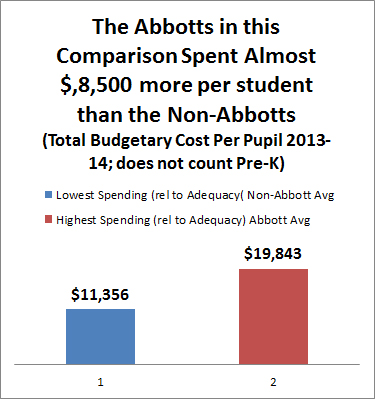
The eight Abbotts have an average Total Budgetary Cost Per Pupil of $19,843.

The eight non-Abbotts have an average Total Budgetary Cost Per Pupil of $11,356.

Not even counting Pre-K and construction money, the Abbotts spend $8,500 more per student.

So with clear-cut budgetary superiority there should be at least a palpable academic superiority, right?

NO.

The eighteen high-spending Abbott elementary schools with tested students on average are, at the 18th percentile in statewide performance.

The eighteen low-spending non-Abbott elementary schools with tested students are, on average, at the 35th percentile in statewide performance.   (all averages in this post are unweighted)


When you hone in on 4th grade scores on the old NJASK (which I consider the last valid year for scores due to PARCC-era opt-outs), the disadvantaged non-Abbotts do better.

On English Language Arts,  the 50th percentile for kids in the Abbott districts is 190 (the state average was 202.)  


For non-Abbotts the 50th percentile for kids in the non-Abbotts is 198.  

On math, the 50th percentile is for kids in the Abbott districts is 212.


Grade 4 Science scores are broken out by Advanced Proficient, Proficient, and Below Proficient status, not percentiles, but the result is the same: the severely underfunded non-Abbotts doing better, with 85% of the students in the severely under-budget non-Abbott schools getting Advanced Proficient or Proficient scores compared to only 81% of the students in the Abbotts.

At for Advanced Proficient scores the gap is even wider: the non-Abbott schools averaged 40% Advanced Proficient compared to 25% in the Abbotts.


Even if you look at absenteeism the non-Abbotts do better.   The Abbotts have chronic absenteeism at 14%.  The non-Abbotts have a chronic absenteeism rate of 8%.   

One of the justifications for Abbott superspending and superlative facilities was that you had to have schools so beautiful and light-filled that kids wouldn't want to be absent.  It seems to be yet another incorrect theory.


There are claims out there that Abbott spending is effective. The Education Law Center just came out with a press release, "THE GOVERNOR IS WRONG ON STUDENT ACHIEVEMENT," which
summarizes research that suggests that Abbott was working and cherry-picks Union City to argue that superspending is academically necessary and beneficial.

The ELC's press release begins:
Governor Chris Christie attempts to justify his proposal to take massive amounts of school aid away from NJ districts educating the most disadvantaged students by making claims about student achievement that simply aren’t true.

The Governor says districts with high student need “get a big check from the state every year, [but] they are not making any changes in the way they educate children and they are not showing any increase in success."

The Governor is just plain wrong. The facts show NJ's most disadvantaged students making substantial gains over the last 15 years, and studies have documented the positive connection between increased funding and improved student outcomes.
But the governor is not "just plain wrong" about Abbott ineffectiveness, but he makes a foolish mistake in comparing Abbotts to their charter schools and not poor non-Abbotts.

The Abbotts have a clear cut, immense budgetary advantage. For Abbott Theory to be correct, a clear-cut advantage in spending should drive clear-cut higher academic performance than in districts that don't have Abbott money, but not only is there no clear-cut superiority, there's not even ambiguous superiority. In fact, the Abbotts appear to be doing worse.

And what if my sample isn't statistically valid enough to prove to Abbottists that Abbott superspending isn't effective?  So what.  If the Abbotts have 5% academic superiority for 50% spending advantage, that isn't a strong argument to sustain Abbott.

And finally, what was affordable in the 1990s isn't affordable today.  New Jersey's economy has been stagnant for years and we are one of the country's most indebted states.  

State aid is zero-sum and more money for the Abbotts means less money for every other district including many districts who are just as poor as the Abbotts.

Abbott: Ineffective, Unaffordable, Unfair.