Showing posts with label Phil Murphy. Show all posts

Friday, March 18, 2022

New Jersey's 2022-23 State Aid

New Jersey's 2022-23 state aid distribution is another big step towards state aid fairness.

Thanks to the addition of $650 million of new K-12 opex aid plus $186 million in redistributed Adjustment Aid,  underaided districts will gain $836 million.  Their deficit will shrink from $1.2 billion in 2021-22 to only $618 million for 2022-23.  The overaided districts will have a surplus of $232 million.

The net deficit, ie deficit minus surplus, is only $386 million.

Below is an analysis of 2022-23 state aid and education spending, organized in the following way:

  • Details About the Underaided.
    • The Education Adequacy Report Misses the late 2021-22 Inflationary Spike.
  • Details About the Overaided.
  • Other Education Spending.
  • Local Fair Share Disparities.


As usual, I've put all the data available on a spreadsheet: 2022-23 NJ State Aid.


Likewise, the surplus for the overaided districts will shrink from $362 million in 2021-22 to $232 million in 2022-23.  Since 2017-18, New Jersey has redistributed $687 million.

Amount Redistributed
2022-23$186 million
2021-22$193 million
2020-21$155 million
2019-20$90 million
2018-19$32 million
2017-18$31 million

Without state aid redistribution, the deficit would be $1.3 billion.  

Because S2 calls for a 76% reduction of Adjustment Aid in 2023-24, this means that at least $176 million in Adjustment Aid will be redistributed in 2023-24, which, combined with the state aid increases we've seen in the last few years, brings 100% state aid for all districts within reach.

Details About the Underaided

Counting vo-techs and non-operating districts, there are 391 underaided districts with a total enrollment of 961,649, or 74% of the total.

In total dollars, the district with the largest deficit is Newark, at -$98,901,597, or -$1,799 pp.  Newark's state aid has risen from $742 million in 2017-18 to $1 billion in 2022-23, but its deficit was originally so large ($146 million) and its Adequacy Budget has grown so much, that the deficit has not yet been eliminated despite getting $258 million in additional state aid.

The districts with the largest deficits per pupil are Cumberland County Vo-Tech at -$3,109 pp and Atlantic City at -$3,057 pp. Cumberland County Vo-Tech and Atlantic City are the only two districts with per pupil deficits over $3,000 per pupil. Their deficits are large, but in 2017-18 Atlantic City and Bound Brook had deficits of over $8000 per student.

In percentage terms, Loch Arbour is the most underaided, but it 69%, $23,359 out of $33,685.  No other district is below 70%.  Only five other districts are even below 80%.  


This is a huge contrast to 2017-18, when 96 districts got less than 50% of their recommended state aid.  It's a huge contrast to when Chesterfield got only 10% of its state aid target.


The Education Adequacy Report Misses Inflation

Second reason this year's deficit decreased so much is that the triannual Education

Adequacy Report's inflationary adjustment stopped in June 2021.
  Hence, SFRA's Base Payment per pupil barely budged, from only $12,177 per student to $12,451 per student.   (see at right)

From June 2021 to February 2022 inflation has been 4.4% and is running even faster now.

This is an important fact because it means aid increases to the underaided are smaller than they initially appeared and aid cuts are larger to the overaided.

Since New Jersey's projected enrollment fell from 1,316,864 in 2021-22 to 1,304,773, the statewide Adequacy Budget did not increase very much despite the inflationary adjustment.

Details About The Overaided

The 201 overaided districts have 343,124 students, or 26% of the total.  Their $232 million surplus is the smallest it has ever been.

Asbury Park's state aid loss merits attention: In 2019-20 Asbury Park's surplus was $22.9 million, or $11,026 per student.  Now it is only $7 million, or $3,653 per student.  Asbury Park's K-12 state aid per student has fallen from $25,000 per student (it was the highest spending K-12 district in the US), to only $15,176 per student.  

Jersey City's aid loss merits attention too.  In 2018-19 its surplus peaked at $171 million, or $5542 per student.  Now it is only $56 million, or $1903 per student.  In total K-12 opex aid, Jersey CIty's aid has gone from $419 million to $185 million, a loss of $234 million.  

Jersey City has actually lost more than $115 million, but it has a constant growth in tax base which converts its Equalization Aid to Adjustment Aid, which is then phased-out per the process laid out in S2.  In 2022-23 Jersey City will still be eligible for $82 million in Adjustment Aid.

The redistribution of state aid for 2022-23 was not something I was sure would happen after the Biden administration, acting on a vicious Education Law Center complaint, interpreted a provision in the ARP to prohibit state aid cuts to high-poverty districts (which Hoboken and Jersey City technically are), but apparently the Murphy administration has found a way to continue aid redistribution.  

Other Education Spending

New Jersey's budget for FY2023 is going to be $49 billion, of which $19.16 billion, or 39%, is considered school aid (see page 58).  That ~40% percentage has been constant for the last decade, although it's worth noting that in 2001 education spending was only 31% of the budget.

On the other hand, education spending actually exceeds the income tax's $18.15 haul due to education getting money from the lottery and a half cent of the sales tax.  Education spending has come to be nearly synonymous with the Property Tax Relief Fund, although the new ANCHOR credit will represent a long-overdue increase for direct tax rebates.


K-12 opex aid is just $9.9 billion, so 52% of the total education spending.  Here are some looks at the other major education spending categories.

Amounts in millions.

Extraordinary Aid will be $400 million.

Below are the net changes year over year for the above categories.  As you can see, the major debt categories of Teacher Pension And Annuity Fund, post-retirement healthcare, construction debt, and Pension Obligation Bonds did not require substantial increases and TPAF and Construction Debt service actually fell.  This is a tremendous contrast to the past, when TPAF payments increased by over $400 million in some years.


Disparities in Local Fair Share

Readers of this blog know that New Jersey's Local Fair Share is NOT a constant tax rate due to it being based 50% on Equalized Valuation and 50% on Aggregate Income.  Thus, towns where residents live within their means in properties that are inexpensive relative to income must pay higher school taxes, as well as property owners in towns without non-residential property and vacation homes.  

New Jersey's Local Fair Share grew from SFRA's inception in 2008-09 when it was a 1.15% median and peaked in 2019-20 at 1.53%.  The cause of the growth was that Adequacy Budgets grew faster than Equalization Aid, so the SFRA formula automatically adjusted to increase Local Fair Share.  (Brick and Toms River repeatedly complained that their Local Fair Shares have increased despite loss of Equalized Valuation, but that has happened statewide).

Phil Murphy's increase to Equalization Aid exceeds the growth of the statewide Adequacy Budget, hence Local Fair Share actually will fall 1.38%, with a low of 0.79% for Wildwood City and a high of 1.91% for Woodlynne (which peaked at 2.1% in 2019-20).

The decrease in Local Fair Share also decreased the number of districts who are ineligible for Equalization Aid from 272 in 2020-21 to 260 in 2022-23. (Note, in SFRA's first year only 180 districts were ineligible for Equalization Aid).

The extremes of LFS are here:


The 2022-23 Local Fair Share formula is:

(0.013089410 x Equalized Valuation + 0.045610629 x Aggregate Income)/2

Conclusion

FY2022-23 was another good year for K-12 opex aid equity.  We have come a long way from the time when New Jersey's state aid formula was inoperative in the early 2010s (which was Christie's fault) and when huge education-debt increases crowded out K-12 opex aid increases (which was not Christie's fault).  If the state's revenues continue to grow, in 2023-24 it's possible that every district will reach 100% funding.  

SFRA is always a work in progress and the legislature is moving to revamp the state aid law.  If it does
so, I hope it includes the following.
  • The tax cap must be loosened for under-Adequacy non-Abbotts who are losing state aid.  
  • The state must move up the timetable on its inflationary adjustment due to the 2022 Education Adequacy Report stopping its inflationary measurement in June 2021
  • New Jersey should base its Local Fair Share solely on taxable property.

Overall, Phil Murphy has been a positive surprise on state aid.  Although I knew that he would increase K-12 opex spending, I did not expect him to prioritize fairness of the distribution as much as he has.

Sunday, March 7, 2021

2021-22 Brings $1.7 Billion to Education, More State Aid Equity

In his budget for FY2022, Phil Murphy has proposed an increase in education spending of $1.7 billion, of which $578 million is for new K-12 operating aid.  


More than just a very large increase in state education support, Phil Murphy has followed a principle I originally thought he would ignore -- making state aid equality a goal in-and-of itself and recognizing the budgetary necessity of redistribution.  He has also targeted new state aid for the most severely underaided districts by using the deficit-based allocation of new aid Steve Sweeney devised for S2.

By making a $578 million increase in K-12 operating aid plus redistributing $192.5 million in Adjustment Aid, Phil Murphy has brought the state aid deficit from $1.9 billion in FY2020-21 to only $1.2 billion.

This is tremendous progress.  In the last Christie budget of 2017-18, there were 377 underaided districts with a total deficit of $1.96 billion and 200 overaided districts with a surplus of $634 million. 

In the fourth Murphy budget of 2021-21, there will still be 380 underaided districts, but with a total deficit of only $1,230,989,213.  They will be balanced by 212 overaided districts, but with a total surplus of $361,728,172.

A $1,230,989,213 deficit is large, but it is the smallest deficit SFRA has had since its first year of 2008-09, under Jon Corzine.
 
The $361,728,172 surplus is the smallest SFRA has ever had. 

As usual, I've put all the 2021-22 State Aid Disparities data online.

Sketch of the Underaided

Atlantic City has the largest deficit in NJ, at $7,110 per student, but there are only six districts with deficits over $4,000 per student. This is a huge contrast to 2016-17, when there were 58. There are only 64 districts that are underaided by more than $2,000 per student, compared to 118 in 2017-18.

Atlantic City is sui generis because of the rapidity of its tax base collapse, including the PILOTing of its casinos in 2015, which makes them "invisible" to the formula for Equalization Aid, although a large percentage of the PILOT money goes to the school district.  A $7,110 per student deficit is very large, but it's much better than $10,939 per student deficit of 2020-21.  Finally, Atlantic City also receives $20 million in Commercial Valuation Stabilization Aid, which is outside the SFRA formula and not included in the DOE's data.  If that $20 million were include, Atlantic City's per student deficit would only be $4,011 per student.

In percentage terms, the most underaided district is Loch Arbour at 48% (a microdistrict whose enrollment anomalously went from one to eight students in a single year). Of normal-size districts, Cumberland County Vocational is the most underaided, but it still gets 58% of its state aid. This is also a massive improvement.  In 2012-13, 157 districts got less than 50% of their state aid.

Looking at the most exceptionally underaided districts of Christie's second term also demonstrates the great increase in equality over the last four years.

  • in 2016-17 Chesterfield was the most underaided district in percentage terms, only getting 9% of its recommended state aid. Now it gets 78%.
  • in 2016-17 Bound Brook was the most underaided district in dollars per student, with a deficit of $9,836 per student.  Now its deficit is only $4,053 per student. 
  • Freehold Boro, where 1,700 children were housed in a school built for 1,200 and which had become a symbol of the grossness of NJ's state aid inequalities, has gone from a deficit of $8,243 per student to deficit of $3,437 per student.

WOODLYNNE-$3,143NORTH PLAINFIELD BORO-$3,712
TRENTON-$3,218ATLANTIC CO VOCATIONAL-$3,805
PENNS GRV-CARNEY'S PT REG-$3,266BOUND BROOK BORO-$4,053
WOODBURY CITY-$3,328FAIRVIEW BORO-$4,236
MANCHESTER REG-$3,365PASSAIC COUNTY VOCATIONAL-$4,239
FREEHOLD BORO-$3,437LINDENWOLD BORO-$4,801
PLAINFIELD CITY-$3,459CUMBERLAND CO VOCATIONAL-$6,453
DOVER TOWN (VICTORY GARDENS)-$3,487ATLANTIC CITY*-$7,110
(Would be $4,110 pp if CVSA)

A $1.2 billion deficit is still large and these are the districts with the largest deficits.

Approximately half of the deficit is in only eighteen districts (enrollment = 257,168 students). Newark's deficit, at $146 million, is by far the largest in absolute terms, although at $2689 per student it is only the 28th largest.


Sketch of the Overaided:


Asbury Park's surplus is the largest in New Jersey in dollars per student, at $5,509 pp ($11.3 million). This is a tremendous decrease from prior to 2017-18, when Asbury Park's surplus was nearly $12,000 per student ($24 million).   Given that Asbury Park was frequently used as a representative of Abbottist excesses and ineffectiveness, the reduction in Asbury Park's state aid could become politically significant.  (See the "Asbury Park, Overaiding at its Most Extreme.")

There are now only 29 districts with surpluses over $2,000 per student, compared to 80 back in 2016-17.

Jersey City has $121 million in excess state aid, or 34% of the total. Jersey City and the five other districts with the largest surpluses, with an enrollment of 68,715, account for half the total surplus.
That amount is not a complete picture of how much state aid will come out of Jersey City, due to Jersey City's astronomical growth in tax base, which converts Jersey City's Equalization Aid to Adjustment Aid, which is then phased-out per the stipulations of S2.  (see a 2019 post by me "In Five Years, Jersey City will be Ineligible for Equalization Aid.")

In 2021-22, Jersey City is still eligible for $84 million in Equalization Aid, but Jersey City's tax base growth combined with the increases to Local Fair Share from next year's Education Adequacy Report should eliminate or nearly-eliminate that.

Hence, Jersey City will eventually lose $200 million in state aid by the time S2 runs its course, but thereafter not see any further losses.

The most overaided, with surpluses in dollars per student.

ASBURY PARK$5,509KNOWLTON TWP$3,446
PEMBERTON TWP (PEMBERTON BORO)$5,454PLUMSTED TWP$3,210
CAPE MAY POINT$5,348KEANSBURG BORO$2,980
WEYMOUTH TWP$5,282OCEAN COUNTY VOCATIONAL$2,961
BASS RIVER TWP$4,764MONMOUTH CO VOCATIONAL$2,796
JERSEY CITY$3,990DENNIS TWP$2,775
PEMBERTON TWP$3,498HOPATCONG$2,553
WASHINGTON (Burlington)$3,474OCEAN TWP (Ocean)$2,499


Overaided districts vary greatly in their tax base capacity and what their spending is relative to Adequacy.  S2 eliminated the tax cap for Abbotts, but non-Abbotts are still constrained by it.  Non-Abbotts like Toms River and Brick who are below Adequacy and losing state aid are in a budget crisis whose only solution is tax cap liberalization.  They have failed to fight for liberalization in favor of fighting for permanent Adjustment Aid.  Hence,  in 2020 after the legislature sent Phil Murphy a bill loosening the tax cap for under-Adequacy, overaided districts, Murphy had no political cover andvetoed it, keeping these districts in a severe vise.

Outlook for the Near-Term

New Jersey has almost never fully-funded its state aid law, going back over forty years to Governor Brendan Byrne.  With the deficit significantly reduced, it's possible to talk about state aid being fully-funded sometime in the near-future.

The possibility can be seriously entertained that SFRA will be fully funded, but there are still large challenges.

To make an optimistic case:

  1. FY2022 marks New Jersey fully meeting its pension obligations, which means that there should not be large increases required for TPAF.  In FY2022, New Jersey is putting $3 billion into TPAF, which should be basically constant from here on out.

  2. NJ's enrollment continues to shrink.  This means that the growth in the Adequacy Budget is lower than it would otherwise be.  If thousands of students leave the public schools because of this year's school closings (the estimate for 2021-22 is for 26,000 fewer K-12 students) and up to 10,000 fewer babies are born in 2021, it would mean hundreds of millions in lower spending targets.
However, there as many reasons to be pessimistic.  
  1. SFRA's spending target continually grows (Despite enrollment loss!).
  2. Phil Murphy has used $4.2 billion in borrowed money for the FY2022 budget and the Education Law Center is demanding billions in additional borrowing for Abbott construction.
  3. New Jersey's revenue growth is low.
1.  The Spending Target Grows
Despite NJ's shrinking enrollment, the full-funding of SFRA is a moving target that grows by an average of $130 million a year.  Although the state's enrollment is slowly declining, inflationary adjustments increase the funding target every three years when the state runs an Education Adequacy Report, and 2022-23 with be an Education Adequacy Report year.  (see "Education Adequacy Report Drives Big Changes to State Aid")

Illustrated by the chart below, to fully fund SFRA (without Adjustment Aid) would have required $9.3 billion in 2015-16, but $10.1 billion in 2021-22.  The growth to $10.071 billion to fully fund SFRA is smaller than in previous years, but note it occurred despite a record-setting loss in enrollment.


2.  DEBT:  Phil Murphy Borrowed $4 billion (and NJ might have to borrow more)

New Jersey borrowed more than $4 billion for the FY2022 budget, which Charlie Stile called a sequel to Christie Whitman's notorious Pension Obligation Bonds and Tom Moran has condemned as well.

I hate to be a spoiler, but there is a sizable caveat [to this budget]: It was made possible by the $4.3 billion the governor borrowed last summer when the economy was in a free fall, and everyone expected tax revenues to plummet. The governor warned that the shortfall could amount to $20 billion to $30 billion over two years.

Not close. As is happens, the economy recovered much faster than expected, and revenues are now rising. In this budget, the governor anticipates revenue growth of 2.4 percent.  [sic, see more context below]

Thanks to those rising revenues, most of the borrowed money was not spent. It was put into the state surplus and rainy day fund, which swelled to more than $6 billion, about twice as big as planned. In this budget, Murphy is tapping $4.4 billion of that to support spending, including on the pensions.

Like former Gov. Christie Whitman, he’s using borrowed money to help shore up the pension funds, a move that has an old-fashion Jersey whiff to it.


In FY2023, when NJ won't have $4 billion in borrowed money to spend, there will be budget stress.

The bonds are scheduled to be repaid over 12 years, with principal payment beginning in Year 3.  The repayment of this debt will crowd-out future spending capability.  

On top of the debt being used to increase spending in FY2022, the Education Law Center


is demanding billions for Abbott construction.  Education Law Center debt servicing will also cut into future spending latitude.  

 (See "ELC Demand for More Abbott Construction Debt Can Only Cut K-12 Operating Aid")


3.  New Jersey's Revenue Growth is Low

Lost amidst the celebration from categories seeing spending increases is that New Jersey's revenue is only projected to increase by $952 million, or +2.4%.  

Part of the reason revenue growth is a one-time only delay of tax payments due to a SALTcap workaround called the "Pass-Through Business Alternative Income Tax."  If this workaround were not created, NJ's revenue would actually increase by 4%, which is still not better than Christie's second term, and much lower than the revenue growth NJ had in the 1980s-1990s.

Although income tax growth from FY2021 to FY2022 is projected to be +6.4%, looking back another year previous, from FY2020 to FY2022, there is practically no increase despite FY2022 having a broader bracket for the 10.75% tax bracket.

Should New Jersey Try to Fully Fund SFRA?

The FY2022 budget delivers a staggering amount to education compared to what most states spend.

NJ's state education spending in FY2022 will be $18.1 billion, of which $17.2 billion is for K-12. That is $13,060 per K-12 student, an amount HIGHER than the national average for local+state+federal education spending, combined.  

Although education gets a stable 40.6% of the budget, its share of the Property Tax Relief Fund has continued to grow at the expense of Municipal Aid, Direct Tax Rebates, and a category "Other Local Aid."

Since Education also gets money from borrowing, the half-cent sales tax diversion, and the lottery, education actually gets more than 100% of income tax revenues ($18.1 billion, out of $16.3 projected in income taxes).


So, bottom line, I have mixed feelings about the 2021-22 budget.  I'm glad that education is getting an increase and that principles of equality are being followed in the distribution, although I worry about the sustainability of this level of spending and the condition of non-education items in the NJbudget.


----


Friday, March 13, 2020

2020-21 State Aid: Closer to Equality?

Note, this was written before Coronavirus. It was accurate back in February, but the parts about aid gains are inaccurate now because the $336 million in new revenue was cancelled.

Updated state aid disparities are here.  The 2020-21 deficit for underaided districts will be $1.9 billion.

2020-21's state aid distribution is the fourth year of New Jersey's attempt to bring equality to NJ's K-12 state aid through the combination of increasing the overall state aid package and redistributing Adjustment Aid from overaided districts to underaided districts, with Phil Murphy's proposed $491 million increase the largest increase NJ's schools have gotten since the 2011-12 Great Recession rebound year, but with the new aid focused on NJ's most severely underaided districts.

I admit that back in the 2016-2017 gubernatorial campaign, I had doubts about Phil Murphy's commitment to state aid equality, but the 2020-21 budget, which cuts Adjustment Aid by $155 million, puts those doubts to rest.

Starting with Chris Christie's final budget in 2017-18 and including 2020-21, New Jersey has now redistributed $307 million in Adjustment Aid.  The combination of that $307 million plus $1.3 billion in new state aid has dramatically reduced the number of districts who are severely underaided, from 50 districts with deficits over $4,000 a student in 2016-17, to only fifteen in 2020-21.

To put it in terms of what percentage of their state aid districts are receiving, we went from a recent peak of 141 districts getting less than 50% of their state aid in 2016-17, to only three getting less than 50% in 2020-21: Atlantic City, South Hackensack, and Cumberland County Vo-tech.

Looking at all districts, if New Jersey can provide the money promised in Phil Murphy's February 25th budget speech, the median district is only underaided by $331 per student, a recent low.  Back in 2016-17 and 2017-18, the median deficit was over $500 per student.  The median district now gets 88% of its SFRA aid target too, a recent record, compared to the median district getting less than 85% four years ago.

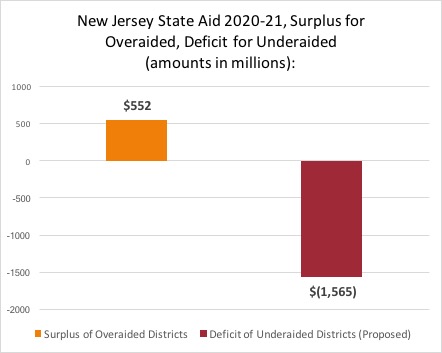
Despite the $491 million proposed infusion of aid into the underaided districts, their deficit only shrank by $220 million, from $1.78 billion in 2019-20 to $1.56 billion for 2020-21, due to the dynamic nature of district needs and the constant increase of Adequacy Budgets.


The Overaided:

There are 216 overaided students, with a total of 324,154 students, down from 342,275 in 2019.  The overaided districts have a surplus of $552 million. ($1612 per student, weighted average)


  • There are twelve districts with surpluses over $4,000 per pupil, with Asbury Park at the most overaided, at $8,138 per pupil.
  • There are ten districts with a surplus of $3,000 to $3,999 per pupil.
  • There are 34 districts with a surplus $2,000 to $2,999 per pupil.
  • There are 61 districts with a surplus of $1,000 to $1,999 per pupil.
Weymouth Township in Atlantic County will get 527% of its recommended state aid, or $1,319,479 when SFRA says it only needs $309,300, making it the most overaided in percentage terms of operating districts.

Cape May Point is non-operating (it has only three students), but it gets 927% ($16,339 versus
$1,975). Cape May Point, has a $3,837,923 Local Fair Share and is among the districts that should get $0 aid at all and undergo involuntary consolidation. 

I exclude Interdistrict Choice money from my comparisons because Interdistrict Choice money is outside of SFRA, but if I included Choice money, Deal would be NJ's most overaided, receiving over 1,000% of its recommended state aid.

I will now profile specific state aid information for three overaided districts, Asbury Park, Pemberton, and Jersey City.

Asbury Park Starts to Meet Reality

Asbury Park has long been ridiculously overfunded and overaided.  The fact that Asbury Park was literally America's highest-spending district among K-12s with more than 500 students and was academically in NJ's bottom 5%, is one of several pieces of evidence that the premise of Abbottism where exceptionally high-spending can be transformative is wrong.

Some Democrats acknowledge that excessive spending has failed in Asbury Park, but Asbury Park became the Republican poster child for Abbott waste, and the favorite Republican talking point to argue that NJ needed to change state aid.

S2 has already lowered Asbury Park's state aid from $55.4 million to $44.6 million, from 2016-17 to 2020-21. In dollars per student, Asbury Park's state aid has fallen from $24,258 to $20,965 per student.


Yet, since S2 is lowering Asbury Park's state aid, it's disappointing to see Republicans condemn all of the $155 million in Adjustment Aid redistribution, without any attempt to have a nuanced view.

EG, Assemblyman Brian Bergen provides an example of this anti-conservativism.  Although most districts in Bergen's District 25 are gaining state aid, Bergen condemns all redistribution
MORRIS PLAINS, N.J. – Gov. Phil Murphy’s proposed spending plan has nearly 200 school districts across the state losing $155 million in aid. Assemblyman Brian Bergen, who represents parts of Morris and Somerset counties as part of the 25th legislative district, which is losing more than $3.7 million, wants the governor to fully fund schools. 
“Only 64 percent of schools are getting increases, the rest will remain flat or continue to lose millions as part of a failed school funding formula that is hurting districts across the state,” said Bergen (R-Morris). “Among the towns I represent, there are five school districts facing a cut of more than $3.7 million and this is on top of what they lost last year.”
If Republicans are supposed to be the defenders of state taxpayers, why are they implicitly condemning redistribution which saves state taxpayers tens of millions a year, including normalizing education spending in NJ's most inefficient district?

The Pemberton State Aid Issue

Pemberton is not a high-profile district, it has consistently been one of New Jersey's most overaided districts, with a surplus of $36 million ($7900 per student) in SFRA's first year of 2008-09 and still possessing a $18.2 million surplus, the sixth most, ($4,248 per student), in 2019-20.

Pemberton made state headlines this March because it was the subject of an error by the Department of Education where the DOE used 2018 data on a district's total tax rate and therefore missed that Pemberton now had an above-average tax rate and had therefore reached S2's exemption from Adjustment Aid cuts for Abbott SDA districts.

Although much was made of the DOE's error and it made New Jersey give an an additional $2.2 million to Pemberton (so Pemberton's state aid surplus is $4,152 per student), the real mistakes are:


  • The New Jersey Supreme Court's rigid & artificial division of low-income districts into Abbotts and non-Abbotts, where the only difference is that Abbotts were ranked as DFG A or B according to the 1980 Census and also had the Department of Community Affairs's "urban status."  (See the "The Abbott List Has Always Been Unfair")
    • Pemberton's continuing inclusion on the Abbott list, despite the fact that it was placed in DFG CD after the 1990 Census
      • SFRA and S2's continuation of various privileges for Abbotts.


Regarding the last point, S2 created difference standards to protect Adjustment Aid for Abbotts and non-Abbotts.

This is the Abbott threshold for Adjustment Aid preservation that applies to Pemberton, even though Pemberton doesn't meet the NJ Supreme Court's Abbott standard anyway.
(2) An SDA district that is located in a municipality in which the equalized total tax rate is greater than the Statewide average equalized total tax rate for the most recent available calendar year and is spending above adequacy as calculated pursuant to section 1 of P.L.2018, c.67 (C.18A:7F-70) shall be subject to a reduction not to exceed the amount by which the district is spending above adequacy multiplied by the corresponding percentage included in subsection b. of this section

And this is the threshold for Adjustment Aid preservation in non-Abbotts.

(3) A school district, other than an SDA district, that is located in a municipality in which the equalized total tax rate is at least 10 percent greater than the Statewide average equalized total tax rate for the most recent available calendar year and is spending at least 10 percent below adequacy.

Moreover, Pemberton's taxes are only trivially above New Jersey's average, so there is no "municipal overburden" issue.

New Jersey's average equalized tax rate is 2.276.

Pemberton Township has a 2.293 tax rate and Pemberton Borough has a 1.909 tax rate, and residents of both towns get "free" PreK for their kids.

So multiple articles and tweets were published after the Department of Education made a mistake with Pemberton's state aid, but Abbottist jurisprudence and S2 are where the substantive mistakes lie.

Jersey City's Economic Boom

Powered by its surging tax base, income, and upward tweaks to the Local Fair Share formula, Jersey
Jersey City's tax base is now equal to suburbs usually
considered to be wealthy.
City's Local Fair Share grew from $474 million to $522 million (+10%) which is $16,960 per student, which is the same as districts often considered "wealthy," such as South Orange-Maplewood, Freehold Township, Glen Rock, Sparta, Parsippany, and Metuchen.

To put it another way, Jersey City has only 2.3% of NJ's K-12 students, it has 2.7% of the tax base.

Jersey City, unlike the suburban districts above, has poorer students, so it does get Equalization Aid ($91.4 million for 2020-21), but its tax base is growing so quickly that in only two years it will be ineligible for Equalization Aid and that Equalization Aid will become Adjustment Aid that is then eliminated.

Note: although Jersey City's state aid has been cut by $86 million in the past four years, its tax base growth has been more rapid than its Adjustment Aid cuts, hence, it has become more overaided, not less.

Adequacy Budget for Equalization AidLocal Fair ShareAmount of Equalization AidTotal K-12 AidAdjustment Aid
2017-18$584,758,085$370,261,455$214,496,630$410,404,292$151,554,542
2020-21$613,543,941$522,089,435$91,454,506$324,393,336$185,321,537


The Overaided Surplus has Shrunk by Less than the Adjustment Aid Reduction

The overaided districts have a total surplus of $551,589,097, which is lower than 2019-20's $640 million surplus, although the reduction is less than $155 million in lost Adjustment Aid.  

The steady rebound of Adjustment Aid despite four years of losses 

Why?  Local Fair Share growth and further enrollment loss.  

This is because S2 bases the cut on Adjustment Aid on the "state aid differential" for the upcoming school year, 2020-21.  When the DOE calculated state aid for 2020-21, they must have originally had overaided districts with a $707 million surplus, and then reduced that by 23%, in accordance with the stipulations of S2.

Again, Jersey City's tax base growth merits special attention.  From 2019-20 to 2020-21, Jersey City'sLocal Fair Share grew from $474,039,468 to $522,089,435 (+$48 million), while its Adequacy Budget fell from $623 million to $614 million. As Jersey City's Equalization Aid fell, it was converted to Adjustment Aid, which then became subject to S2's 23% reduction requirement.

Note, although the surplus is $551.6 million, not all of that is subject to redistribution, due to provisions in S2 that protect vo-techs and Abbotts (like Pemberton) and non-Abbotts with higher-than-average taxes.

The Underaided

Phil Murphy's budget was developed in February 2020, before the coronavirus outbreak hit New Jersey and the rest of the USA.  The revenue projections the FY2021 budget proposal were built on are no longer accurate and cuts are a possibility, but I shall discuss how Phil Murphy's budget proposal would have affected underaided districts anyway.

There are 375 underaided districts, up from 370 in 2019-20. The underaided districts have 1,018,824 students.  As mentioned earlier, their total deficit is $1.56 billion.

  • There are 44 districts with deficits between $1,000 and $1,999 per pupil.
  • There are 34 districts with deficits between $2,000 and $2,999 per pupil.
  • There are 23 districts with deficits between $3,000 and $3,999 per pupil.
  • There are fifteen districts with deficits more than $4,000 per pupil.
The districts with the largest deficits in dollars per student in 2020-21 are:

DistrictDeficit Dollars PPDistrictDeficit Dollars PP
EDGEWATER PARK-$3,823PLAINFIELD CITY (A)-$4,609
TRENTON-$3,895ATLANTIC CO VOC.-$4,729
MERCHANTVILLE-$3,907DOVER (VICTORY GARDENS)-$4,752
MANVILLE-$3,948PASSAIC COUNTY VOC.-$5,033
BRIDGETON (A)-$3,951BOUND BROOK-$5,184
RIVERSIDE-$4,057FAIRVIEW BORO-$5,464
MANCHESTER REG-$4,103HI NELLA-$5,658
FREEHOLD BORO-$4,384LINDENWOLD-$5,877
DOVER TOWN-$4,525CUMBERLAND CO VOC.-$8,167
NORTH PLAINFIELD-$4,552ATLANTIC CITY-$9,087

For some of the above districts, the deficits remain large due to some combination of steady (weighted) enrollment growth combined with income loss or tax base erosion.

But to focus on the good news, the districts who were the most severely underaided in 2016-17 have made steady gains, with the important exception of Atlantic City.


DistrictDeficit Per Pupil in 2016-17Gain in Dollars Per Student for 2017-18Gain in Dollars Per Student for 2018-19Gain in Dollars Per Student for 2019-20Gain in Dollars Per Student for 2020-21Deficit Per Pupil in 2020-21
Dover-$6,558$417$776$868$1,453-$4,525
Guttenberg-$6,645$511$1,337$392$916-$2,888
Ridgefield Park-$6,740$491$1,764$290$432-$1,439
Atlantic City-$7,270$816$700$1,718$2,685-$9,087
Hi Nella-$7,302$427$817$981$1,712-$5,658
Atlantic Co Voc-Tech-$7,529$733$2,213$888$1,439-$4,729
Passaic Co Voc-Tech-$7,551$520$1,302$914$1,625-$5,033
Fairview Boro-$7,625$630$1,951$937$1,676-$5,464
Freehold Boro-$8,243$0$1,890$851$1,282-$4,384
Manchester Reg-$8,698$653$1,830$850$1,074-$4,103
East Newark-$8,716$397$514$464$646-$2,203
Bound Brook-$9,836$865$2,289$1,013$1,591-$5,184


--------