Showing posts sorted by relevance for query local share. Sort by date Show all posts

Monday, January 14, 2019

The Highs and Lows of Local Fair Shares in New Jersey


What do you think should be a "fair" school tax rate for New Jersey school districts?  How about 0.7% of property value?  Or how about 2%?  How about 1.4%?

Well, if you are the School Funding Reform Act (SFRA) your answer is ALL OF THE ABOVE, because Local Fair Shares in New Jersey range from as low as 0.7% to as high as 2%, with a statewide median of 1.42%.

To demonstrate the variation in Local Fair Share another way, how about this real-world scenario?

Secaucus and Lawrence Township (Mercer) both have $4.8 billion in taxable property, so they should have the same ability to fund their schools, right?

Answer: NO.  SFRA assigns a Local Fair Share of $52 million to Secaucus, which would be a 1.1% tax rate, and a Local Fair Share of $69 million to Lawrence Township, which would be a 1.4% tax rate.

And Secaucus compared to Lawrence Township is not extreme either.  Avalon's taxable property is $8.42 billion and Cherry Hill's taxable property is $8.34 billion, but Avalon's Local Fair Share is only $60 million while Cherry Hill's is $136 million.

Why?

The reason SFRA creates such divergent tax rate targets is that the formula for Local Fair Share uses the Aggregate Income of a district's permanent residents in addition to the Equalized Valuation (ie, taxable property), so if a district has little income relative to its Equalized Valuation, it will end up with a Local Fair Share that is a low tax rate.  On the other hand, if a district has a high income relative to Equalized Valuation, it will have a high tax rate.

As for comparing Lawrence Township and Secaucus, Lawrence Township's residents make $1.5 billion, whereas Secaucus' make $808 million, hence Lawrence Township's Local Fair Share is higher despite the two towns having identical amounts of taxable property.  Likewise for Avalon and Cherry Hill.  Avalon's permanent residents only earn $75 million , while Cherry Hill's earn $3.4 billion.  Hence SFRA calculates a higher Local Fair Share for Cherry Hill.

So the divergence comes from the Local Fair Share formula itself!!

(Equalized Valuation x 0.013828828) / 2 + (Aggregate Income x 0.046200477) / 2

Which in simpler terms is:

0.7% of Equalized Valuation + 2.3% of Aggregate Income =

(If you're curious about what your district's Local Fair Share is as a tax rate, see this spreadsheet)

See note at the end of this post for where EV and Aggregate Income come from and what the state does for non-K-12 districts.

To see how the Local Fair Share formula gives divergent tax rates for towns with identical tax bases, consider the following:

If a district is perfectly average in terms of its Equalized Valuation:Income ratio, and has an Equalized Valuation of $1 billion and an Aggregate Income of $300 million (which is near NJ's average ratio of 28.5%), its Local Fair Share will be:

($1,000,000,000*0.013828828+$300,000,000*0.046200477) / 2 =  
$13.8 million per year, which would be a 1.38% school tax rate.  (eg, numerous from Mt Laurel to Paterson to Freehold Regional)

But if another district has an identical $1 billion Equalized Valuation but a lot more non-residential property or second-home property, so that its Aggregate Income is only $200 million, its Local Fair Share will be:

($1,000,000,000*0.013828828+$300,000,000*0.046200477) / 2 =  $11.5 million per year, which would be a 1.15% school tax rate.   (eg, East Hanover, Ocean Township,  Asbury Park, Englewood Cliffs)

On the other hand, if yet another district has the same $1 billion Equalized Valuation, but very little non-residential property and a lot of high-earners, so that its Aggregate Income is $400 million, its Local Fair Share would be $16.2 million, or a 1.62% school tax rate.   (eg, Kingsway Regional, Cherry Hill, Glen Ridge, South Orange-Maplewood)

Every school district in New Jersey must tax all taxable property at the same rate, so the regular homeowners are either hurt by or benefit from the incomes (or lack thereof) of their neighbors.

There are many unintended consequences of using Aggregate Income in the formula for Local Fair Share.  
  • If a district is economically diverse, the high-earners will skew Aggregate Income upwards and force middle-income and low-income property owners to have to pay a higher school tax rate.
  • If a district has a lot of non-residential property or second-home property, it is already advantaged, but then the SFRA formula adds further advantage to that since non-residential property has no income attached to it and hence a district with a lot of non-residential property will have a lower Local Fair Share.
  • Districts that have residents in tax-exempt property or PILOTed property will have higher Local Fair Shares.
  • Districts where people live below their means will have higher Local Fair Shares.
  • If a district happens to have high-income outliers, it would skew Local Fair Share to an amount unreflective of the average property owner's ability to pay.
  • If a district has many people working off-the-books who do not report their income, the Local Fair Share will be lower.
---- The Highest Local Fair Share Tax Targets 
Are Mostly in South Jersey ----

The clearest observation I have of New Jersey's highest Local Fair Share districts is that they are overwhelmingly in South Jersey due to property values there being lower there relative to income than in North Jersey.


Audobon Park and Winfield are owned by tax-exempt mutual housing corporations.
They are not normal towns from the perspective of taxation.


Of the districts in New Jersey whose Local Fair Shares are above the state median (1.42%) and whose Local Fair Share is below Adequacy (meaning that actually the district should pay its full Local Fair Share), there is an overwhelming skew towards South Jersey, specifically the suburbs of Philadelphia.

Lindenwold, Woodlynne, Wenonah, Hi Nella have Aggregate Incomes that are half of Equalized Valuation, and hence their Local Fair Shares are approximately 2%.

CountyNumber of Districts w/ Above Median Local Fair Shares (and LFSs under Adequacy)CountyNumber of Districts w/ Above Median Local Fair Shares (and LFSs under Adequacy)
Camden34Mercer5
Burlington23Somerset4
Gloucester21Monmouth4
Atlantic12Passaic4
Cumberland9Morris4
Warren8Sussex3
Salem7Hudson2
Middlesex6Ocean2
Bergen6Hunterdon2
Union5

Winfield and Audobon Park are outliers here, but that is because they are highly-unusual mutual housing co-ops that originated as housing for industrial workers in World War II.  Most property in both towns is tax exempt, hence their Equalized Valuations are artificially low.  I do not consider them to be treated unfairly by the Local Fair Share formula.  On the contrary, I think what they are doing is similar to PILOT exploitation and both towns underpay in county taxes.


Winfield, NJ has a 19% all-in tax rate, but
that is
due to it having an exceptional
amount of tax-exempt
property on which people live.


There are also affluent districts among those with the highest Local Fair Share tax rates like Essex Fells, Somerset Hills, and Mountain Lakes, but the full Local Fair Share of an affluent district or high-tax base district is irrelevant because their Local Fair Shares exceeds their Adequacy Budgets anyway.

For instance, Essex Fells' Local Fair Share is $9.2 million, which would be a 1.84% Equalized tax rate, but Essex Fells' Adequacy Budget is only $2.8 million, so Essex Fells would never have to have a $9.2 million tax levy.  Essex Fells' actual tax levy of $4.6 million is thus more than enough for Essex Fells' students and a low tax rate for its residents.

Likewise for Somerset Hills. Somerset Hills' Local Fair Share is legally $62,518,639, but its Adequacy Budget is only $27,095,338, so Somerset Hills' Actual $25.4 tax levy is more than plenty for the district while actually resulting in a low tax rate for Somerset Hills.

It is not only conventionally affluent districts that will never need to tax at full Local Fair Share.  Secaucus' has a lot of non-residential property. 

It is entirely possible that the affluent districts among the highest Local Fair Share tax rates, Saddle River, Essex Fells, Chester, Somerset Hills, and Mendham are on the list due to randomly having ultra-high income outliers living there.

----  The Lowest Local Fair Shares ----

The districts with the lowest Local Fair Share tax rates have an obvious thing in common, which is being at the Jersey Shore.

This tendency is from the fact that residential properties at the Jersey Shore tend to have extremely high valuations, but they are second homes with no permanent income attached to them.  Hence, they only contribute to a district's Local Fair Share through the real estate component of Local Fair Share, not the Aggregate Income component.


The only one of the lowest Local Fair Share tax rate districts that isn't at the Jersey Shore is Carlstadt, which is 74% non-residential.   However, like the Jersey Shore districts on this list, Carlstadt's Local Fair Share is well in excess of its Adequacy Budget and hence it will never need to tax at 100% of Local Fair Share.  Carlstadt's tax levy is only $10 million on a $19 million Local Fair Share.

And this brings me to Brick and Toms River...

Brick and Toms River have aggressively said that SFRA overcalcualtes their wealth and ability to pay
These waterfront
mansions in Brick are worth $2-$5 million,
but if they are second homes, they have no
income attached to them. Hence, Brick's Local Fair Share
is a lower tax rate than what the median town in
NJ's is.
taxes but the OPPOSITE IS TRUE because Brick  and Toms River have second home properties to which no income is attached.

Hence, Brick and Toms River have Local Fair Shares that are below the median.  Brick's Aggregate income is only 22% of its ualized Valuation, so its Local Fair Share tax rate is only a 1.22% tax rate.  Toms Rivers' income is 21% of its Equalized Valuation, so its Local Fair Share would be a 1.18% tax rate.

Neither Brick nor Toms River pays anything near its Local Fair Share anyway.  Both are at approximately 1%, not the 1.2% SFRA recommends.


---- The Income Crossover Point: Why Having Affluent or Frugal Neighbors Will Raise Your Taxes ----

I do not know why the School Funding Reform Act uses income to calculate Local Fair Share.  County taxes are apportioned strictly by Equalized Valuation.  Taxes in regional school districts are almost always apportioned strictly by Equalized Valuation as well. 

But if New Jersey is going to use income at all, it should use something based on median income, not Aggregate Income, because Aggregate Income is distorted by high-income outliers and there is the unintended consequence of using Aggregate Income is that the more money residents make relative to their housing values, the higher their property taxes are supposed to be.  

In fact, there is an Income Crossover Point where a frugal person or rich person will raise a district's Local Fair Share by an amount greater than his or her taxes.

Based on how Local Fair Share is computed by taking 2.3% of a district's income, the Income Crossover Point is the inverse of 2.3%, which is 43.5x.  

Whenever someone's income is 43.5 times his or her school taxes, he or she will RAISE Local
Note, this only applies if the district is eligible for
Equalization Aid and 240 districts in NJ are not
eligible
Fair Share by a greater amount than what he actually pays in school taxes.  Since Equalization Aid decreases as Local Fair Share increases, frugal and/or rich people can hurt a district financially. 
(43.5 = 1 / .023)

Imagine someone pays $10,000 a year in school property taxes and makes over $435,000.  2.3% of $435,000 = $10,000, so for every $1,000 over $435,000 that person earns, his district's state aid is reduced by $23!

Someone doesn't have to be rich to trigger a theoretical loss of state aid, but I'll use Phil Murphy as an example since he is a public figure with a known income and known property taxes, even though Phil Murphy's town of Middletown doesn't receive Equalization Aid.

Phil and Tammy Murphy pay $204,360 in property taxes on their Middletown compound, of which $130,381 is for the schools.  Phil and Tammy Murphy made $7.3 million in tax year 2015, which would increase Middletown's Local Fair Share by $167,900!


Livingston provides the supreme example of Equalization Aid loss since Livingston was the home of David Tepper, New Jersey's richest person whose taxable income was $800 million to $1 billion, which would be 28-34% of Livingston's total.   Although Tepper's house was spacious, it was not extravagant and only had an assessment of $2,155,900, or 0.03% of Livingston's total.

In Tax Year 2014/School Year 2016-17 David Tepper was a New Jersey resident and Livington's Aggregate Income was $3,809,964,019. That $3.8 billion number was used to calculate a Local Fair Share of $139,074,977.

Yet, in 2015 David Tepper moved to Florida and so in 2015/School Year 2017-18 Livingston's Aggregate Income fell to $2,943,567,080, which is actually less income than Livingston had in Tax Year 2013/School Year 2016-17. The departure of one ultra-high-wealth person, David Tepper, thus caused Livingston's Local Fair Share to fall to $123,636,221.

The fall in Livingston's Aggregate Income and Local Fair Share is totally anomalous.  All of the other affluent towns in NJ saw their Aggregate Incomes increase from 2014 to 2015.  We can thus conclude that the fall is entirely attributable to Tepper's departure.

$123 million is still in excess of Livingston's Adequacy Budget, so my point isn't to worry about Livingston itself, but the raise the possibility that if an ultra-high income person happens to live in a small town or a middle-class town, that person will distort the town's Local Fair Share.  What if David Tepper had fallen in love with an historic mansion in a middle-class town and moved there?  What if David Tepper had decided to live in a grand country estate somewhere in rural New Jersey?  Tepper's arrival would have crashed that district's Equalization Aid.  What if David Tepper lived like Warren Buffett in a middle-class house?  

Since a Board of Education cannot tax a rich person's income, it doesn't make sense to use Aggregate Income to calculate Local Fair Share.  

And, If New Jersey ever gets to the point where every district receives 100% of its Uncapped Aid and that principle is followed year to year, New Jersey will develop problems because Aggregate Income & Local Fair Share -- and hence Equalization Aid -- fluctuate year to year.

---- Residential PILOT and Tax-Exempt Property Distortion ----

Another oddity of using Aggregate Income to calculate Local Fair Share is that residents of tax-exempt buildings and PILOTed buildings will have their incomes count towards Local Fair Share, even though their properties are not taxable by a Board of Education.

---- Conclusion ----

New Jersey may not be able to ever have low or moderate property taxes, but at least we should have equitable taxes, in the sense where there is equity between taxpayers in different towns, where people generally pay the same property tax rates, unless one town is paying for extra services that other towns eschew.

SFRA is intended to equalize school spending and create a spending advantage for high-FRL districts, but as we can see here, it does not do as much to equalize school taxes and can actually exacerbate existing disparities.

The distortions from using Aggregate Income in the formula for Local Fair Share have been obscured by the completely off-formula distribution of state aid in New Jersey that existed because of Chris Christie and SFRA's own Adjustment Aid provision, but if New Jersey got to the point in 2024 where every district is funded at 100%, the disparities that result from SFRA's own core formulas will be harder to ignore.  

And since Boards of Education can't tax income, getting rid of income as a component of Local Fair Share (or at least using a median!) would make sense

----

See Also:


----


Note on Sources of Equalized Valuation & Aggregate Income 

To calculate Local Fair Share, the Department of Education uses Equalized Valuation from previous budget year (so tax year 2017 for 2018-19 state aid and Aggregate Income is from two pre-budget years previous, so 2016 for 2018-19.

Note on Non-K-12 Districts

If a town sends students to two sequential school districts, like a K-8 and then a 9-12, the tax base is split according to a formula where the percentage of taxable property is equal to the percentage of a town's students in a district.  If 75% of the students are in the K-8 district, then that district's Equalized Valuation is equivalent to 75% of the full, real Equalized Valuation.  If 60% of a town's students are in the K-8 district, then the K-8 district's Equalized Valuation and Income are equivalent to 60% of the full, real Equalized Valuation.

To give a real world example, Chesterfield's real Equalized Valuation (used for county taxes) was $793,850,669 for tax year 2017, but the Chesterfield Public Schools' Equalized Valuation is only $472,499,918 because Northern Burlington County Regional also taxes Chesterfield Township. 

This is because 60% of Chesterfield's public school students were at Chesterfield Elementary School and 40% of the students were at Northern Burlington Regional.

If a town has a K-8 district and then has a Send-Receive relationship for its high school-age children, then the state calculates Local Fair Share on the district's full Equalized Valuation.




Thursday, April 19, 2018

2018 New Jersey School Taxes

This post is a dive into New Jersey's school taxes for 2018.

This post uses 2018-19 Local Fair Share and compares it to 2017-18 tax levies.  At first it might seem like this is a faulty analysis, but since Local Fair Share is built on lagging data anyway, ie, the 2018 Equalized Valuation and the 2015 Aggregate Income, it is legitimate.

The formula for Local Fair Share is tweaked year to year.  This is the formula for 2018-19.

(Equalized Valuation x 0.013828828) / 2 + (District Income x 0.046200477) / 2

Average and Median Taxes
  • The weighted average for taxes as a percentage of Local Fair Share : 86.52%
  • The unweighted average for taxes as a percentage of Local Fair Share: 94.00%
  • The median district's taxes as a percentage of Local Fair Share: 98.45%
That's quite a divergence between the weighted average from the median and unweighted average, isn't it?

A slightly different, but still wide, divergence exists if you look at districts' averages for Local Fair Share per student and median.
  • The weighted average for Local Fair Share per student is $12,752.
  • The unweighted average for Local Fair Share per student is $31,318.
  • The median district's Local Fair Share per student is $13,436.
The reason for these divergences is that a large share of New Jersey's property wealth is concentrated in relative handful of districts, often at the Jersey Shore, that have very few students and tax well below their full Local Fair Shares.

The following 30 districts have the highest Local Fair Shares per student, ranging from $1.9 million per student for Avalon to $62,655 per student for Wildwood Crest Boro.

Avalon, Point Pleasant Beach (Mantoloking), Stone Harbor Boro, Allenhurst, Cape May Point, Sea Isle City,  Loch Arbour, Longport, Hasbrouck Heights Boro (Teterboro), Long Beach Island, Beach Haven Boro, Spring Lake Boro, Sea Girt Boro, Alpine Boro, Bay Head Boro, Oceanport Boro (Sea Bright), Lavallette Boro, Saddle River Boro, North Wildwood City, Seaside Park Boro, Interlaken, Deal Boro, Cape May City, Margate City, Rockleigh, Hoboken, Englewood Cliffs, Harding Township, Ocean City, Wildwood Crest Boro.

These 30 districts, who claim only 8,093 students (0.6% of NJ's total) possess $883,083,692 in Local Fair Share, or 5.15% of New Jersey's total Local Fair Share. 

So doing the straightforward calculation of weighted average, of dividing the total levy, $14,892,976,955, by the total Local Fair Share $17,213,030,481, produces a skewed result that doesn't reflect the burden that a typical New Jerseyan has for school taxes.

The unweighted average for Local Fair Share per student is skewed by only four tiny districts, Avalon, Mantoloking, Stone Harbor, and Allenhurst, who all have over $1 million in Local Fair Share per student.

The bottom line is, use the median if you are going to talk about typical tax burdens or typical tax base per student!
  
***Notice that Millburn and Princeton are not among the districts with the highest Local Fair Shares per student. Millburn's Local Fair Share per student is $35,462. Princeton's is $31,619.

In property wealth per student, Hoboken is twice as
wealthy as Millburn.  (and yet it is an Abbott!)

Millburn is indeed the richest K-12 district in New Jersey with a normal age distribution, but the richest K-12 district in New Jersey is Hoboken ($79,106 in LFS per student), not Millburn. However, even Hoboken's wealth is dwarfed by the wealth of microdistricts and non-operating districts at the Jersey Shore plus Harding and Alpine.***


However, aside from those handful of ultra-high tax base districts, the tax base is not that concentrated like individual wealth is.  You would need to take the 231 most property-rich districts to get 50% of the total Local Fair Share.

But Ultra-Rich Districts Still Get State Aid!!

Despite having no need for even a cent of state aid, these ultra-high tax base districts are slated to get $22,939,081 in SFRA aid under Phil Murphy's budget and $1,134,967 in Interdistrict Choice Aid.

That state aid is almost $3000 per student, yet it does not include the state's TPAF payments, teachers Social Security payments, post-retirement healthcare, construction payments, and PreK for Hoboken.


Tax Burdens in Overaided and Underaided are Similar, Except for the Severely Underaided:
  • The median overaided district pays taxes that are equal to 98.6% of Local Fair Share.  
  • The median underaided district pays taxes that are equal to 98.2% of Local Fair Share.  
Even the 85 districts who get $2000 per student or more of their state aid have a median tax burden of 102% of Local Fair Share.  

On the other hand, severely underaided districts indeed do have higher taxes. The 109 districts who are underaided by $2000 per student or more pay taxes that are 116.2% of Local Fair Share. Atlantic City, which is now the second most underaided district in New Jersey after Bound Brook, has taxes that are 287% of Local Fair Share ($81,888,890 out of $29,396,657)

The Abbotts Pay Nowhere Near their Local Fair Share

The median Abbott only pays 56.3% of its Local Fair Share in taxes.  Only three Abbotts, Burlington City, Salem City, and Phillipsburg, have taxes in excess of 100% of their Local Fair Shares or even above the state median.

44% of New Jersey's Districts are Not Supposed to Get Equalization Aid

Another facet of NJ's wealth distribution is that 260 districts -- 44% of New Jersey's districts total of 593 -- are not supposed to get Equalization Aid because their Local Fair Shares exceed their Adequacy Budgets (for Equalization Aid).  The only direct operating aid these districts get is Special Education Aid, Transportation Aid, Security Aid, and Adjustment Aid.

The percentage of districts who are not supposed to receive Equalization Aid has gradually increased.  In 2009-09, SFRA's first year, only 184 districts - 31% of all in New Jersey - did not receive Equalization Aid.

The ratios of Local Fair Share to Adequacy Budget range from 138:1 for Avalon to 1:13 for Bridgeton.

In the 2020s as New Jersey's pension crisis deepens I expect that the state will want to reduce state aid for districts who do not economically need it.

Most of the Heaviest Tax Burdens are in the Severely Underaided

Although, very broadly speaking, tax burdens in overaided and underaided districts are similar, most (22/30) of New Jersey's most overtaxed districts are underaided.

Heaviest-taxed districts who are severely underaided include Atlantic City (-$7,898 pp for 2017-18), Manchester Regional (-$7,712), Woodlynne (-$4,781 pp), Winfield Township (-$3,261 pp), Lawnside Boro (-$3,638 pp), Linden (-$4,381 pp), Pine Hill Boro (-$2,721 pp) Hi Nella (-$5,900 pp), Ridgefield Park (-$5,093), Newton (-$3,162), Wharton Boro (-$3,792 pp), and Chesterfield (-$4,263 pp).


NJ's most extreme tax burdens are often due to falls in tax base.
  • Atlantic City's Equalized Valuation has fallen from $16.16 million to $2.8 billion since 2010.
  • Milford's EV has fallen from $146 million to $119 million since 2010.
  • Califon's EV has fallen from $153.6 million to $144.6 million since 2010.
  • Woodlynne's EV $100.6 million  to $68.5 million since 2010.
  • Lawnside's EV has fallen from $268.2 million to $213.5 million since 2010.
  • Gateway Regional's EV has fallen from $1.05 billion to $897 million since 2010.
  • Fredon's EV has fallen from $495.8 million to $433 million since 2010.

Although not every town with an extreme school tax burden is underaided, this is a reminder of how the state needs to step in with additional state aid for severely underaided towns so they can break their cycles of higher taxes > lower property values > higher taxes > lower property values.

It is also a reminder of how many NJ towns are seeing erosion of tax base against inflation and even in absolute dollars.


Tuesday, March 22, 2022

A Politically Realistic Proposal to Fix Local Fair Share


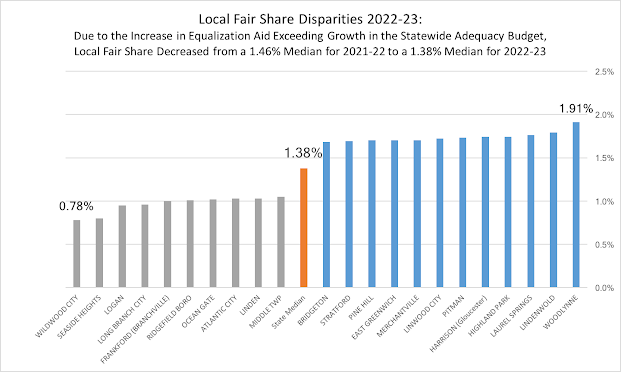
Now that Adjustment Aid is being phased out, the biggest problem in the School Funding Reform Act is its use of Aggregate Income to calculate Local Fair Share.  To see how bad Local Fair Share disparities can get, check these out:

If you are unfamiliar with the problems of Local Fair Share, New Jersey's formula for local share is nearly unique in the United States in that it is a 50:50 hybrid of a district's Equalized Valuation and its Aggregate Income.  

The use of Aggregate Income means Local Fair Share is unequal and the following categories of districts have high Local Fair Shares:

  • Where residents live in houses that are inexpensive relative to income.
  • Districts that lack non-residential property and/or vacation homes because non-residential + vacation property has no income "attached" to it.
  • Districts where many residents live in tax-exempt housing.
  • Districts with high-income outliers.
The districts who are the most hurt by the use of Aggregate Income tend to be Philadelphia suburbs, then rural districts, and then some random ones in Northeastern New Jersey.  Woodlynne's Local Fair Share is the highest and fluctuates around 2%.  The state's median Local Fair Share fluctuates at 1.4%.  In 2021-22 the median was 1.46% and in 2022-23 the median will be 1.38%.


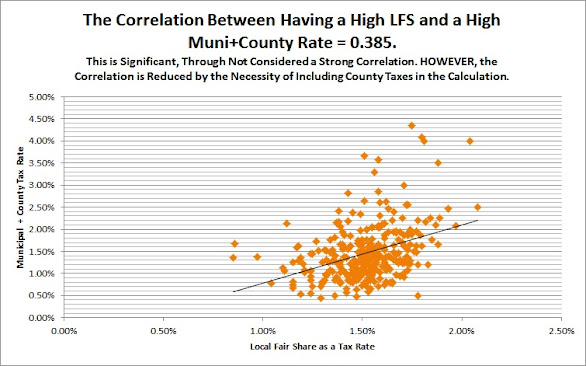
Due to the penalty against districts that have high percentages of residential property and those towns are already disadvantaged, having a high Local Fair Share correlates with having high municipal taxes.


Ideally what New Jersey would do to fix Local Fair Share is base it solely on taxable property (ie, Equalized Valuation, which would make the tax rate the same for all Equalization Aid-eligible districts, but I realize that equalizing Local Fair Share would require some districts to pay higher taxes and that is politically difficult.

What I propose instead of an equal Local Fair Share that there be a cap on how high a Local Fair Share would be.  It would not require low LFS districts to pay more, but at least lessen the extremes of high Local Fair Shares that afflict some districts.

The costs are not high.

For instance, capping Local Fair Share at 1.7% would only affect eight districts (Woodlynne, Lindenwold, Laurel Springs, Highland Park, Harrison (Gloucester), Pitman, Linwood City, and Merchantville) and cost $2,063,729 in additional Equalization Aid.

DistrictLocal Fair ShareEqualized ValuationLocal Fair Share as a Tax RateAmount of Equalization Aid at Real LFS if SFRA were 100% FundedEqualization Aid if LFS were Capped at at 1.7%Additional Equalization Aid at 1.7%
Woodlynne$1,391,251$72,802,5271.91%$10,880,769$11,034,377$153,608
Lindenwold$11,303,200$631,255,8421.79%$51,900,777$52,472,628$571,851
Laurel Springs$2,287,277$130,051,2421.76%$2,719,218$2,795,624$76,406
Highland Park$24,379,427$1,399,324,1531.74%$2,795,761$3,386,677$590,916
Harrison (Gloucester)$15,252,825$878,645,6981.74%$3,353,627$3,669,475$315,848
Pitman$11,665,247$674,646,5641.73%$4,817,288$5,013,543$196,255
Linwood City$10,856,880$629,986,8221.72%$71,230$218,334$147,104
Merchantville$4,641,379$272,331,6691.70%$4,746,854$4,758,595$11,741
TOTAL$2,063,729

The costs aren't even that high if LFS were capped at 1.6% or 1.5%.  

If Local Fair Share is Capped at ...Additional Equalization Aid
....1.7%$2,063,729
....1.6%$14,152,048
....1.5%$69,092,717


Several more districts who are not ineligible for Equalization Aid would become eligible if Local Fair Share were capped.  Haddon Heights and Wenonah become eligible for Equalization Aid at a 1.6% cap.  Medford, Washington Twp (Morris), and Haddonfield become eligible at a 1.5% cap.  (their totals are included in the table above)

There is a lot of inertia behind keeping Aggregate Income in the Local Fair Share formula, but at least capping the contribution at a certain point above the state median would eliminate the worst victimization by the formula.


-----
See Also


Wednesday, March 9, 2016

Beyond the Point of Fairness: NJ's Most Overtaxed School Districts

Everyone in NJ thinks that their property taxes are brutal, but just because NJ's average property taxes are the country's highest doesn't mean that everyone's burden is equally excruciating.  This post is going to be about the school districts where taxpayers truly have the worst school taxes by the standards of New Jersey.

Although there are different ways to assess tax burdens, this will use the 2016-17 Local Fair Share.

Basic Facts on NJ School Tax Burdens:

  • The median district's 2015-16 tax levy was equal to 102% of its 2016-17 Local Fair Share. 
  • There are 306 districts that pay 100% or more of their Local Fair Share.
  • There are 17 districts that pay 150% or more of their Local Fair Share.
  • There are 284 districts that pay 99.9% or less of their Local Fair Share.
  • There are 55 districts that pay 49.9% or less of their Local Fair Share.

What is Local Fair Share?
(Readers who understand how SFRA is supposed to work can skip this section.)

Local Fair Share is a measurement of a district's ability to pay taxes.  It is a hybrid calculation that depends on Equalized Valuation (ie, market value of a town's taxable real estate) and on Aggregate Income.

The formula for Local Fair Share for 2016-17 is:

(Equalized Valuation x 0.013156218 + Aggregate Income x 0.046185507)/2

Where Equalized Valuation is from 2015 (for FY2016) and Aggregate Income is from 2013.

The formula for Local Fair Share might look wild, but all it says is that a district's fair share of taxes equals 0.65% of Equalized Valuation (1.3% / 2) plus 2.3% of income (4.6% /2 ).

So, to use South Orange-Maplewood as an example, its Equalized Valuation is $6,118,482,231 and its Aggregate Income for 2013 was $2,414,402,178.

Thus, when you plug those values into the formula you get South Orange-Maplewood's Local Fair Share of $96,003,237.

Local Fair Share is half of the calculation of Equalization Aid, the state's most important aid stream.

Equalization Aid is calculated by determining a district's Adequacy Budget (using population and various at-risk weights) and then subtracting Local Fair Share. So, South Orange-Maplewood's Adequacy Budget is $104,753,980 and its Local Fair Share is $96,003,237, therefore it would get $8,750,743 in Equalization Aid if SFRA were followed.

Of course, SFRA is NOT followed and South Orange-Maplewood gets $0 (ZERO) in Equalization Aid.

If a district's Local Fair Share is greater than its Adequacy Budget it does not get Equalization Aid. A third of NJ's districts do not qualify for Equalization Aid.

(It might seem inappropriate to some readers that I am using the 2015-16 tax levy and comparing it to the 2016-17 Local Fair Share, but Local Fair Share is (unavoidably) is calculated during the previous school year anyway and uses lagging data.  Thus, comparing the previous year's tax levy to the next year's Local Fair Share is a legitimate way to assess relative tax burdens.)

NJ's Most Overtaxed


Manchester Regional really stands out here for exceptionally bad taxes.  Manchester Regional's taxes are so incredible because of the new and unique tax apportionment arrangement Prospect Park, Haledon, and North Haledon have where North Haledon (a middle class district) pays taxes to Manchester Regional based 50% on Equalized Valuation and 50% on the percentage of students there who are from North Haledon. It must be known that most of Manchester Regional's taxes are paid by Prospect Park and Haledon.

Even though Manchester Regional is only a grades 9-12 district, even if you combined its taxes with the taxes of Haledon and Prospect Park, the resulting tax levies would still be exceptional for those two towns.  Prospect Park/Manchester Regional's combined tax levy would be 173% of Local Fair Share. (see graphic.)  Haledon/MR's combined tax levy would be 167% of Local Fair Share.  North Haledon, on the other hand, would have taxes that are slightly below LFS.

For some districts the high tax burden is something they found themselves in because their tax levies stayed constant (or increased) as their tax bases declined.  Atlantic City is the ideal example of a  district like this.  In 2008 when Atlantic City's Equalized Valuation was $22.2 billion, its $109 million school tax levy was easily affordable, now that Atlantic City's Equalized Valuation is about $8 billion, a $100+million tax levy is a huge challenge for a district whose income is as low as Atlantic City's is.

Linden, Lodi, and Newton have also had substantial losses to their Equalized Valuations.

Although Manchester Regional and a few other high-tax districts like Linden, Lodi, Woodlynne, West Orange, are severely underaided, the highest-taxed districts are overall a mix of districts that are overaided and underaided.  The underaided, high-tax districts can be seen as trying to make up for a lack of state aid; the overaided, high-tax districts can be seen as trying to spend more to improve educational quality.


Several of NJ's other severely underaided districts, such as Bound Brook, East Newark, and Freehold Boro, have tax burdens which are closer to their Local Fair Shares or even below their Local Fair Shares.

On the other hand, most of the districts whose districts whose taxes exceed Local Fair Share the most in absolute terms are indeed underaided.


Some of NJ's most overtaxed districts do well in state aid and should be considered voluntary overtaxers who; other overtaxers get a pittance for state aid and are essentially being forced to overtax themselves or else sacrifice their children.  If Manchester Regional taxed at its Local Fair Share ($4.7 million) instead of its actual $10.7 million levy, Manchester Regional would have $6 million less, or $6400 less per student.  Since Manchester Regional's total budget is about $18 million ($13300 per student), this would be a gigantic setback that would make Manchester Regional easily New Jersey's lowest spending school district.

All of the other overtaxed/underaided districts here tax themselves thousands of dollars in excess of their Local Fair Shares.

Some inequity in taxation is unavoidable because some districts (like Jersey Shore microdistricts) have more property wealth per student than others, but what is infuriating and unacceptable is how NJ's unfair distribution of state aid (where 199 districts get 100% or more of their uncapped aid) exacerbates these "natural" inequities.  Jersey City's school taxes are so low because it gets $130 million in K-12 aid in excess of what SFRA recommends.

What is also maddening is how little known all of these inequities are because the Department of Education does not publicize Local Fair Share data.

Both the Democrats and Republicans fail New Jersey's working class districts and poor non-Abbotts.  Republicans fail NJ's working class districts and poor non-Abbott districts through their opposition to any income tax increase whose proceeds could relieve property tax burdens; Democrats fail NJ's working class and poor non-Abbotts through their favoritism towards their urban (Abbott) base, lack of realism on pensions. and general non-prioritization of K-12 school funding.

Will help ever come for districts like Linden, Lodi, and Manchester Regional?  Not unless these districts can successfully make the case that they are truly victimized by the state and they can inform the public that not everyone's tax burden is equally heavy.

---

PS  The towns with the highest all-in (county, school, and municipal) Equalized tax rates are in this chart.

These data do not take income into account residential income.  I also excluded Winfield because its Equalized tax rate seems to be 18%, a figure I find unbelievable without further corroboration.

Source: http://www.state.nj.us/dca/divisions/dlgs/resources/property_tax.html#1


---

See Also:

Helping the Needless: New Jersey's Richest Districts and Their State Aid

The Robbers and the Robbed: State Aid Disparities for 2016-17

Choice Districts, Charterized Districts Are Big Winners for 2016-17 State Aid

More on 2016-17 State Aid: Where the Money's Going