Showing posts with label Lakewood. Show all posts

Wednesday, March 17, 2021

Good and Bad in the Lakewood State Aid Case

One of the most significant state aid news events of the past month is the decision by an Administrative Law Judge, Susan M. Scarola, that the School Funding Reform Act is not necessarily unconstitutional for Lakewood, but that the Commissioner of Education could decide on a special budgetary remedy for Lakewood.


An administrative law judge has determined the public school district cannot fulfill its constitutional mandate to provide students a "thorough and efficient education," but stopped short of determining that the state funding formula is unconstitutional. 

In a non-binding decision Judge Susan Scarola recommended that the New Jersey Commissioner of Education conduct a needs assessment of the school district's ability to meet its obligations and make "appropriate recommendations to the district."
 
The decision scarcely binds the Acting Education Commissioner Dr. Angelica Allen-McMillan to do anything; the recommendation may be adopted, modified or rejected by Allen-McMillan. But the harsh assessment — that the school district cannot meet its constitutional mandate — puts fresh focus on the troubled school district and pressure on the state's top education official to intervene.

The situation in Lakewood is complex, and I agree and disagree with the ALJ's decision.  I agree with the ALJ that Lakewood has the capacity to increase its local taxes, but I disagree that SFRA might produce an adequate state aid amount for Lakewood even if Lakewood paid 100% of its Local Fair Share.  If you look at Lakewood's unique demographics, there is no possibility of that. (See "The Origins of Lakewood's Budget Disaster")

Background

The School Funding Reform Act bases Lakewood's Adequacy Budget, and hence its Equalization Aid, on the number of students who are enrolled in the public schools, which is 5,896 for 2020-21.

If you look at the number of Lakewood students who are Out Of District special ed placement compared to the Lakewood Public Schools, it is wildly disproportionate, but if you look at the number who are in Out Of District placement compared to the whole Lakewood population, it is merely average.  

Equalization Aid is meant to be a district's "all purpose state aid."  Equalization Aid, along with the local tax levy, that is is supposed to be used for everything from teacher salaries to basketballs to furnace repairs to reading coaches, to most relevant for Lakewood, Out of District tuition and private school transportation.

Year2011-20122012-20132013-20142014-20152015-20162016-20172017-20182018-20192019-20202020-2021
OOD Tuition$18,089,987$19,587,230$20,979,587$18,325,244$17,972,788$24,777,814$27,648,082$30,052,929$31,865,269$33,922,516
Transportation Spending$14,978,022$15,978,039$22,989,657$25,449,467$28,093,613$31,780,583$31,963,75337,638,604 443,252,944 5$51,100,775

Transportation Aid covers about a third of (mandated) private school bussing, but the other two-thirds are meant to be paid for with the local tax levy and (if eligible) Equalization Aid.   Extraordinary Aid covers a fifth of Out Of District tuition, but the rest of the spending is supposed to come from the local tax levy and (if eligible) Equalization Aid.  


So Lakewood's Equalization Aid would be inadequate in any case, but Lakewood's sub-problem is that its Equalization Aid is $0.  (It is not clear that the ALJ realized this)


In a normal district, private school transportation is a tiny expense and Out of District tuition falls in a range where the local tax levy, Extraordinary Aid, and, if relevant, Equalization Aid cover it.  

But not Lakewood, because Lakewood's public school population is only a sixth of the total population.  Lakewood's 362 students in special ed private schools out of ~35,000 are at New Jersey's 1% average, but they are over 6% of the public school enrollment of 5,896.

I believe the logic of the Lakewood situation indicates that SFRA doesn't work for Lakewood, but something worrisome about the ALJ's decision is that it is unclear if she realized Lakewood was already ineligible for Equalization Aid.

Adequacy Budget (for Equalization Aid)Local Fair Share
Equalization Aid
2017-18$109,857,390$102,034,106$7,823,284
2018-19$123,904,450$111,534,172$12,370,278
2019-20$123,598,294$123,904,450$0
2020-21$121,724,164$134,643,568$0


For instance:

The challenge is that when taxes were raised, they covered public schools and State aid was increased. But now, in Lakewood Township, the number of public school students stays about the same, while the non-public school student population goes up about 10% per year. This affects the budget in transportation, because Lakewood has to pay the LSTA $1,000 per student per year, which actually comes to about $710 per student after State aid is factored in. Usually taxes and State aid are sufficient for most communities to cover this expense, but in Lakewood, even with categorical aid and equalization aid, it is not enough because the equalization aid and the categorical aid are frozen. It is not enough because increased taxes do not cover the costs.

She does quote a witness who predicted Lakewood's Equalization Aid would go to zero, without realizing it already had.

The largest calculation in State aid is equalization aid, which is based on property value and income. Lakewood’s equalization aid is disappearing because of its increase in property value, and Wyns predicts that it will soon be zero. This is a consequence of recent amendments to the SFRA: adjustment aid and equalization aid will be gone, and only categorical aid of special education and security aid will be left.

And

The district has a revenue problem. The State-aid funding formula works well for 99% of the state. It does not work for Lakewood because the district cannot contribute to its adequacy budget because wealth and ratables are taken into account when calculating aid. The district gets some equalization aid. Lakewood has a base of 36,000 students, where one-sixth of the students are in public school and five-sixths are not. 

Also, Lakewood never was listed as getting Adjustment Aid.  It is among the small number of districts who flipped from being underaided to overaided in 2018-19, but it never had a sustained stream of Adjustment Aid like most overaided districts did.  

The ALJ also conflates Lakewood's loss of Equalization Aid with the loss of Adjustment Aid, when they are separate phenomena.  

Based on recent legislation, Lakewood’s equalization aid will disappear next year or the year after and will not be offset by any State-aid advances.

The disappearance of Lakewood's Equalization Aid has nothing to do with S2.  S2 phases out Adjustment Aid aid which causes Lakewood to lose state aid, but the disappearance of Equalization Aid is because of growth in the Local Fair Share and stability in the Adequacy Budget, and those predate S2.  S2 causes Lakewood to lose state aid, but it does not cause Lakewood to lose Equalization Aid per se.  


The judge is correct here:

The tax levy is not determined just by the 6,000 attending the public schools, but by Lakewood Township’s population and ratables. There is a bigger pot of money in Lakewood Township. The tax levy generated $96.9 million this year based on property taxes.

In 2020-21, Lakewood's Tax Levy-LFS gap is $28.7 million.   If Lakewood received an exemption from the tax cap, it could considerably mitigate its budget problems, although even an additional $28.7 million would not be sufficient, hence, Lakewood merits additional state aid.

(Lakewood's Local Fair Share would be only a 1.1% if it had to pay it.  This is below NJ's 2021-22 average ($131 million out of $12 billion)).

Tax LevyLocal Fair ShareLevy, LFS Gap
2015-16$91,024,977$96,735,200$5,710,223
2016-17$94,823,327$92,974,112-$1,849,215
2017-18$98,699,341$102,034,106$3,334,765
2018-19$100,827,483$111,534,172$10,706,689
2019-20$102,844,033$123,904,450$21,060,417
2020-21$105,870,754$134,643,568$28,772,814
2021-22
----$131,866,083

(The cause of the fall in LFS is reductions in LFS multipliers.)

Conclusion:

I think the Administrative Law Judge is right to look at Lakewood's strong tax base and recommend a more comprehensive solution than simply ordering more state aid, but in not knowing that Lakewood was already ineligible for Equalization Aid and conflating the disappearance of Lakewood's Equalization Aid with the phase-out of Adjustment Aid, Judge Scalora reveals gaps in state aid knowledge that are not fitting to a major state aid decision maker.  

Lakewood, uniquely, can make a strong case that SFRA does not give it sufficient state aid although by not appealing for tax cap liberalization in addition to state aid it weakens its case for either.


Tuesday, March 19, 2019

2019-20 State Aid Gets Fairer, but Deficit Grows


For 2019-20 school year Phil Murphy proposed to increase overall K-12 opex aid by $206 million and redistribute another $90 million of Adjustment Aid, for an all-in increase of $296 million for underaided districts, with the bulk of that new money going to districts who are severely underaided.

However, despite the increase in state aid, the deficit for the underaided districts rose from $1.75 billion to $1.78 billion.

Although $296 million increase is very large and appreciated by the recipient districts, since the deficit constantly grows, the increase is only sufficient to prevent further backsliding into
deeper deficit, as New Jersey struggles to advance against a strong headwind of inflation and then enrollment growth and tax base erosion that is disproportionately in districts who are already underaided.

Indeed, inflation's contribution to the growth of the funding target in 2019-20 is particularly large due to the FY2020 Education Adequacy Report and the $566 per student increase in the base cost per student.

This post is a first look at state aid disparities in 2019-20 and emphasize that SFRA funding targets are dynamic.  In 2018-19 it would have cost $9,562,210,757 to fully fund SFRA, but in 2019-20 it would cost $9,801,544,588 to fully fund SFRA.  The increase in costs is disproportionately in underaided districts, hence the constant growth of their aid deficit.    


Note, the deficits reflected above would be the _net_ deficit if every district was funded at exactly 100% (implying that
all Adjustment Aid were eliminated).  The more meaningful deficit is that for the underaided districts, which is $1.787 billion for 2019-20.

Thus, the number of underaided districts slightly grew, and so did the deficit itself, which rose from $1.75 billion to $1.8 billion.

Despite the size of the $90 million reduction in surplus aid (ie, "Adjustment Aid"), the total amount of excess aid is only falling by $10 million, from $651.9 million to $641.7 million aid surplus, which simultaneously grew due to continued enrollment loss, tax base growth, and the DOE's changes to the formula for Local Fair Share.  The stability of Adjustment Aid is due to continuing enrollment loss and tax base growth, although the contribution of tax base growth is disproportionately from Jersey City alone.   (discussion below).

Lakewood, despite being overaided in 2018-19, gained $14.9 million in SFRA-non compliant aid, which the DOE is listing in its normal state aid releases.  Lakewood's increase also appears to increase the statewide amount of excess aid.

This blog post is based on state aid information from the Department of Education which I received after an OPRA request.  The calculations of state aid deficits, percentage overaiding/underaiding, dollars per student overaiding/underaiding and tax stress are done by me.  The 2019-20 State Aid Disparities information is available online here.

The Big Picture

Statewide, the median district has a deficit of $383 per student and gets 86% of its Uncapped Aid.  The median deficit is smaller than in 2018-19, when it was $417 per student and the median percentage is slightly better than 2018-19, when it was 86%.

There are 383 underaided districts, with a total deficit of $1.8 billion and 209 overaided districts with a total surplus of $641 million.

There are zero districts who get exactly 100% of their state aid, which is a contrast from 2018-19, when 16 districts got 100%. The slippage of any districts getting 100% is the reason there are apparent increases in the number of overaided and underaided districts.  (the lack of 100% funded districts is due to S2)

The Underaided

There are 96 districts who are underaided by more than $2,000 per student for 2019-20, versus 109 districts with deficits over $2,000 per student in 2018-19.  In 2019-20 there will be 30 districts are underaided by more than $4,000 per student, versus 35 in 2018-19.

So this is incremental reduction in severe underaiding.

The district with the largest state aid deficit is Atlantic City, whose deficit is -$56 million, or -$8,534 per student.  (this deficit includes AC's $20 million in "Commercial Valuation Stabilization Aid,"  

After Atlantic City, the districts with the biggest deficits are:

DistrictDeficit in Dollars PPDistrictDeficit in Dollars PP
BRIDGETON CITY-$4,488FREEHOLD BORO-$5,694
PLAINFIELD-$4,552DOVER TOWN-$5,809
EGG HARBOR CITY-$4,603ATLANTIC CO VOC-$5,942
DUNELLEN BORO-$4,850LINDENWOLD-$6,075
WOODLYNNE-$4,868PASSAIC VOC.-$6,115
HALEDON BORO-$4,992FAIRVIEW-$6,268
PROSPECT PARK-$5,085HI NELLA-$6,562
ROSELLE BORO-$5,283BOUND BROOK-$6,776
NORTH PLAINFIELD-$5,308CUMBERLAND VOC.-$8,181
MANCHESTER REG-$5,689ATLANTIC CITY*-$8,534

These deficits are unacceptable, and yet an improvement from 2018-19, when there were 109
Bound Brook, NJ.
Still one of NJ's most underaided school districts.
districts who were underaided by at least $2,000 per student and 35 who are underaided by at least $4,000 per student or more. 

Bound Brook also shows improvement. The -$6,776 deficit is huge, but it is smaller than in 2017-18, when Bound Brook's deficit was -$9,546 per student or 2016-17 when Bound Brook's deficit was -$9,836.

The reason the increase for Bound Brook hasn't been larger is significant loss of tax base there and corresponding increase in the Uncapped Aid target.  Although tax base erosion is the rarest cause of severe underaiding

In order to demonstrate the decline in severe underaiding, the following table shows the most underaided districts starting with 2016-17, the rock bottom year of state aid injustice, and how Steve Sweeney's fight for fairness (now supported by Phil Murphy) has brought results, although equity is still years away (and perhaps unattainable).


DistrictDeficit Per Pupil in 2016-17Gain in Dollars Per Student for 2017-18Gain in Dollars Per Student for 2018-19Gain in Dollars Per Student for 2019-20Deficit Per Pupil in 2019-20 (projected)
Dover-$6,558$417$776$868-$5,809
Guttenberg-$6,645$511$1,337$392-$2,626
Ridgefield Park-$6,740$491$1,764$290-$1,942
Atlantic City-$7,270$816$700TBDTBD
Hi Nella-$7,302$427$817$981-$6,562
Atlantic Co Voc-Tech-$7,529$733$2,213$888-$5,942
Passaic Co Voc-Tech-$7,551$520$1,302$914-$6,115
Fairview Boro-$7,625$630$1,951$937-$6,268
Freehold Boro-$8,243$0$1,890$851-$5,694
Manchester Reg-$8,698$653$1,830$850-$5,689
East Newark-$8,716$397$514$464-$3,106
Bound Brook-$9,836$865$2,289$1,013-$6,776
Because state aid is dynamic, 2016-17 deficit + new aid will not equal the 19-20 deficit.

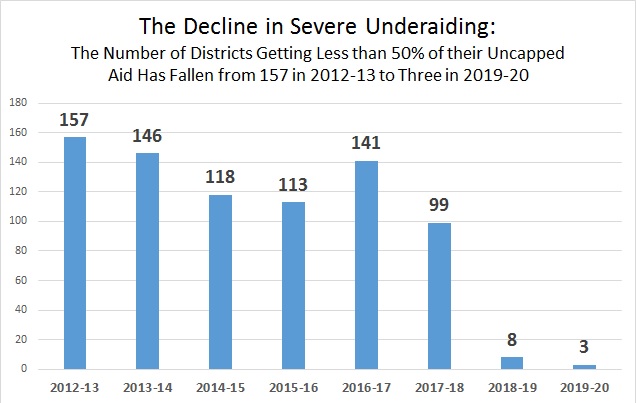
Although I consider deficits in dollars-per-student more significant than percentage deficits, something encouraging about 2019-20 is that there will be only three districts who get less than 50% of their Uncapped Aid: North Brunswick and Cumberland Co Vocational at 48%, and Woodbridge at 46%.

Since in 2016-17 Chesterfield only got 9% of its Uncapped Aid, let it also be marked as an improvement too that the bottom has risen from 9% to 46%.


There are also only 55 districts getting 60% of their Uncapped Aid.  In 2018-19 there were 151.

HOWEVER, some districts are becoming more underaided, especially ones who already receive high percentages of their state aid, but whose state aid targets are so high that even getting 80% of their state aid translates into a large deficit.  For a district already getting a high percentage of its state aid, the gain under S2 will be proportionally small.

This scenario is true of many of the Abbotts.  Paterson, Elizabeth, and Newark all gained state aid, but saw their state aid deficits increase.  (A future post will examine the Abbotts in detail)

The Biggest Gainers

Newark grabbed headlines for gaining $24.7 million, but Newark is a district of 52,000 students, and that only is $469 per student.

Lakewood gained the most in percentage terms at 64%, but Lakewood is sui generis and much of that money will not go to support public education.  Atlantic City gained the second most in percentage terms at 39%, but Atlantic City also seemingly lost $12 million in Commercial Valuation Aid and its net increase is small.

Of normal districts, the biggest gain in percentage terms was Woodbridge, at 22% (+$7.4 million), but that is $531 per student.

The real biggest gainers, in dollars per student are:


CUMBERLAND VOC.$1,222
HI NELLA$981
FAIRVIEW$937
PASSAIC COUNTY VOC.$914
ATLANTIC CO VOC.$888
DOVER$868
FREEHOLD BORO$851
PLAINFIELD CITY$841
LINDENWOLD$799
NORTH PLAINFIELD$793
ROSELLE BORO$789
BRIDGETON$768
PROSPECT PARK$760
HALEDON BORO$746
WOODLYNNE$727


The Overaided Districts

There are 209 districts who are receiving more state aid than the SFRA formula says they should
Asbury Park
AP Lost $3 million in Adjustment Aid
But Actually Became MORE Overaided
Due to Tax Base Growth, Enrollment
Loss, and the increase in the LFS formula.
receive, with a total surplus of $641 million.

Of those districts:
  • 130 are overaided by more than $1,000 per student.
  • 75 are overaided by more than $2,000 per student.
  • 37 are overaided by more than $3,000 per student.
  • 13 are overaided by more than $4,000 per student.
Asbury Park, as always, is the most overaided district in New Jersey, with a surplus of $11,026 per student.   (Asbury Park's state aid +186% of its SFRA target)  Asbury Park's excess aid alone is more than the $9324 per student that its high-FRL, severely underaided neighbor Freehold Boro will receive.

In percentage terms, Washington Township in Burlington County is the most overaided, getting $435,110 more for its 55 students than SFRA recommends, or 545% of its SFRA target.

Many Overaided Districts Became More Overaided

Despite the loss of $90 million in Adjustment Aid (13%), a large number of overaided districts became more overaided, the most important of which is Jersey City.

The following 15 districts had the largest Adjustment Aid totals in New Jersey.  Altogether they represent 60% of the 2018-19 total.

As you can see, six of the fifteen districts with the most Adjustment Aid gained Adjustment Aid for 2019-20, despite the 13% Adjustment Aid cuts they experienced.


2018-19 Adjustment Aid2019-20 Adjustment AidAdjustment Aid Gain or Loss
JERSEY CITY$170,778,034$182,106,881$11,328,847
PEMBERTON$25,259,032$17,725,530-$7,533,502
EAST ORANGE$24,391,436$18,288,196-$6,103,240
FREEHOLD REGIONAL$24,090,617$25,302,050$1,211,433
ASBURY PARK$23,563,095$22,933,389-$629,706
BRICK$21,331,456$18,349,599-$2,981,857
TOMS RIVER REG.$17,581,822$18,607,945$1,026,123
JACKSON TWP$15,963,963$15,372,258-$591,705
MANALAPAN-ENGLISHTOWN REG$12,175,534$10,297,786-$1,877,748
NEPTUNE TWP$11,424,541$10,939,598-$484,943
OLD BRIDGE$11,126,695$13,123,877$1,997,182
VERNON$9,970,059$9,406,636-$563,423
HOWELL$9,715,911$11,012,370$1,296,459
HOPATCONG$8,229,916$7,308,000-$921,916
WASHINGTON (Gloucester)$8,164,374$9,737,141$1,572,767

The causes of the increases are different for each district, but the usual factors are enrollment loss and tax base growth, plus the tweaking of the Local Fair Share multipliers.

Jersey City merits special discussion here:
Jersey City's Local Fair Share grew from $399 million to $474 million (+$75 million).  Although Jersey City's Adequacy Budget grew from $590 million to $622 million (+$32 million), which all-else-being-equal would increase Jersey City's Equalization Aid, the increase in Local Fair Share was so much larger than the increase in the Adequacy Budget and then the cut of $27 million in Adjustment Aid that Jersey City's state aid surplus actually grew by the $11 million you see above.  (See Note 1)

Aside from the usual enrollment loss and/or tax base growth, the Murphy administration also increased the Local Fair Share multipliers by 6% and that drive increases in Local Fair Share that were larger than the increases for Adequacy Budgets.

The 2018-19 Local Fair Share formula was:

(Equalized Valuation x 0.013828828) / 2 + (Aggregate Income x 0.046200477) / 2

Which looks complex, but was really 0.69% of Equalized Valuation plus 2.3% of Income.

But this is the formula for 2019-20

(Equalized Valuation x 0.014523812) / 2 + (Aggregate Income x 0.049819447) / 2 

Which is really 0.73% of Equalized Valuation plus 2.5% of Income.

-----

(1)  This refers to Jersey City's Adequacy Budget for Equalization Aid.

See Also: