Thursday, March 2, 2017

Jersey City PILOTed Property is Worth $11.6 Billion

FYI, this article by Terrence McDonald of the Jersey Journal about Jersey City PILOTs is worth reading for several reasons, but I wanted to point out something from the conclusion of the article:

Last year Jersey City's PILOT program took in $127,800,476 from tax-abated properties. If all these properties were taxed conventionally, the total would be $211,967,791.
None of This Pays Any
School Taxes
(The relevance of this to state aid is that PILOTed property is "invisible" to the formula for Equalization Aid, thereby sustaining an artificially high state aid package for Jersey City.)

The State of New Jersey has no comprehensive database on how much property towns have in PILOT status, but the publication of  what Jersey City's PILOTed properties would pay if they were subject normal taxation allows one to calculate what the PILOTed properties are worth.

Jersey City's all-in tax rate is only 1.826%.

If Jersey City's PILOTed properties would pay $211,967,791 in taxes, that means that their full valuation is $11.6 BILLION.

$211,967,791 / .01826 = $11,608,312,760.10

This is up substantially from 2015, when Jersey City's PILOTed properties were only worth $8.6 billion.

$11.6 billion is a gigantic amount, it is equal to 45% of Jersey City's $25.7 billion in taxable property.

If Jersey City's PILOTed properties were an independent city, their Equalized Valuation would be the seventh largest in New Jersey.

Here are the top Equalized Valuations in New Jersey:

  1. Jersey City's (taxable) $25.7 billion
  2. Edison $15.8 billion
  3. Toms River $15.167 billion
  4. Hoboken $15.128 billion
  5. Newark $13.8 billion
  6. Ocean City $12 billion
  7. Jersey City's PILOTed $11.6 billion
  8. Middletown $10.6 billion
  9. Woodbridge $10.5 billion

At Jersey City's tiny 0.471% (Equalized) school tax rate, those PILOTed properties should be paying $54,675,153.10.

The $11.6 billion is also equal to 16% of Hudson County's $71 billion in Equalized Valuation.  At Hudson County's 0.458% tax rate, that means that that PILOTed property should be paying $53 million in county taxes.

Hence, the distortion of Hudson County's taxation cannot be ignored any more than the distortion of school taxes and school aid can be.

This means that taxpayers in Hudson County's several severely underaided school districts - like Bayonne, Guttenberg, East Newark, North Bergen, and Kearny - are victimized twice by Jersey City; first as state taxpayers who must subsidize Jersey City's schools, second as Hudson County taxpayers who must subsidize Jersey City's county services.

As Jersey City blogger CivicParent has documented, when Steve Fulop of Jersey City campaigned in 2013 for mayor, he attacked the incumbent (Jerramiah Healy) for granting PILOTs, saying PILOTs "robbed the schools."

If elected, Fulop swore he would share PILOT revenue with the Board of Education.

HOWEVER, after he won the election, Fulop immediately forgot that promise.

Although there has been an attempt to reduce downtown tax abatements - Fulop should get credit for not PILOTing the supertall skyscraper 99 Hudson Street - since Fulop became mayor Jersey City has given out 70 PILOT agreements, presumably worth billions.

Although the primary thrust of Steve Sweeney's state aid reform fight is to eliminate Adjustment Aid, Sweeney's effort to end the distortion of state aid that results from PILOTing cannot be ignored either.


----
See Also


Sunday, February 26, 2017

John Wisniewski State Aid Plan, the Good, the Bad, and the Insufficient

Wisniewski's Aid Plan:
The Ends Don't Quite Meet

Gubernatorial candidate John Wisniewski has just come out with a plan on state aid that he claims will bring every district up to 100% funding entirely through higher spending, without redistribution.

As usual, there's some good news and bad news in this.

The good news is that Wisniewski is talking about state aid at all, which is an issue he has generally ignored on the campaign so far.  It is also laudable that Wisniewski actually has come out with a set of specifics on where the new revenue will actually come from, which is a major contrast to Phil Murphy, who frankly has a vapid "I'll fully fund the formula" line.

Although John Wisniewski is not the only Democratic candidate with a plan on state aid (Sen. Ray Lesniak supports Steve Sweeney's approach), Wisniewski at least is putting the most original thought into aid.

That being said, Wisniewski's plan comes up short.

The fastest way to immediately provide property tax relief in New Jersey is to fully fund our public schools.John Wisniewski is prepared to close the educational funding gap by taking the following actions: 
Restore the estate tax.  We must overturn the “deal” made between the Legislature and Gov. Christie last year that began the phase out and eventual elimination of the estate tax.  John Wisniewski voted against eliminating the estate tax because New Jersey is already underfunding education and we cannot afford tax breaks that benefit an estimated 3,500 super wealthy families at the expense of 1.4 million students.  Restoring the estate tax will generate an estimated $150 million within the first year and will eventually put as much as one billion in revenue back into the State budget. 
Freeze corporate welfare.  John Wisniewski will enact an immediate freeze and review of all corporate business tax incentive programs.  Gov. Christie has abused these giveaways as he has doled out $7.4 billion in corporate welfare to his wealthy friends and political cronies — without generating any measurable economic activity.  Simply freezing these giveaways will free up an estimated $800 million annually. 
Wisniewski will sign a millionaire’s tax.  Adjusting New Jersey’s highest marginal tax rate will generate $500-600 million annually.  Education is an investment in our future that pays dividends.  It is not unreasonable to ask New Jersey’s wealthiest residents to help fully fund education and provide property tax relief. 
Overturn Gov. Christie’s $300 million State House renovation.  New Jersey has to tighten its belt and this extravagance must wait or be bid out for much less money.Our next governor must think about New Jersey’s next generation, not the next election.  John Wisniewski will fully fund K-12 education.
First of all, even if we accept all of Wisniewski's assumptions on how much money would come in from these tax increases, the total is woefully insufficient to fund even the K-12 portion of SFRA.

If we accept Wisniewski's own numbers of $150 million from a restored estate tax, $800 million from eliminating tax incentives (which I'm highly doubtful on), and $600 million from a higher income tax and you assume no rich person or business leaves New Jersey and Wisniewski can put every cent into K-12 education, it doesn't add up to 100% funding.

$150+$800+$600 = $1.55 billion.

The cumulative deficit for the 379 underaided districts for 2016-17 is $1.93 billion.

That cumulative deficit will grow since the underaided districts are the ones with growing populations and/or falling tax bases.

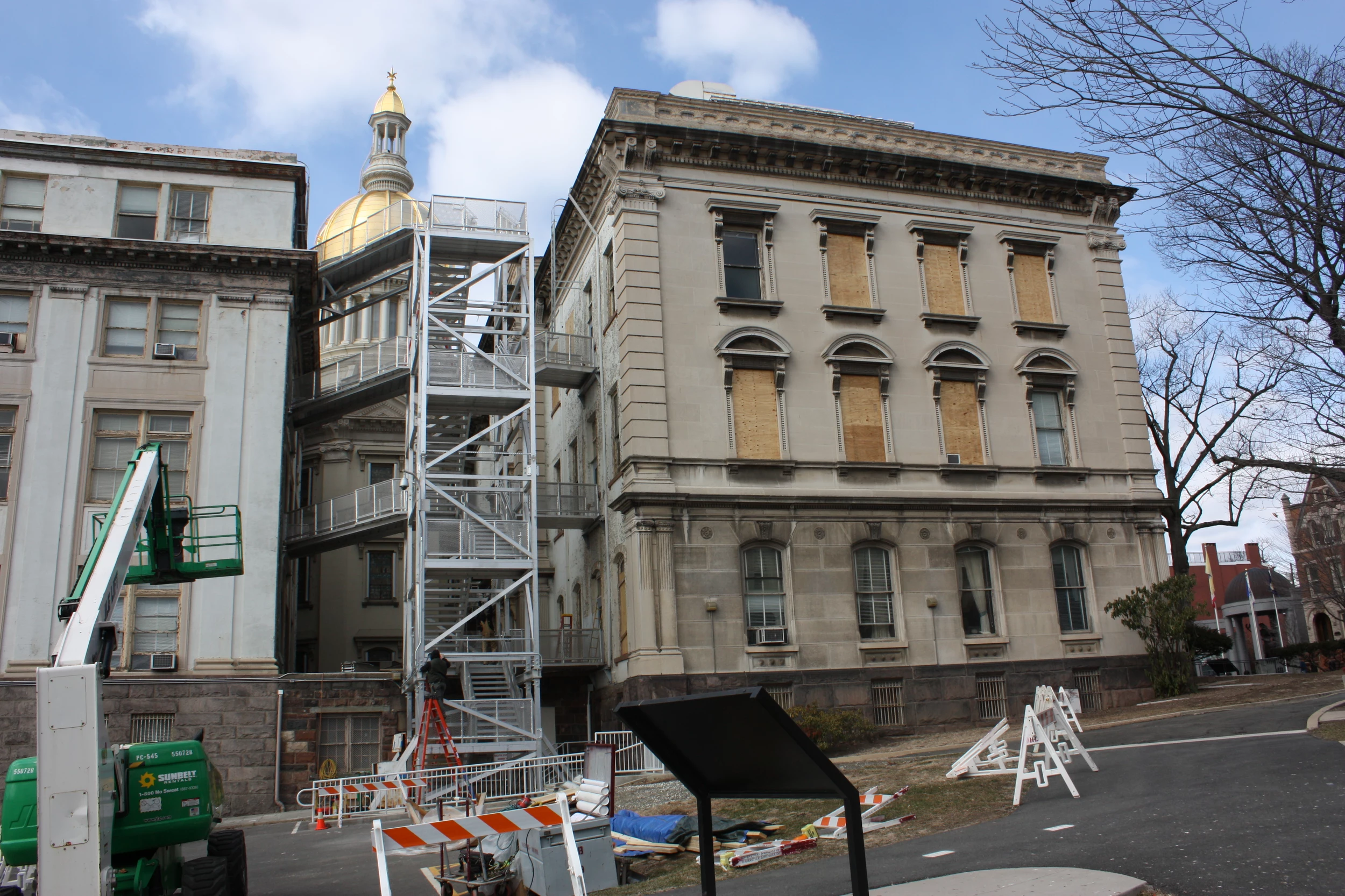
Is repairing the Statehouse really an
"Extravagance"?
Wisniewski also says we can use $300 million from cancelling the State House renovation, but even if you agree with him that the renovation is a "extravagance," the $300 million is non-existent since the state was planning to bond that money through the EDA.

Is Wisniewski seriously saying NJ should start bonding money for K-12 operating aid?  Because his proposal to use the $300 million intended for the Statehouse Renovation is tantamount to this.   No state can stay solvent by using one-time revenue shots to fund recurring costs like K-12 spending.  

I agree with Wisniewski's proposals to increase taxes on incomes above $1 million and commend him for stating that this would only bring in $500-$600 million annually.

I also agree with Wisniewski's proposal to restore the estate tax, although I think he would find it politically difficult to restore it at the previous threshold of $675,000 since that was the country's lowest. Assuming Wisniewski could/would only restore the estate tax to $1 or $2 million, New Jersey would not recover the full amount lost.

However, by putting all of the estate tax revenue into K-12 aid (it previously went into the General Fund), Wisniewski would be taking money from one pocket and putting it into another. Since items paid out of the General Fund include non-discretionary spending categories like the Executive branch, non-TPAF pensions, and Corrections, taking this money out of the General Fund would put a lot of pressure on higher ed funding, which is technically discretionary.  But this conflicts with Wisniewski's plan to make public college "free" for students from families making under $125,000 a year.

The biggest gap in Wisniewski's proposals is his plan to fund K-12 aid by eliminating tax incentives.

If Wisniewski actually followed through on this, there would be no immediate savings since NJ cannot rescind tax credits already granted.  The theoretical savings would come from not giving out any new tax incentives, but even that assumes that the business would still relocate to New Jersey or remain in New Jersey without the incentives.
  • If the XYZ Corporation is currently located in New York and says it would locate 500 jobs to New Jersey if it gets a $20 million (cumulative) tax credit, and John Wisniewski says no to a tax credit, New Jersey hasn't gained $20 million since the XYZ Corporation still won't be paying anything to the NJ Treasury!  The business will stay put where it is in New York State or go to another state that will gladly give it a tax credit.
  • If the 321 Corporation is located in New Jersey and says it will relocate to Georgia if it doesn't get a $20 million tax subsidy, Wisniewski says no, and then the 321 Corporation really does relocate to Georgia, New Jersey still loses at least that $20 million, since the 321 Corporation no pays zero New Jersey taxes, plus tens of millions of more in spending power by the corporation itself and its employees.
  • If Big Rebuild developers propose converting a vacant office building in downtown Paterson into apartments if they get a $5 million tax subsidy and Wisniewski says no, the NJ Treasury hasn't gained either since that renovation project probably wouldn't happen without a subsidy.

So Wisniewski is blowing hot air when he says that eliminating tax incentives is a budgetary salvation for New Jersey.

The Forgotten Piece:
A major missing piece of Wisniewski's proposal is any reform of how PILOTs distort state aid.

Conclusion:
So I'm glad that John Wisniewski has come up with a plan of sorts.  I hope this encourages Phil Murphy and Jim Johnson to come up with anything too.  I hope this encourages Ray Lesniak to talk about his support for Steve Sweeney's much more mathematically-literate plan.

BUT John Wisniewski has got to go back to the drawing board.

----
See Also:

Tuesday, February 14, 2017

SFRA Was Never Fully Funded

One of the most pernicious myths about the School Funding Reform Act is that it was fully funded in its first year, 2008-2009.

This myth is spread by the Education Law Center
NJ’s weighted student funding formula – codified as the School Funding Reform Act (SFRA) – stands as a national model of state public school finance. But the formula has not been fully funded since its first year in law (2008-09), and was cut in 2010-11 by Governor Chris Christie.

Including from Paul Tractenberg himself:

Tractenberg said the current state funding formula under the School Funding Reform Act has only been fully funded once under Christie. That's the real problem that should be addressed, he said.

and picked up by many journalists.

Example, Meir Rinde of NJSpotlight

The formula was run and funded for one year. Then the recession hit, Christie was elected, and he cut education aid overall by $1 billion (though half of that was eventually restored to Abbott districts).

“The school funding formula that is written into law has only been fully funded once in the last seven years.”
And even the state legislature:
WHEREAS, While the SFRA was used to distribute State school aid for the 2008-2009 school year, since then the SFRA has not been fully funded and its provisions which lay out a constitutional pathway for the distribution of State school aid have been ignored and overridden;
However, SFRA was never fully funded in a real sense because in that first year districts were only funded at their Capped Aid levels.

It's rarely explained, but SFRA contains a cap in the amount of aid an underaided district can gain in a single year, either a 10% boost if the district is above Adequacy or a 20% boost if the district is below Adequacy.

From the statute itself:
d. For the purposes of this section, “State aid growth limit” means 10% in the case of a district spending above adequacy and 20% in the case of a district spending below adequacy. 

Due to the existence of these caps, there is a difference between the statutory full funding of SFRA and the real full funding of SFRA, which would be funding every district at uncapped aid.

In 2008-09, yes, every district was funded at its Capped Aid level, but there was a $1 billion funding deficit between actual aid and uncapped aid, which, again, is the real demographic-economic aid level for districts.

I got these data from the Department of Education via an OPRA request and have put the Actual Aid vs Capped Aid data online.

Let's look at Clifton as an example of how the State Aid Growth Limits (aka "caps") reduce a district's aid:

SFRA's formulas looked at Clifton's enrollment and tax capacity and determined Clifton should get $55,999,000, which would have been $5300 per student.

But what did Clifton actually get in 2008-2009, the year SFRA was "fully funded"?

$27,374,845.

Which is only $2,600 per student.

$27 million is actually 40% higher than Clifton's 2007-08 aid of $19 million, so I admit I don't know quite was going on here, but I know 

$27,374,845  $55,999,000.

And there are 278 districts that were, like Clifton, not fully funded in 2008-09, despite so many groups and journalists saying they were.

These are just the largest deficits in absolute terms:

The data I received from the DOE had errors for certain districts which I have removed from this graph, and yet reappear in the original source material:
http://bit.ly/2knaI6K

River Edge was the most underaided in NJ in percentage terms, getting only 19% of its uncapped aid. Northvale, Clinton, and Chesterfield also in the bottom four.

In that year Manchester Regional was the most underaided in per student terms, with a $5,300 per student deficit.

Overall, in that year there were 44 districts who got less than 50% of their uncapped aid, which is better than now, when 141 districts get less than 50% of their uncapped aid, but still, this means that many districts were still underaided even when SFRA was statutorily followed.

So, again, in 2008-2009, SFRA was fully funded in a statutory sense, but not a real sense.

The total cumulative deficit for the 279 underaided districts that year was $1.05 billion (not counting vo-techs).

Adjustment Aid was $850,612,518 ($948 million with inflation) that year so the net deficit appears to have been smaller then than now (It is now $1.4 billion in 2016 dollars, counting vo-techs), but when so many districts were still in 2008-09 substantially underaided, it's wildly inaccurate to say that "SFRA was fully funded in its first year."

Here's the bottom line:

New Jersey, going back to the 1970s, has always struggled to fully fund its aid formula.

Since the Great Depression, New Jersey's fiscal situation has never been worse, nor its economy more slowly growing.

New Jersey did not fully fund SFRA in 2008-09, and our oncoming pension depletion, stagnant economic growth, and the high spending targets of SFRA make fully funding SFRA now unrealistic unless the Democrats were to pass tax increases much larger than they have ever hinted at.

---

See Also:


Friday, January 27, 2017

Three Cheers for Pemberton!

Tony Trogone of Pemberton:
Doing the Right Thing

The State Senate Education Funding Committee's hearing at Kingsway Regional had a great deal of emotional testimony from parents and administrators of underfunded school districts who demanded a redistribution of Adjustment Aid.

I will write more of that soon, but I wanted to highlight the surprising testimony by Pemberton's Superintendent.

The Pemberton is actually NJ's second most overfunded district (after Jersey City), with over $26 million in excess aid, or nearly $6,000 per student.

At the hearing, Pemberton's superintendent said that Pemberton was ready to lose Adjustment Aid:


Pemberton Township is one of the so-called overfunded districts and stands to lose millions if it's adjustment aid is eliminated. That's no easy pill to swallow, but township school officials say it's still preferable to Gov. Chris Christie's proposal to scrap the funding formula altogether and give all districts a flat per-pupil amount. 
Doing so would likely result in significant aid increases for many underfunded districts, but Pemberton Township would stand to lose $52 million [this is erroneous, the amount is $26 million] , well over half of its $83 million in annual aid. 
Superintendent Tony Trongone made the trip to Kingsway to testify in favor of his district, which has large populations of students from military families serving on Joint Base McGuire-Dix-Lakehurst, as well as substantial populations of students from poor families. Most of the township is also in the protected Pinelands Reserve, which limits its ability to grow its tax base. 
Despite those challenges, Trongone supports Sweeney's approach and said the district has spent several years trying to reduce its reliance on Adjustment Aid. 
"We've been waiting for this shoe to drop. The district has been fiscally prudent for when this time has come," he said, adding that he believes there is also a moral obligation to support fairness for school districts like Delran and Chesterfield that have been shortchanged. 
"I want to do everything I can for Pemberton. But I know we have to look at the bigger picture," Trongone said.

The source of this quote is from this Burlington County Times article (which has some errors in it)

Pemberton's Mayor has also come out in acceptance of losing Adjustment Aid.  I now feel bad about calling Pemberton an "aid hoarder."  

Friday, January 20, 2017

Why the ELC's "Just Fund the Formula" is Impossible


On January 17th, David Sciarra of the Education Law Center appeared
before the Assembly Education Committee and presented his solution to the crisis of New Jersey education aid:

"Just Fund the Formula"

However, before Sciarra got to "solution," he began with a preamble that unintentionally explained the pension crisis, when he boasted that New Jersey:

"leads the nation by funding our public schools not on available dollars or raw political considerations, but on the needs of students and schools"

First, this history inaccurate.  NJ has never properly funded working class and poor non-Abbotts.  The utopian dream that Sciarra refers to only applies to the 31 districts that were lucky enough to receive the NJ Supreme Court's "Abbott Remedy."  [see below for disparities of funding between Abbotts and poor non-Abbotts]

Anyway, Sciarra is right about the overall immensity of the spending though and it is that 20+ year budgetary history of ignoring "available dollars" that pressured Florio, Whitman, and their successors to ultimately abandon New Jersey's pension system.

Anyway, Sciarra started with a message that said, literally and loudly, :  
"Just Fund the Formula"

Let’s get right to the heart of why we’re here today.   
The problem with school funding is not our formula but the fact that Governor Christie, since he took office in 2010, has steadfastly refused to fund it, even at reduced levels. He also cut $1.1 billion from the formula in his first budget, an aid cut yet to be restored in many districts across the state. NJ school districts should be – but are not – receiving an additional $1 billion in state aid in the current school year. 
Another consequence of the Governor’s failure to fund the SFRA is that more school districts are now “below adequacy,” and the gap between “adequacy” and the state and local revenue in district budgets has grown. Each district’s “adequacy budget” is at the heart of the SFRA; it represents the level of spending, based on weighted student enrollment, districts must have to provide a thorough and efficient education. ....

Sciarra then spent much of his testimony criticizing Christie's "Fairness Formula," even though no one had spoken in favor of it, before getting back to his Just Fund the Formula "solution," concluding:

So let’s keep our focus on the SFRA and what we can do to get districts on a path to adequacy through the formula. We can start with three simple steps:
• Beginning with the FY18 State Budget, implement a multi-year phase-in of new state aid through the SFRA formula, targeting the aid to districts that are most under adequacy and/or experiencing significant increases in student population.
       [to be continued on Sciarra's other steps.]

Ok, poor me.

The time it takes to refute bullshit is many times the amount of time it takes to create the bullshit in the first place, but here is my explanation of why Sciarra's "Just Fund the Formula" is impossible.

Here goes:

This is debt as a percentage of state income.
First, Sciarra never says what the cost is of "Just Fund the Formula," but for 2016-17, without redistribution, bringing every district up to its uncapped aid for K-12 would be $2 billion.  However, that $2 billion figure is sure to rise due to inflation and the fact that in most of NJ's underaided towns, Equalized Valuations are falling or lagging.  Since Local Fair Share depends, in part, on Equalized Valuation, this means that Local Fair Shares will fall and the state formula will increase aid targets for districts.

Fully funding the PreK component of SFRA would cost $700 million.  ($700 million = $13,500 per student x 50,000 eligible students)

$2.7 billion would be a large increase for any state, but New Jersey is one of the country's most indebted states, with up to $200 billion (state+local) in debt and unfunded liabilities.

Every year NJ's state revenue increases by about $1 billion through economic growth, but pension costs, medical costs, and debt servicing costs consume all that new revenue:


Although New Jersey's non-pension debt will actually fall by a few hundred million a year, the federal copay for ACA-related Medicaid expansion is also slated to fall too, so NJ's Medicaid expenses might eat up that savings.  

So David, the state is broke?  Get it?

But what about "making the rich and corporations pay their fair share?"

Ok.  Sure.  But raising the top bracket from 8.97% to 10.75% (which would give us the country's second highest top bracket) would only bring in $615 million and $615 million isn't even close to being enough to fully fund SFRA.

Sciarra would probably support other tax increases, like Combined Reporting, but the amount of money NJ might get from that is $100-$200 million.  Perhaps Combined Reporting is appropriate (even Republican Jack Ciattarelli supports it), but Combined Reporting was vigorously protested by businesses when Connecticut imposed it in 2015 and was one factor in GE's decision to leave the Nutmeg State.

Whatever the economic consequences are of Combined Reporting, even another $100-$200 million per year plus the $615 million per year from a higher top bracket are not enough to fully fund SFRA.
Other Education Law Center Ideas:

Aside from "Just Fund the Formula" Sciarra did present a few other ideas on charter schools and limited reductions of Adjustment Aid that I will address now:

Gradually phase out hold harmless aid [ie, Adjustment Aid] to districts that are over their SFRA adequacy budgets and to charter schools. Charter schools should also be required to adhere to the same 2% cap on excess fund balance as districts. 

Ok, if New Jersey only eliminated "Hold Harmless Aid" that currently goes to over Adequacy districts then the total amount of aid that could be redistributed is reduced from about $550 million to less than $100 million.

Also, although the over-Adequacy districts get $174,024,179 in Adjustment Aid, they mostly undertax and therefore they are nowhere near $174 million over Adequacy.

For instance, Asbury Park gets $24 million in (nominal) Adjustment Aid, but it is only $13.9 million above Adequacy.  Hoboken gets $5.4 million in Adjustment Aid, but it is only $1.1 million above Adequacy.  Pleasantville gets $14 million in Adjustment Aid, but it is only about $100,000 above Adequacy.  Etc etc etc.

All in all, if New Jersey follows David Sciarra's advice and no Adjustment Aid district is allowed to sink below Adequacy, the most aid that could be redistributed is $93 million.

The nine most underaided districts alone for 2016-17 (Bound Brook, Manchester Regional, East Newark, Freehold Boro, Atlantic County Vo-Tech, Fairview, Ridgefield Park, Hi Nella, and Atlantic City) have a combined aid deficit of $103 million.  

David Sciarra and the Education Law Center are very hostile to charter schools, so he basically lies about charter school surpluses to distract everyone from the injustice of Adjustment Aid.  "Charter schools should also be required to adhere to the same 2% cap on excess fund balance as districts."

This Education Law Center argument against charter school surpluses goes back to a 2015 report where the Education Law Center claimed that NJ charters had a $100 million hoard  that they were unethically withholding from district schools

However,  the unacknowledged context is:
  1. The Education Law Center looked at charter surpluses in June, when charter school surpluses are at their peak due to the need to save money for salaries in July and August, when charter schools receive no money.
  2. Charter schools do not receive facilities money (or very much of it) and cannot bond money, so they therefore have to save operating money for several years in order to pay for their construction needs.  
In any case, charter schools' purported $100 million cumulative "surplus" is less than one-fifth the "surplus aid" that overaided districts get annually via Adjustment Aid.

Sciarra concluded with a reform to the tax cap law I agree with:

• Raise the 2% cap on increases in local property taxes for school budgets in districts under their adequacy budgets and where there is a sizable gap between their local revenue level (local levy) and the local fair share under the SFRA.

Indeed.  When Jersey City's tax deficit compared to its Local Fair Share is over $200 million, something is wrong.  The Education Law Center should make this point more often.

However, Sciarra made this a peripheral demand compared to "Just Fund the Formula."

-------


David Sciarra began his statement praising New Jersey for ignoring "dollars available" and spending whatever Education Law Center lawyers and utopian Supreme Court judges demanded, however, a state government isn't like the federal government and eventually the money runs out.  New Jersey's economic growth has been half of the national average since 2002, so the money is basically running out now.

Again, Sciarra is also wrong that NJ's state aid has been given out according to the "needs of students and schools," since the Abbott decisions only applied to the 31 Abbott districts, and poor non-Abbotts have been savagely neglected.

Finally, I can't even begin to think how Sciarra believes he is giving an honest argument when he doesn't even give the full cost of fully funding SFRA.


WHAT Steve Sweeney and others are trying to do now is finally right that wrong and restore justice and common sense to a state aid landscape that aligns to need as it was in the 1980s, not today.

The Education Law Center's opposition to this reflects how it has become a reactionary organization that opposes its original tenets.  It is standing athwart common sense and justice.

---

Below:  As you can see, poor non-Abbotts receive nowhere near as much state aid as Abbott districts do.


This chart does not include PreK money or construction money.


Thursday, January 19, 2017

NJ Superintendents Stand Up for Fair Aid


At the Joint Committee on the Public Schools' hearing on state aid on January 17th, Dr. Ken Greene of Newton and Patrick Fletcher of River Dell, speaking for the NJ Association of School Administrators (eg, superintendents), gave a presentation and address on state aid and why eliminating Adjustment Aid is a must-do for the state of New Jersey.

The School Funding presentation is highly informative and it's something everyone interested in state aid should go through.

The presentation has a very important section "Myths and Facts," which attempts to clear up some widespread misunderstandings:

  • districts all over New Jersey are underaided.  Contrary to some assertions, slightly fewer South Jersey are underaided than Central and North Jersey districts.
  • district of all sizes are underaided, not just small ones.  Contrary to some assertions that school fiscal problems could be resolved by a wave of consolidation, slightly more large districts are underaided than large districts.
  • Abbotts and non-Abbotts are underaided.  Of the 31 Abbotts, 17 are underaided.  
  • Inequity isn't new.  It has always existed and New Jersey has never consistently funded its aid formula going back to 1976.


And, most powerfully:

The presentation also breaks down underfunding into two parts, $1.4 billion in underfunding, and $600 million in "inequitable distribution."  (which I refer to as "excess aid.")

These figures are slightly different from figures I've received from the DOE, in which I had $1.5 billion in underfunding and $550 million in inequitable distribution (of which $50 million is for Interdistrict Choice), but the sum of $2 billion is the same figure I have and reflects the true cost of fully funding SFRA without redistribution.

Saturday, January 14, 2017

Dear NJ Journalists, Vincent Prieto DOESN'T Represent Jersey City (He just acts like he does)

I was bemused by a recent story on PolitickerNJ by JT Aregood about the the politics of state aid reform. The article contrasted Steve Sweeney's plan, which is prescriptive and is clearly an attempt to redistribute Adjustment Aid to underaided districts, with Speaker Vincent Prieto's vague plan for yet another legislative committee "without predetermined outcomes or politics."

In attempting to explain Prieto's frosty attitude towards redistributing state aid, the article made a very telling, very blatant error.

Prieto, whose home district encompasses Jersey City, opposes Sweeney’s plan. 
Jersey City and other districts in Hudson County would stand to lose under Sweeney’s plan to phase out state Adjustment Aid and funding caps for districts with significant enrollment changes over five years. 
Those protections for individual districts were put in place in 2008, the last time lawmakers revised the school funding formula. Sweeney holds that removing Adjustment Aid and funding caps would bring every district in the state to 88 percent funding.
John Reitmeyer made the same error in a piece on NJ Spotlight:
But so far, Prieto is not onboard with Sweeney’s proposal, which could significantly cut funding for school districts in some of the communities Prieto represents, including Jersey City.
wrong Wrong WRONG!!!


Vincent Prieto does NOT represent Jersey City!
Vincent Prieto represents District 32, which includes East Newark, Edgewater, Fairview, Guttenberg, Harrison, Kearny, North Bergen, Secaucus, and West New York.


Jersey City is in legislative Districts 31 and 33. Its Assembly members are Nicholas Chiaravalloti, Angela McKnight, Annette Chaparro, and Raj Mukherji, NOT  Vincent Prieto.

Every single district in District 32 is underaided, with East Newark, Fairview, Guttenberg, and Kearny being severely so.

East Newark, in fact, is the third most underaided district in New Jersey, with an aid deficit of $7782 per student.  East Newark's school spending is barely $10,000 per student and its students attend school built in the 1890s.

Fairview is NJ's fifth most underaided district too, with a deficit of $7,118 per student.

(See: "Will Vincent Prieto Put Hudson County First")


I wouldn't be surprised if Jersey City's four Assemblymembers are urging Prieto to preserve Legalized Aid Hoarding "Adjustment Aid."  Raj Mukherji, for one, has made public statements defending Jersey City's state aid.  But, Vincent Prieto does not have a single Jersey Cityan or Hobokener among his actual constituents.

Then again, maybe Vincent Prieto's most important constituent is just Jersey City Mayor Steve Fulop?

It was Steve Fulop himself who told PolitickerNJ:

“We’re lucky to have the speaker here,” he said, a reference to Assembly Speaker Vinny Prieto (D-32). “I have significant clout with Speaker Prieto.”
Indeed. Steve Fulop has tipped off his influence over Prieto and the Assembly in his statement it would be a "long road" before any state aid changes happened.

Based on Prieto own constituents' interests as well as the state-interests he is supposed to act in as Speaker of the Assembly, Speaker Prieto should be in the vanguard of state aid reform.  His indifference to this issue and clear attempts at stalling reform is hard to understand unless it is an attempt to benefit Jersey City, Weehawken, Hoboken, and Jersey City's mayor, Steve Fulop, at the expense of poor districts.

Why is this?

The 8th Congressional
district does include the
Gold Coast.

Agusten Torres reports that Vincent Prieto wants to represent the 8th Congressional district, after Rep. Albio Sires retires, and the 8th district does include Jersey City and Hoboken.

Prieto's residence in Secaucus is not in the 8th district, but since Prieto is originally from Union City, his personal relocation to a town in the 8th district would not be a major move.

If Prieto does have designs on Sires' seat, then Steve Fulop's support would be critical in the Democratic Party.

-----------

Finally:

Not Everyone from Jersey City is Against Justice

I do not think that every Jersey City politician is opposed to state aid reform.

Sens Sandra Cunningham and Brian Stack actually abstained from voting on Steve Sweeney's aid bill. Councilman Michael Yun has said Jersey City's state aid "doesn't make sense."  Mayoral challenger Bill Matsikoudis seems resigned to, not opposed to, having Jersey City's state aid cut, a position I believe a few Jersey City BOE members also share.

There are also many ordinary Jersey Cityans who recognize that Jersey City has become wealthier and can pay for more than 17% of its school budget.  Many Jersey Cityans warn City Hall to reduce its promiscuous PILOTing due to the inevitability of state aid losses.

The people in Jersey City who are operating contrary to progressive values are Steve Fulop and a clique around him.