On January 17th, David Sciarra of the Education Law Center appeared
before the Assembly Education Committee and presented his solution to the crisis of New Jersey education aid:
"Just Fund the Formula"
However, before Sciarra got to "solution," he began with a
preamble that unintentionally explained the pension crisis, when he boasted that New Jersey:
"leads the nation by funding our public schools not on available dollars or raw political considerations, but on the needs of students and schools"
Anyway, Sciarra started with a message that said, literally and loudly, :
"
Just Fund the Formula"
Let’s get right to the heart of why we’re here today.
The problem with school funding is not our formula but the fact that Governor Christie,
since he took office in 2010, has steadfastly refused to fund it, even at reduced levels.
He also cut $1.1 billion from the formula in his first budget, an aid cut yet to be restored
in many districts across the state. NJ school districts should be – but are not – receiving
an additional $1 billion in state aid in the current school year.
Another consequence of the Governor’s failure to fund the SFRA is that more school
districts are now “below adequacy,” and the gap between “adequacy” and the state and
local revenue in district budgets has grown. Each district’s “adequacy budget” is at the
heart of the SFRA; it represents the level of spending, based on weighted student
enrollment, districts must have to provide a thorough and efficient education. ....
Sciarra then spent much of his testimony criticizing Christie's "Fairness Formula," even though no one had spoken in favor of it, before getting back to his Just Fund the Formula "solution," concluding:
So let’s keep our focus on the SFRA and what we can do to get districts on a path to
adequacy through the formula. We can start with three simple steps:
• Beginning with the FY18 State Budget, implement a multi-year phase-in of new
state aid through the SFRA formula, targeting the aid to districts that are most
under adequacy and/or experiencing significant increases in student population.
[to be continued on Sciarra's other steps.]
Ok, poor me.
The time it takes to refute bullshit is many times the amount of time it takes to create the bullshit in the first place, but here is my explanation of why Sciarra's "Just Fund the Formula" is impossible.
Here goes:
 |
| This is debt as a percentage of state income. |
First, Sciarra never says what the cost is of "Just Fund the Formula," but for 2016-17, without redistribution, bringing every district up to its uncapped aid for
K-12 would be $2 billion. However, that $2 billion figure is sure to rise due to inflation and the fact that in most of NJ's underaided towns,
Equalized Valuations are falling or lagging. Since Local Fair Share depends, in part, on Equalized Valuation, this means that Local Fair Shares will fall and the state formula will increase aid targets for districts.
Fully funding the
PreK component of SFRA would cost $700 million. ($700 million = $13,500 per student x 50,000 eligible students)
$2.7 billion would be a large increase for any state, but New Jersey is one of
the country's most indebted states, with up to $200 billion (state+local) in debt and unfunded liabilities.
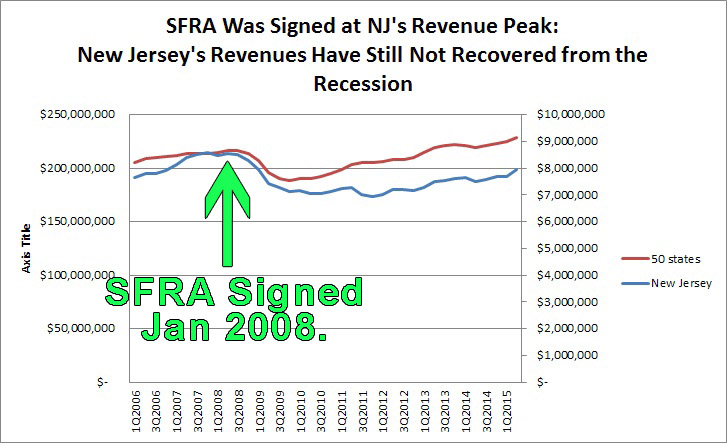
Every year NJ's state revenue increases by about $1 billion through economic growth, but pension costs, medical costs, and debt servicing costs consume all that new revenue:

Although New Jersey's non-pension debt will actually fall by a few hundred million a year, the federal copay for ACA-related Medicaid expansion is also slated to fall too, so NJ's Medicaid expenses might eat up that savings.
So David, the state is broke? Get it?
But what about "making the rich and corporations pay their fair share?"
Ok. Sure. But raising the top bracket from 8.97% to 10.75% (which would give us the country's second highest top bracket) would
only bring in $615 million and $615 million isn't even close to being enough to fully fund SFRA.
Sciarra would probably support other tax increases, like Combined Reporting, but the amount of money NJ might get from that is $100-$200 million. Perhaps Combined Reporting is appropriate (even Republican Jack Ciattarelli supports it), but Combined Reporting
was vigorously protested by businesses when Connecticut imposed it in 2015 and was one factor in GE's decision to leave the Nutmeg State.
Whatever the economic consequences are of Combined Reporting, even another $100-$200 million per year plus the $615 million per year from a higher top bracket are not enough to fully fund SFRA.
Other Education Law Center Ideas:
Aside from "Just Fund the Formula" Sciarra did present a few other ideas on charter schools and limited reductions of Adjustment Aid that I will address now:
Gradually phase out hold harmless aid [ie, Adjustment Aid] to districts that are over their SFRA
adequacy budgets and to charter schools. Charter schools should also be
required to adhere to the same 2% cap on excess fund balance as districts.
Ok, if New Jersey only eliminated "Hold Harmless Aid" that currently goes to over Adequacy districts then the total amount of aid that could be redistributed is reduced from about $550 million to less than $100 million.
Also, although the over-Adequacy districts get $174,024,179 in Adjustment Aid, they mostly undertax and therefore
they are nowhere near $174 million over Adequacy.
For instance, Asbury Park gets $24 million in (nominal) Adjustment Aid, but it is only $13.9 million above Adequacy. Hoboken gets $5.4 million in Adjustment Aid, but it is only $1.1 million above Adequacy. Pleasantville gets $14 million in Adjustment Aid, but it is only about $100,000 above Adequacy. Etc etc etc.
All in all, if New Jersey follows David Sciarra's advice and no Adjustment Aid district is allowed to sink below Adequacy, the most aid that could be redistributed is $93 million.
The nine most underaided districts alone for 2016-17 (Bound Brook, Manchester Regional, East Newark, Freehold Boro, Atlantic County Vo-Tech, Fairview, Ridgefield Park, Hi Nella, and Atlantic City) have a combined aid deficit of $103 million.
David Sciarra and the Education Law Center are very hostile to charter schools, so he basically lies about charter school surpluses to distract everyone from the injustice of Adjustment Aid. "Charter schools should also be required to adhere to the same 2% cap on excess fund balance as districts."
This Education Law Center argument against charter school surpluses goes back to a 2015 report where the Education Law Center claimed that NJ charters had
a $100 million hoard that they were unethically withholding from district schools
However, the unacknowledged context is:
- The Education Law Center looked at charter surpluses in June, when charter school surpluses are at their peak due to the need to save money for salaries in July and August, when charter schools receive no money.
- Charter schools do not receive facilities money (or very much of it) and cannot bond money, so they therefore have to save operating money for several years in order to pay for their construction needs.
In any case, charter schools' purported $100 million cumulative "surplus" is less than one-fifth the "surplus aid" that overaided districts get annually via Adjustment Aid.
Sciarra concluded with a reform to the tax cap law I agree with:
• Raise the 2% cap on increases in local property taxes for school budgets in
districts under their adequacy budgets and where there is a sizable gap
between their local revenue level (local levy) and the local fair share under the
SFRA.
Indeed. When Jersey City's tax deficit compared to its Local Fair Share is over $200 million, something is wrong. The Education Law Center should make this point more often.

However, Sciarra made this a peripheral demand compared to "Just Fund the Formula."
-------
David Sciarra began his statement praising New Jersey for ignoring "dollars available" and spending whatever Education Law Center lawyers and utopian Supreme Court judges demanded, however, a state government isn't like the federal government and eventually the money runs out. New Jersey's economic growth has been half of the national average since 2002, so the money is basically running out now.
Again, Sciarra is also wrong that NJ's state aid has been given out according to the "needs of students and schools," since the Abbott decisions only applied to the 31 Abbott districts, and poor non-Abbotts have been savagely neglected.
Finally, I can't even begin to think how Sciarra believes he is giving an honest argument when he doesn't even give the full cost of fully funding SFRA.
WHAT Steve Sweeney and others are trying to do now is finally right that wrong and restore justice and common sense to a state aid landscape that aligns to need as it was in the 1980s, not today.
The Education Law Center's opposition to this reflects how it has become a reactionary organization that opposes its original tenets. It is standing athwart common sense and justice.
---
Below: As you can see, poor non-Abbotts receive nowhere near as much state aid as Abbott districts do.
 |
| This chart does not include PreK money or construction money. |