Showing posts with label Freehold Boro. Show all posts

Friday, March 16, 2018

Despite Aid Increases, Inequalities Worsen: Phil Murphy's FY2019 Aid Proposal


UPDATED STATE AID ANALYSIS IS HERE

On Thursday, March 15th, the Murphy Department of Education, led by Asbury Park's former superintendent Lamont Repollet, released its proposed state aid figures for 2018-19.

Due to a combination of raising the income tax to 10.75% and a surge in state revenue, the Murphy administration is able to meet the next step of the Christie administration's ten-year rampup to full TPAF funding (+$392.5 million), as well as provide big increases for free community college (+$50 million), free PreK (+$57 million), and what I assume is another round of mostly Abbott construction (+$148 million in debt service)

The Murphy administration is proposing to increase K-12 operating aid by $283 million, which would be the biggest state aid increase since 2012-13. They are claiming this will bring New Jersey to full funding of SFRA, "The Governor is committed to putting New Jersey’s schools on the path to full funding within four years, and is proposing an additional $283 million in formula aid."

While that increase is worth lauding, the Murphy administration is following SFRA (almost) to the letter, including increasing Adjustment Aid for already overaided districts and utilizing SFRA's flawed design of how to distribute new aid.

Therefore, while the underfunding of state aid diminishes slightly, the inequalities of the distribution are exacerbated.

(I have calculated aid growth in dollars per student and put it online here.)
(I also have Actual Aid vs. Uncapped Aid here.)

1.  Insufficient Help Goes to the Lowest Aided

The reason the distribution is unfair to the most underaided districts in NJ is that the Murphy
administration strictly followed the State Aid Growth Limits, which restrict a district's aid gain to 10% or 20% of what it got the year before, regardless of how underaided it is.
For the 2009-2010 school year and thereafter, total stabilized aid shall include Equalization aid, Special Education categorical aid, Security Aid, and Transportation aid.
d. For the purposes of this section, “State aid growth limit” means 10% in the case of a district spending above adequacy and 20% in the case of a district spending below adequacy.
Back in 2008 the authors of SFRA were being overly optimistic about NJ's revenue growth, but Capped Aid was supposed to be an incremental step towards the goal of real, full funding, not the goal itself.

The Murphy administration, however, is treating Capped Aid as the goal in itself, is making the achievement of Capped Aid by FY2023 the goal and calling that "full funding."

Hence, the districts that are supposed to get a 20% gain in one year are stretching that out into four 5% gains.

Phil Murphy to New Jersey
"Capped Aid = Full Funding"
Because the State Aid Growth Limits are calculated based on existing aid, the lower a district's state aid is, the less money it gains in real terms.  (see "The Skews of Capped Aid")

For instance, Freehold Boro got 45% of its recommended, Uncapped Aid for 2017-18 and is underaided by over $7,675 per student.

Under the proposed State Aid distribution, Freehold Boro will gain 5% ($534,991), which equals $318 per student. Likewise, Red Bank Boro, which only gets 38% of its Uncapped Aid (-$4219 per student), will likewise only gain 5%, or $178,503, and yet that only equals $127 per student.  

Bound Brook, NJ's most underaided district in dollars per student (-$9,546 per student for 2017-18)), is gaining 5%, but that is only $300 per student.

In 2017-18 Steve Sweeney and his state aid reform allies - Paul Sarlo, Louis Greenwald, Teresa Ruiz, Joann Downey, Eric Houghtaling - based new state aid on deficits and even though they had only $130 million to work with, they delivered larger aid boosts to the most underaided districts in New Jersey.
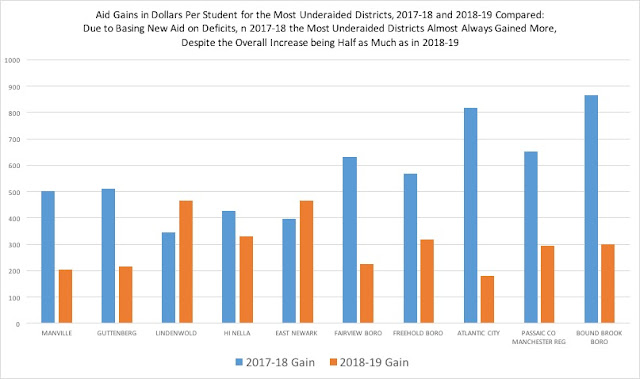


On the other hand, districts that are modestly underaided will gain far more.  

Trenton was only underaided by $2856 per student, but for it to gain 5%, equals $793 per student. 

Newark was underaided by $2852 per student for 2017-18 but its 5% gain equals $729 per student.  Paterson was only underaided by $3,062 per student but its 5% gain equals $717 per student.  

Half of all new aid will go to only thirteen districts, all Abbotts.  As usual, the Abbotts get about 55% of all new aid.

Under the Murphy/Repollet plan, any district that already gets 83% or more of its Uncapped Aid will reach full funding in four years, but districts that receive 60% or less will have to wait years, even decades.  

Since Freehold Boro receives 45% of its Uncapped Aid, At increases of 5% a year Freehold Boro will bring only be at 65% of what is its 2017-18 Uncapped Aid by FY2023. Under this pathway it would take Freehold Boro 16 years to reach what is just its 2017-18 Uncapped Aid (neglecting inflation and enrollment growth).

Some districts are even worse off. Chesterfield only got 19% of its Uncapped Aid in 2017-18. Under Murphy's planned 5% increases Chesterfield will take THIRTY SIX YEARS (2054!) to get what is only its 2017-18 Uncapped Aid.  (Chesterfield's aid increase is a paltry $52 per student)

Some districts that are underaided but nonetheless above Adequacy are the most screwed. Cherry Hill was underaided by $1397 per student, but it is gaining only $44 per student.  West Orange was underaided by $2459 per student, but is gaining a pathetic $36 per student.

Although it is a unique district, Lakewood is only gaining $239,242, or $39 per student.

2. Adjustment Aid is Sustained and Increased

Even worse than blindly obeying the flawed State Aid Growth Limits is the restoration of Adjustment Aid to about 172 already-overaided districts, for a grand total of an additional $28,604,340 increase in aid.
  • Marlboro was overaided by $5.3 million, it is gaining $270,369 (+$58 per student)
  • Pemberton was overaided by $25 million, it is gaining $658,924 (+$154 per student)
  • Brick was overaided by $23 million, it is gaining $750,798 (+$88 per student)
  • Asbury Park was overaided by $24 million, it is gaining $796,127 (+$360 per student)
  • Hopatcong was overaided by $9.2 million, it is gaining $169,007 ($109 per student)
  • East Orange was overaided by $22.5 million, it is gaining $1,114,526 (+$115 per student)
  • Jersey City was overaided by $151 million, it is gaining $1,863,714 (+$61 per student)
  • Manalapan was overaided by $13 million, it is gaining $498,300 (+$100 per student)
  • Ocean Township was overaided by $5.5 million, it is gaining $464,924 (+$175 per student)
  • Keansburg was overaided by $6.9 million, it is gaining $160,716 (+$114 per student)
Even Deal, whose Local Fair Share is $17 million for 178 students, is gaining $124,117 (+$697 per student) (this is mostly from Interdistrict Choice)

Asbury Park's state aid gain of $796,127 is actually greater than its severely underaided neighbors, Red Bank Boro (+$178,503) and Freehold Boro (+$534,991) will get COMBINED.  No wonder Asbury Park's superinintendent is "delighted."
 
Since Murphy plans to "fully fund" (ie overfund) overaided districts for another three years, the total projected gain is $84 million.  

The legal justification for increasing aid to the overaided is that Adjustment Aid technically does not allow a district to receive less than 102% of what it got in 2007-08, but Adjustment Aid was cut in 2010, 2013, and 2017.

What Phil Murphy and Lamont Repollet are trying to do is bring all these overaided districts back to their aid levels of 2008-09. Hence, since Jersey City's aid was then $417.9 million versus $410 million for 2017-18 , the Murphy administration has it on a four year path back to $417.9 million. Likewise, Asbury Park's peak aid was $57.6 million versus the $54.4 million it got in 2017-18, the Murphy adminstration has a four year path for Asbury Park back to that peak.

(See "How Overaided Districts Would GAIN Money if SFRA is Not Changed.")

If Adjustment Aid were reduced by a fifth, according to Steve Sweeney's state aid reform plan, NJ's underaided districts would be gaining an additional $128 million. ($128 million = a fifth of 2017-18's $640 million in excess aid)

3.  Ignoring SFRA When It Benefits the Overaided

Lamont Repollet has already told people that he had "no choice" but to blindly obey Adjustment Aid and the State Aid Growth Limits, but he is ignoring SFRA when it benefits overaided districts.

SFRA has no statutory sunset for Adjustment Aid, but it does allow a minimal decrease in Adjustment Aid is allowed if a district's enrollment loss after 2008 exceeds 5%.    (See "Adjustment Aid Has No Statutory Sunset")

There are actually 45 districts that SFRA calls for $9.8 million in cuts to, but Murphy/Repollet are ignoring this provision of SFRA.


DistrictSFRA Allowed Aid Loss (despite Adj. Aid)Proposed Aid Change for FY2019
Beach Haven Boro-$619$0
West Cape May Boro-$3,929$0
Lawrence Twp-$7,368$0
Deal Boro-$12,602$0
South Amboy City-$13,695$0
Califon Boro-$25,451$0
Milford Boro-$31,640$0
Union Beach-$37,569$0
Hampton Boro-$37,857$0
Upper Freehold Reg.-$47,019$0
Cape May City-$57,377$0
Elk Twp-$60,133$0
Port Republic City-$63,349$0
Montague Twp-$68,702$0
Glassboro-$71,938$0
Commercial Twp-$78,341$0
Hillsborough Twp-$81,254$0
Washington Twp-$86,701$0
Delaware Twp-$88,516$0
Downe Twp-$89,019$0
Dennis Twp-$92,124$0
Neptune City-$93,351$0
Oaklyn Boro-$98,879$0
Brooklawn Boro-$132,585$0
Lafayette Twp-$140,013$0
Frenchtown Boro-$154,323$0
East Amwell Twp-$157,165$0
Waterford Twp-$166,921$0
Byram Twp-$179,052$0
Estell Manor City-$202,559$0
Harrison Twp-$206,468$0
Roosevelt Boro-$213,779$0
Upper Pittsgrove-$252,837$0
Ogdensburg Boro-$259,688$0
Bloomsbury Boro-$286,288$0
Clinton Twp-$302,694$0
Delsea Reg. H.S Dist.-$381,559$0
Plumsted Twp-$421,093$0
Greenwich Twp-$455,185$0
Buena Regional-$546,074$0
Tuckerton Boro-$565,991$0
Lower Cape May Reg.-$761,881$0
Clearview Regional-$824,053$0
Freehold Regional-$885,391$0
Hoboken City-$1,069,199$0
Total-$9,812,231$0

Conclusion

New Jersey is proposing to increase income taxes by $765 million and income taxes are actually surging, but only $283 million of that is going into K-12 state aid.

Increasing funding for NJ's many streams of indirect aid - TPAF, post-retirement medical, and construction debt service - is required, and Phil Murpy has a mandate by his electoral victory to increase PreK and community college aid as he wants.

However, Phil Murphy repeatedly promised to "fully fund that formula" and what he is doing will not bring New Jersey anywhere near to that point, and in fact, will preserve inequalities and in many cases, make them worse.  By completely ignoring the legislature's work last year to expose and fix state aid inequalities, he is trying to govern without the input of Democtatic officials who are actually more knowledgeable on state aid than he is.

All of us in the state aid reform community have our work cut out for us in explaining to the public, elected officials, and journalists why the proposed increases have to be changed.

-----

See Also


Wednesday, December 23, 2015

Administrative Law Judge recommends that Freehold Boro's voters be Overruled on Bond Referendum


Administrative Law Judge Susan Scarola has recommended that Commissioner of Education David Hespe overrule the voters of Freehold Boro and authorize a $32.9 million bond in order to expand school capacity in what has become New Jersey's most overcrowded school district.


No one disputes that crowding is intense in Freehold Boro. The district's schools were built to educate 1,148 students but now educate 1,700 students. Freehold Boro's response to this has been to convert libraries into classrooms (with no walls separating the classes), bus about 200 students to Freehold Township, and "packing students on top of each other."


(Freehold Boro rents the six classrooms from Freehold Township at $120,000, or $20,000 per classroom, or $111 per classroom per day. Freehold Township is able to rent the space to Freehold Boro because Freehold Township's student population has fallen by over 500 students since 2010. (and yet it has not lost aid because of that))


In low turnout elections, Freehold Boro's voters have twice rejected bonding $32.9 million to build 23 new classrooms, a cafeteria and more gym space.


Although the rejection of the bonding is disappointing, it is entirely understandable since Freehold Boro's taxes are already 10% above Local Fair Share and its municipal taxes are fairly high as well. In 2015, Freehold Boro's Effective Tax Rate the fifth highest in Monmouth County. Also, Freehold Boro's voters are well aware that Freehold Boro's schools are ripped off in state aid and believe that they - the taxpayers of Freehold Boro - are being unfairly asked to carry the burden of a very poor, non-English speaking population.


The tax impact of the bonding would be $278 per year on an average tax bill which is now only $6,175.

State Senator Jennifer Beck (R) agrees with Freehold Boro's voters on state aid, clearly saying:

“It is unconscionable to me that the state would hinder the ability of Freehold Borough to educate its children adding it is the “responsibility of the state, not local taxpayers.”

Freehold Boro's Board of Education and Superintendent know Freehold Boro's taxes are already high. They also know that even if David Hespe approves their request that the money will do nothing to address Freehold Boro's inadequate operating aid and the town cannot pay higher taxes on top of the tax increase that may come from the bonding.  Thus Freehold Boro's school leadership has also asked Judge Scarola for more state aid:

Freehold Borough Superintendent of Schools Rocco Tomazic spoke with passion and conviction during a public hearing before Administrative Law Judge Susan Scarola and cited the reasons why the Freehold Borough K-8 School District needs help from the state to provide a thorough and efficient education to the town’s children as mandated by law.


However, based on what I have read about Judge Scalora's decision (see here and here), the Judge only recommended that David Hespe give permission to Freehold Boro to bond the $32.9 million. The reporting could be incomplete, but it seems like Judge Scalora was silent on state aid.

Nonetheless, Freehold Boro's Board of Education and Superintendent Rocco Tomazic say that they will continue to work to receive more state aid. "We are also continuing our work with legislators and the Department of Education to address our state aid underfunding." 
Freehold Boro's state aid/tax situation is all the more glaringly awful because it is in Monmouth County, home of some of New Jersey's most savage aid inequalities.

Monmouth County contains several of New Jersey's worst aid hoarders, including Asbury Park ($23.4 million in excess aid), Freehold Regional ($20.2 million in excess aid), Manalapan-Englishtown Regional ($12 million in excess aid), Keansburg ($9.3 million in excess aid.)  
The excess aid Asbury Park gets annually is two-thirds of the money that Freehold Boro needs to bond.  


The decision to overrule Freehold Boro's voters and authorize a large tax increase is a difficult one, but Freehold Boro's aid situation is appallingly unfair and is a shame of the state.  It is also an illustration of the deep unfairness of the Abbott Regime and the continuing all-or-nothing (or all or 38% to be literal) nature of NJ Supreme Court's mandate on construction aid.


----

Please, if you want to help Freehold Boro and other underaided districts, please sign this state aid petition from Our Fair Share!

----

See Also:

"Freehold Boro: Where Children Are Packed On Top of Each Other."

"Freehold Boro: Where Population Growth and Stagnant Aid Collide in the Worst Way"


Monday, October 26, 2015

Freehold Boro: "We asked for help, the answer was silence."

Senate President Steven Sweeney, accompanied by Jennifer Beck (R) and Teresa Ruiz,  just visited Freehold Boro, where they toured the schools.


Freehold Boro is underaided by $8,113 per student, making Freehold Boro one of the five most undreaided districts in New Jersey.  Freehold Boro's schools were built to house 1,100 students but now are forced to try to house 1,600 students.  Freehold Boro has dealt with this population growth by converting labs and libraries to regular classrooms and renting space in other districts at large expense.

Freehold Boro has had two referenda to bond more money to expand the schools, but these referenda have been rejected.  Since Freehold Boro is already taxed above its Local Fair Share, these rejections are disappointing, but understandable.

The two Democrats wanted to talk about early childhood education and some expansion of Pre-K that Freehold Boro has recently received.

“There’s no doubt that the sooner you get a child, and you start educating the child, the stronger the child is going to be,” Sweeney said.
“I think we’re shortsighted when we think about the early interventions, ELL, even special ed., what you can do to change a child’s life that will cost us much better in academic interventions later in life as a resource to working families what we can do,” Ruiz said.
But what their hosts in Freehold Boro wanted to talk about was K-12 education and the state's savage underaiding of Freehold Boro.

"We're here at the end of our rope, we don't know what to do. The people in this town have twice said we cannot afford the taxes needed," Councilwoman Sharon Shutzer told the senators. The district asked local taxpayers last year to approve a $32.9 million spending plan to build more classroom space and relieve chronic overcrowding. Voters rejected the measure twice. 
"The heartbreak in Freehold Borough is we have this grant where we're able to take care of these (pre-K) children," said Shutzer. "But we're not able to take care of the rest of them." 
The senators said they were working to fix the school funding issue but remained focus on preschool as a much-needed investment. 
"We’re here to recognize that you're overcapacity and there's a critical need and you're doing a job well done," said Ruiz. "We’re here to focus on the programming here and figure out how we can expand it and make it better."

The vice president of the Freehold Boro BOE reminded Sweeney and Ruiz that other districts with dropping enrollments are seeing their aid stay constant while Freehold Boro, whose population is increasing tremendously, gets no new money at all.

"We are not able to give the children of this town a thorough and efficient education. ... We did not create this problem that exists, with the influx and the overcrowding. We did not create it, and we do not have the power to fix it," she said. "And yet, the State of New Jersey and the federal government have all said: 'Fix it. You are charged with giving these kids a thorough and efficient education.' And we cannot do it. This town cannot afford it!" 
Shutzer said the district's overcrowding issues are not new and that Freehold Borough representatives, including Beck, boarded a bus in yellow shirts several years ago to petition the state for help. 
"We saw this coming, we asked for help ... and our answer was a silence that was deafening," she said. "I am appalled. I think this was supposed to be a positive meeting. But you know what? We're here at the end of our rope."

Jennifer Beck, the Republican who represents Freehold Boro in Trenton, agreed on the focus on K-12 aid.

“We have 500 more students in our schools than the state actually will allow. We are overcrowded to a point where there’s not a library in the Park Avenue school and kids are being taught where ever they can find space,” Beck said.
Steven Sweeney and Teresa Ruiz had wanted to talk about Pre-K, but Sweeney acknowledged that Freehold Boro's problems were real and made an economy-based assessment of why SFRA is underfunded.   (As opposed to the Education Law Center, which puts all the blame on Christie for SFRA being underfunded.)

Sweeney said the senators knew what they were walking into when they chose to visit a Freehold Borough school as part of their initiative, and weren't planning on a "feel good" meeting. 
"We're not asking anyone to tell us that the sun's shining when it's raining, we're really not," he said. "The point is we know we have an issue with funding, we know that. And we know that if we had fully funded the school funding formula, and if the economy was better, things would be much better for everyone."

Freehold Boro pointed out to Sweeney and Ruiz that the matter wasn't only a lack of money for SFRA, the problem was how the money was distributed.

"Towns around us are having their enrollment decline and their funding stays the same. Meanwhile our enrollment continues to go up and we're spending less, yet we're being asked to do the same and more," Susan Greitz, vice president of the school board, told the senators. "It almost feels like we're being penalized ... it's very frustrating."


After multiple complaints from Freehold Boro BOE members and staff, Steven Sweeney let out a glimmer of awareness that of how unfair the distribution is

"None of that is lost on us and we want to be fair with it," added Sweeney. "There's going to be other discussions about school funding as we go forward to try to be more fair. We gotta make sure ... money is getting put in places in districts that are growing that don't receive additional funding and you have districts that are decreasing and are receiving the same."

I'm glad that Sweeney talked about districts with dropping enrollment maintaining their old aid levels.  This is certainly a problem, especially with Asbury Park's aid, but declining enrollment districts maintaining aid is only half of the problem with overaiding.  The other half of overaided districts are ones whose student populations are stable or slightly growing, but whose wealth has dramatically increased and therefore have the ability to pay for a much higher share of their schools than they used to.   Sweeney was speaking extemporaneously and in response to a question about declining-enrollment districts, and I'll cut him some slack, but Sweeney's comment doesn't completely frame overaiding correctly.

The problem for Freehold Boro isn't that the state hasn't increased its aid: In fact, Freehold Boro gets double now ($9.6 million) what it got in 2006-07 (then $4.9 million).  Freehold Boro's population has increased by 20% since 2006-07, but the state aid increase is even larger.

Freehold Boro's problem is that it started from a very, very low base. Even the $4.9 million that Freehold Boro got back in 2006-07 was only $3562 per student, even though Freehold Boro was then in DFG B.


Freehold Boro's problem thus underscore the unfairness the Abbott decision.  Keansburg then got $14,700 per student.  Long Branch then got $7800.  Neptune Township then got $7,800 per student.  Asbury Park then got $19,800 per student.  Even though Freehold Boro's aid has increased to $5,940 per student and that represents a large increase in percentage and per student terms, Freehold Boro's base was so low that the increase is inadequate.

Overall, this is how one reporter summarized the visit:

There were slightly different agendas at work here today. The Democrats promoting their early childhood initiative. The district and its Republican senator calling attention to the overcrowding and underfunding in this largely Hispanic district. As the superintendent said, it’s nice to have in the room the people who just might be able to help us out.

Thursday, October 15, 2015

Abbott and Adjustment Aid at Their Most Extreme: The Overaiding of Asbury Park

Greetings from Asbury Park!  Where the boardwalk is cool, the beach is wide, rock & roll history is everywhere, the restaurants hip, and the schools are tops in New Jersey in state aid, getting $55.4 million for 2350 K-12 kids, a record setting $23,567 per student! 

Asbury Park represents Abbott funding and Adjustment Aid at their most extreme and unjust.  I often criticize the disparities between Abbotts and equally poor (or poorer) non-Abbotts, but the case of Asbury Park is an example of disparities between Abbotts themselves.  

Yes, I am going to criticize the amount of aid Asbury Park gets, but this doesn't mean that I think Asbury Park shouldn't have an above-average amount of money.  The percentage of Asbury Park's students who are Free & Reduced Lunch eligible is 93%, the fifth highest in New Jersey. Additionally, 9% of Asbury Park's students are classified as having "Limited English," which is significantly above the state's 5% average (although below the average for DFG A)  

However, even given these facts about its challenging demographics, it is difficult to how Asbury Park's state aid is fair when its demographic peers get nowhere near as much money.  The next highest aided Abbott district, Camden, "only" gets $17,768 per student, nearly $6,000 per student less than Asbury Park! 


A couple of these districts, like Seaside Heights, Wildwood City, and Atlantic City have good tax bases and can use local revenue to produce adequate spending, but most cannot do this, especially Red Bank Boro, East Newark, Woodlynne, Lakewood, and Prospect Park.


To add to the unfairness of Asbury Park's exceptional state aid, it actually has a better tax base than most of its peers.

Asbury Park has an Equalized Valuation of $1,424,689,394, or a little over $600,000 per student, a figure which is below average, but above what Belleville and many non-Abbotts have.

Asbury Park Local Fair Share equals $16,502,549, or about $7,000 per student, again, below the state's average, but not that far below average that it justifies $23,567 per student in state aid.

Almost none of the Abbotts tax themselves anywhere near their Local Fair Share,  butAsbury Park taps less than a third of its Local Fair Share for a Local Tax Levy of $6,505,623, or $2,768 per student, which is low even compared to the other Abbotts.  Asbury Park recently had a three year streak of not raising taxes at all.

Though Asbury Park is below the state's average for tax base, Asbury Park is above most of its demographic peers in local resources.  If New Jersey's state aid were rational, Asbury Park would get less money than most of the other Abbotts, not significantly more.


(The above chart shows how strong a claim Woodlynne, Prospect Park, and possibly East Newark have to Abbott status.)

How Did Asbury Park Get Here?
I admit I am not completely sure how Asbury Park's aid became so high. The rampup of Asbury Park's spending came during the Big Abbott Decade of 1996-2006, when Asbury Park increased by 243%, compared to an Abbott average of 202%.  However, Asbury Park did not get the largest increase among the Abbott districts.  

One reason for Asbury Park's aid becoming so high in per pupil terms is that it has lost student population.  Unfortunately information on student enrollment is not available online prior to 2006-2007, but since 2006-2007 Asbury Park's student population has fallen from 2,700 to 2,350, or 13% and I know the decline goes back much farther than that. As that decline has occurred, Asbury Park has not lost state aid proportionally, thereby driving up per pupil aid levels and its spending.  

Yet another reason Asbury Park's aid is so high is that prior to SFRA the Abbott districts could request/demand supplemental funds from the state that were outside of the aid formula.  Asbury Park may have been more aggressive than most of the other Abbotts in pursuing this supplemental money.  

Asbury Park was involved in litigation against the state even outside of the neverending Abbott lawsuit.


Adjustment Aid = "Hold Harmless" money = Aid Hoarding

SFRA ended the Abbott privilege of being able to seek supplemental funds, but the funds Abbott districts already had were baked into Adjustment Aid, which is the major cause of Asbury Park's aid remaining so high.

If Asbury Park got only the amount of Equalization Aid, Special Education Aid, Security Aid, and Transportation Aid that SFRA recommended for it, Asbury Park's aid would be about $13,000 per pupil.  


The huge Adjustment Aid that Asbury Park gets, $24,422,872, puts Asbury Park in the #1 position for Most Overaided District in New Jersey.

Asbury Park's Adjustment Aid alone is higher than the aid high-FRL non-Abbotts Freehold Boro, Red Bank Boro, East Newark, and Woodlynne get combined.

DistrictCountyExcess Aid, Compared to Uncapped Aid Per Student
Asbury ParkMonmouth$9,995
Cape May PointCape May$8,349
Dennis TownshipCape May$8,165
KeansburgMonmouth$7,008
Ocean TownshipOcean$6,203
Pemberton TownshipBurlington$6,188
Washington TownshipBurlington$6,188
Greenwich TownshipCumberland$5,667
HopatcongSussex$5,429
Estell Manor CityAtlantic$5,043
Woodbine BoroCape May$4,680
Lower Cape May RegionalCape May$4,607
AllenhurstMonmouth$4,387
Weymouth TownshipAtlantic$4,031
Seaside Park BoroOcean$4,020
Hampton BoroHunterdon$3,957
Jersey CityHudson$3,551
Corbin CityAtlantic$3,448
Lower Alloways CreekSalem$3,321
Tabernacle TownshipBurlington$3,182
Bass River TownshipBurlington$3,144
Lakeland RegionalPassaic$3,085
Frankford TownshipSussex$3,006

Despite its unbelievably high school spending, Asbury Park's schools are very low performing.  Asbury Park High School is at the 3rd percentile statewide.  Its other schools are at the 3rd, 3rd, and 1st percentage statewide.  

Even compared to their demographic peers Asbury Park's schools do very badly.  Asbury Park High School underperforms all but 8% of its peers, all of whom are lower spending than Asbury Park.  Asbury Park's other schools do just as badly.  

Asbury Park's schools do poorly by other measures too.
[The high school] has a 49 percent graduation rate. Only 2 percent of the senior class scored higher than 1550 on their SAT's, a measure of college and career readiness. This systemic failure doesn't start in high school: 87 percent of third graders can't read at grade level and 47 percent fail the basic skills test in math.
Asbury Park underperforms even Lakewood, whose schools spend less than half as much in the classroom as Asbury Park, where few kids get Pre-K, and whose system is notorious for bad management.  

Asbury Park dramatically underperforms East Newark, whose Total Budgetary Cost per pupil is under $10,000 per student, only one third of Asbury Park's.

When Asbury Park does this badly compared to significantly less well financed peers, I conclude that there comes a limit to how much good more money can do, especially when more money falls into an inefficiently run school district.

Yes, in 1990 when the Abbott II decision was handed down the Abbott districts needed more money - just like many poor districts now need more money - but NJ Supreme Court's "Parity Plus" doctrine where the Abbott plaintiffs had a constitutional right to be funded above the level of the most affluent districts has not been good policy.  In the case of Asbury Park it's been insane.

Glaring Injustice in Monmouth County

What is glaringly wrong about Asbury Park is that it is so close to Red Bank Boro and Freehold Boro, two of New Jersey's most rapidly growing and thus underfunded and underaided districts. 


The Freehold Borough school district is emblematic of the many districts across New Jersey that are struggling to meet the academic and social needs of their students as a result of years of underfunding by the State. Rapid population growth has the district facing severe overcrowding without the resources to increase staff and facilities to appropriately serve all students. 
The district currently has class sizes that exceed the minimums required for “high need” districts at all early elementary grades. For example, there are 25 students in kindergarten and first grade classes and one second grade class with 30 students, far above the 21 student threshold.
Freehold Borough students are also deprived of many of the supports, including reading interventionists and special education staff, that are necessary to ensure they read on grade level, a skill that is critical to their success in school.... 
Freehold Borough in Monmouth County is a preschool-8th grade district with a current enrollment of just over 1,580 students. Enrollment has increased 43% since 1998-99. Student demographics have also changed dramatically, with a doubling of the number of at-risk (low-income) students and a fourfold increase in Hispanic students. Over three-quarters of the district’s students are now low-income, up from 51% in 1998-99.


"We are educating an increased number of students with the same amount of money," Howe said. "I don't want to say our students aren't doing well... but certainly they could benefit if we got more money in state aid."

Asbury Park gets over 18 times more state money than Red Bank Boro and over six times more money than Freehold Boro.

Will the state stand for that even if Red Bank Boro and Freehold Boro equal Asbury Park in size?

It looks like it.  The populations of Red Bank Boro and Freehold Boro have already converged with Asbury Park's and there is no Democrat that I know of who supports redistribution.  Since leading Democrats have now given up on fully funding SFRA and the caucus would rather give $1 million to Montclair than any of New Jersey's most underaided districts, it seems that there is not much hope for Red Bank Boro and Freehold Boro.

How is it that a Republican, Caroline Casagrande, who seems to have an economically viable proposal to help?

“The children (in Freehold) are grossly under adequacy,” said Casagrande. She called it "maddening" that 31 urban districts, formerly known as Abbott districts, absorb 60 percent of all school funding. “Our school dollars are still fully locked up in who was impoverished in 1986; leadership in both the Senate and Assembly have blocked reforms to redistribute those funds. It’s such an injustice.”

---

See Also: