Note, this was written before Coronavirus. It was accurate back in February, but the parts about aid gains are inaccurate now because the $336 million in new revenue was cancelled.
Updated state aid disparities are here. The 2020-21 deficit for underaided districts will be $1.9 billion.
2020-21's state aid distribution is the fourth year of New Jersey's attempt to bring equality to NJ's K-12 state aid through the combination of increasing the overall state aid package and redistributing Adjustment Aid from overaided districts to underaided districts, with Phil Murphy's proposed $491 million increase the largest increase NJ's schools have gotten since the 2011-12 Great Recession rebound year, but with the new aid focused on NJ's most severely underaided districts.
I admit that back in the 2016-2017 gubernatorial campaign, I had doubts about Phil Murphy's commitment to state aid equality, but the 2020-21 budget, which cuts Adjustment Aid by $155 million, puts those doubts to rest.
Starting with Chris Christie's final budget in 2017-18 and including 2020-21, New Jersey has now redistributed $307 million in Adjustment Aid. The combination of that $307 million plus $1.3 billion in new state aid has dramatically reduced the number of districts who are severely underaided, from 50 districts with deficits over $4,000 a student in 2016-17, to only fifteen in 2020-21.
Looking at all districts, if New Jersey can provide the money promised in Phil Murphy's February 25th budget speech, the median district is only underaided by $331 per student, a recent low. Back in 2016-17 and 2017-18, the median deficit was over $500 per student. The median district now gets 88% of its SFRA aid target too, a recent record, compared to the median district getting less than 85% four years ago.
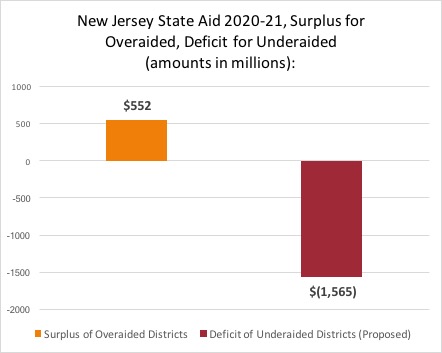
Despite the $491 million proposed infusion of aid into the underaided districts, their deficit only shrank by $220 million, from $1.78 billion in 2019-20 to $1.56 billion for 2020-21, due to the dynamic nature of district needs and the constant increase of Adequacy Budgets.

The Overaided:
There are 216 overaided students, with a total of 324,154 students, down from 342,275 in 2019. The overaided districts have a surplus of $552 million. ($1612 per student, weighted average)

- There are twelve districts with surpluses over $4,000 per pupil, with Asbury Park at the most overaided, at $8,138 per pupil.
- There are ten districts with a surplus of $3,000 to $3,999 per pupil.
- There are 34 districts with a surplus $2,000 to $2,999 per pupil.
- There are 61 districts with a surplus of $1,000 to $1,999 per pupil.
Weymouth Township in Atlantic County will get 527% of its recommended state aid, or $1,319,479 when SFRA says it only needs $309,300, making it the most overaided in percentage terms of operating districts.
I exclude Interdistrict Choice money from my comparisons because Interdistrict Choice money is outside of SFRA, but if I included Choice money, Deal would be NJ's most overaided, receiving over 1,000% of its recommended state aid.
I will now profile specific state aid information for three overaided districts, Asbury Park, Pemberton, and Jersey City.
Asbury Park Starts to Meet Reality
Asbury Park has long been ridiculously overfunded and overaided. The fact that Asbury Park was literally America's highest-spending district among K-12s with more than 500 students and was academically in NJ's bottom 5%, is one of several pieces of evidence that the premise of Abbottism where exceptionally high-spending can be transformative is wrong.
Some Democrats acknowledge that excessive spending has failed in Asbury Park, but Asbury Park became the Republican poster child for Abbott waste, and the favorite Republican talking point to argue that NJ needed to change state aid.
S2 has already lowered Asbury Park's state aid from $55.4 million to $44.6 million, from 2016-17 to 2020-21. In dollars per student, Asbury Park's state aid has fallen from $24,258 to $20,965 per student.

Yet, since S2 is lowering Asbury Park's state aid, it's disappointing to see Republicans condemn all of the $155 million in Adjustment Aid redistribution, without any attempt to have a nuanced view.
EG, Assemblyman Brian Bergen provides an example of this anti-conservativism. Although most districts in Bergen's District 25 are gaining state aid, Bergen condemns all redistribution
I will now profile specific state aid information for three overaided districts, Asbury Park, Pemberton, and Jersey City.
Asbury Park Starts to Meet Reality
Asbury Park has long been ridiculously overfunded and overaided. The fact that Asbury Park was literally America's highest-spending district among K-12s with more than 500 students and was academically in NJ's bottom 5%, is one of several pieces of evidence that the premise of Abbottism where exceptionally high-spending can be transformative is wrong.
Some Democrats acknowledge that excessive spending has failed in Asbury Park, but Asbury Park became the Republican poster child for Abbott waste, and the favorite Republican talking point to argue that NJ needed to change state aid.
S2 has already lowered Asbury Park's state aid from $55.4 million to $44.6 million, from 2016-17 to 2020-21. In dollars per student, Asbury Park's state aid has fallen from $24,258 to $20,965 per student.

Yet, since S2 is lowering Asbury Park's state aid, it's disappointing to see Republicans condemn all of the $155 million in Adjustment Aid redistribution, without any attempt to have a nuanced view.
EG, Assemblyman Brian Bergen provides an example of this anti-conservativism. Although most districts in Bergen's District 25 are gaining state aid, Bergen condemns all redistribution
MORRIS PLAINS, N.J. – Gov. Phil Murphy’s proposed spending plan has nearly 200 school districts across the state losing $155 million in aid. Assemblyman Brian Bergen, who represents parts of Morris and Somerset counties as part of the 25th legislative district, which is losing more than $3.7 million, wants the governor to fully fund schools.
“Only 64 percent of schools are getting increases, the rest will remain flat or continue to lose millions as part of a failed school funding formula that is hurting districts across the state,” said Bergen (R-Morris). “Among the towns I represent, there are five school districts facing a cut of more than $3.7 million and this is on top of what they lost last year.”If Republicans are supposed to be the defenders of state taxpayers, why are they implicitly condemning redistribution which saves state taxpayers tens of millions a year, including normalizing education spending in NJ's most inefficient district?
The Pemberton State Aid Issue
Pemberton is not a high-profile district, it has consistently been one of New Jersey's most overaided districts, with a surplus of $36 million ($7900 per student) in SFRA's first year of 2008-09 and still possessing a $18.2 million surplus, the sixth most, ($4,248 per student), in 2019-20.
Pemberton made state headlines this March because it was the subject of an error by the Department of Education where the DOE used 2018 data on a district's total tax rate and therefore missed that Pemberton now had an above-average tax rate and had therefore reached S2's exemption from Adjustment Aid cuts for Abbott SDA districts.
Although much was made of the DOE's error and it made New Jersey give an an additional $2.2 million to Pemberton (so Pemberton's state aid surplus is $4,152 per student), the real mistakes are:
Regarding the last point, S2 created difference standards to protect Adjustment Aid for Abbotts and non-Abbotts.
This is the Abbott threshold for Adjustment Aid preservation that applies to Pemberton, even though Pemberton doesn't meet the NJ Supreme Court's Abbott standard anyway.
And this is the threshold for Adjustment Aid preservation in non-Abbotts.
Pemberton Township has a 2.293 tax rate and Pemberton Borough has a 1.909 tax rate, and residents of both towns get "free" PreK for their kids.
Pemberton is not a high-profile district, it has consistently been one of New Jersey's most overaided districts, with a surplus of $36 million ($7900 per student) in SFRA's first year of 2008-09 and still possessing a $18.2 million surplus, the sixth most, ($4,248 per student), in 2019-20.
Although much was made of the DOE's error and it made New Jersey give an an additional $2.2 million to Pemberton (so Pemberton's state aid surplus is $4,152 per student), the real mistakes are:
- The New Jersey Supreme Court's rigid & artificial division of low-income districts into Abbotts and non-Abbotts, where the only difference is that Abbotts were ranked as DFG A or B according to the 1980 Census and also had the Department of Community Affairs's "urban status." (See the "The Abbott List Has Always Been Unfair")
- Pemberton's continuing inclusion on the Abbott list, despite the fact that it was placed in DFG CD after the 1990 Census
- SFRA and S2's continuation of various privileges for Abbotts.
Regarding the last point, S2 created difference standards to protect Adjustment Aid for Abbotts and non-Abbotts.
This is the Abbott threshold for Adjustment Aid preservation that applies to Pemberton, even though Pemberton doesn't meet the NJ Supreme Court's Abbott standard anyway.
(2) An SDA district that is located in a municipality in which the equalized total tax rate is greater than the Statewide average equalized total tax rate for the most recent available calendar year and is spending above adequacy as calculated pursuant to section 1 of P.L.2018, c.67 (C.18A:7F-70) shall be subject to a reduction not to exceed the amount by which the district is spending above adequacy multiplied by the corresponding percentage included in subsection b. of this section
And this is the threshold for Adjustment Aid preservation in non-Abbotts.
(3) A school district, other than an SDA district, that is located in a municipality in which the equalized total tax rate is at least 10 percent greater than the Statewide average equalized total tax rate for the most recent available calendar year and is spending at least 10 percent below adequacy.
Moreover, Pemberton's taxes are only trivially above New Jersey's average, so there is no "municipal overburden" issue.
New Jersey's average equalized tax rate is 2.276.
New Jersey's average equalized tax rate is 2.276.
Pemberton Township has a 2.293 tax rate and Pemberton Borough has a 1.909 tax rate, and residents of both towns get "free" PreK for their kids.
So multiple articles and tweets were published after the Department of Education made a mistake with Pemberton's state aid, but Abbottist jurisprudence and S2 are where the substantive mistakes lie.
Jersey City's Economic Boom
Powered by its surging tax base, income, and upward tweaks to the Local Fair Share formula, Jersey
City's Local Fair Share grew from $474 million to $522 million (+10%) which is $16,960 per student, which is the same as districts often considered "wealthy," such as South Orange-Maplewood, Freehold Township, Glen Rock, Sparta, Parsippany, and Metuchen.
To put it another way, Jersey City has only 2.3% of NJ's K-12 students, it has 2.7% of the tax base.
Powered by its surging tax base, income, and upward tweaks to the Local Fair Share formula, Jersey
 |
| Jersey City's tax base is now equal to suburbs usually considered to be wealthy. |
To put it another way, Jersey City has only 2.3% of NJ's K-12 students, it has 2.7% of the tax base.
Jersey City, unlike the suburban districts above, has poorer students, so it does get Equalization Aid ($91.4 million for 2020-21), but its tax base is growing so quickly that in only two years it will be ineligible for Equalization Aid and that Equalization Aid will become Adjustment Aid that is then eliminated.
Note: although Jersey City's state aid has been cut by $86 million in the past four years, its tax base growth has been more rapid than its Adjustment Aid cuts, hence, it has become more overaided, not less.
The Overaided Surplus has Shrunk by Less than the Adjustment Aid Reduction
The overaided districts have a total surplus of $551,589,097, which is lower than 2019-20's $640 million surplus, although the reduction is less than $155 million in lost Adjustment Aid.
The overaided districts have a total surplus of $551,589,097, which is lower than 2019-20's $640 million surplus, although the reduction is less than $155 million in lost Adjustment Aid.
The steady rebound of Adjustment Aid despite four years of losses
Why? Local Fair Share growth and further enrollment loss.
This is because S2 bases the cut on Adjustment Aid on the "state aid differential" for the upcoming school year, 2020-21. When the DOE calculated state aid for 2020-21, they must have originally had overaided districts with a $707 million surplus, and then reduced that by 23%, in accordance with the stipulations of S2.
Again, Jersey City's tax base growth merits special attention. From 2019-20 to 2020-21, Jersey City'sLocal Fair Share grew from $474,039,468 to $522,089,435 (+$48 million), while its Adequacy Budget fell from $623 million to $614 million. As Jersey City's Equalization Aid fell, it was converted to Adjustment Aid, which then became subject to S2's 23% reduction requirement.
Note, although the surplus is $551.6 million, not all of that is subject to redistribution, due to provisions in S2 that protect vo-techs and Abbotts (like Pemberton) and non-Abbotts with higher-than-average taxes.
Again, Jersey City's tax base growth merits special attention. From 2019-20 to 2020-21, Jersey City'sLocal Fair Share grew from $474,039,468 to $522,089,435 (+$48 million), while its Adequacy Budget fell from $623 million to $614 million. As Jersey City's Equalization Aid fell, it was converted to Adjustment Aid, which then became subject to S2's 23% reduction requirement.
Note, although the surplus is $551.6 million, not all of that is subject to redistribution, due to provisions in S2 that protect vo-techs and Abbotts (like Pemberton) and non-Abbotts with higher-than-average taxes.
The Underaided:
There are 44 districts with deficits between $1,000 and $1,999 per pupil.There are 34 districts with deficits between $2,000 and $2,999 per pupil.There are 23 districts with deficits between $3,000 and $3,999 per pupil.There are fifteen districts with deficits more than $4,000 per pupil.
For some of the above districts, the deficits remain large due to some combination of steady (weighted) enrollment growth combined with income loss or tax base erosion.
But to focus on the good news, the districts who were the most severely underaided in 2016-17 have made steady gains, with the important exception of Atlantic City.
--------


