Showing posts with label 2017 gubernatorial race. Show all posts

Thursday, June 15, 2017

Kim Guadagno's Circuit Breaker: Positives and Negatives


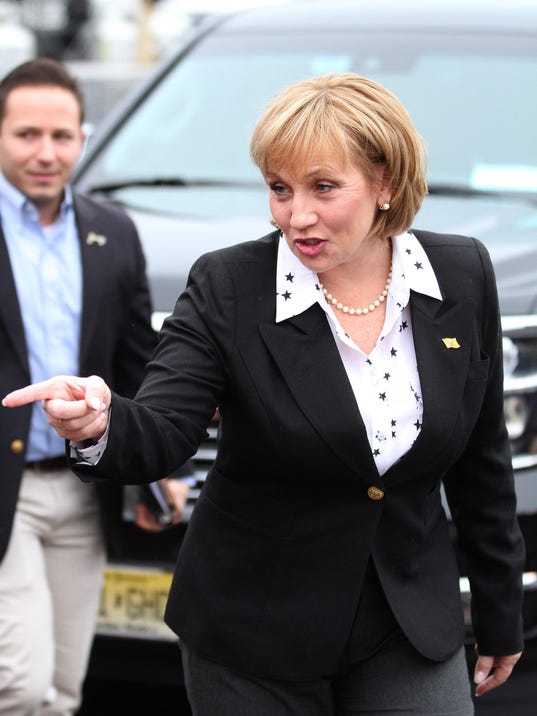
Kim Guadagno is making a property tax relief proposal she calls a "circuit breaker" the centerpiece of her campaign for governor.

Guadagno's proposal is that all New Jersey residents have the school portion of their property taxes capped at 5% of income, with taxes due in
excess of that now assumed by the state.

As Guadagno's campaign explains it:

This innovative program would cap the school portion of a homeowner’s property tax bill to 5% of their household income, ensuring no New Jersey family would have to leave our state due to untenable property taxes. For instance, if a household makes $100,000 in income annually, they would not pay more than 5%, or $5,000, towards the school portion of their property tax. Any amount owed in excess of the 5% circuit breaker threshold will be applied directly to the homeowner’s property tax bill as a credit. So if the same family making $100,000 a year has a school property tax bill of $6,000 annually, they would receive a $1,000 credit. The school districts would then receive increased state aid to cover the cost of the credit so no school districts lose funding. 
Under this program, a family making New Jersey’s median household income of $72,000 will save an average of $895 on their property taxes annually. This proposal will apply to primary residences only and be capped at $3,000 annually. While the Homestead and Senior Freeze programs will remain in effect. homeowners will only be able to qualify for one program at a time and be able to choose the relief program that best meets their needs.
The state reimbursement would be capped at $3,000, so it is possible that certain households who have high property:income ratios would still pay over 5% of income in school taxes, but for most non-renters, taxes would be capped at 5%.

Overall, Guadagno's proposal would make NJ school funding more income-tax based than property-tax based, since the "Property Tax Relief Fund" comes from income taxes, and so make school taxation more progressive.

Guadagno's own staff estimates the cost at $1.5 billion, which Guadagno says could come from "auditing Trenton," eliminating existing property-tax rebates, and economic growth.

Since Guadagno came out with her circuit-breaker in April 2017 most of the criticism of it has been that Guadagno has underexplained where the state money would come from, since Guadagno rules out any tax increases (although that criticism applies to Phil Murphy and his agenda.)

Anyway, this is a look at some of the positives and negatives of Guadagno's proposal that I feel haven't gotten any attention.

The Good Things

It hasn't been independently verified that the circuit breaker would cost $1.5 billion per year, but assuming that amount is indeed the cost and assuming that Guadagno actually could find that $1.5 billion, this proposal would deliver real tax relief to the most overburdened taxpayers in New Jersey.

If a governor poured another $1.5 billion into SFRA the tax relief would probably be extremely limited, since Boards of Education would spend a large portion of their new money and/or teacher contracts would gradually consume whatever new revenue exists too.  If the money actually were directly given to households, people would end up with more money in their pockets.

The Bad Things

The Circuit Breaker's Not Looking Good,
Even if Guadagno Could Fund It
Since, under Guadagno's proposal, the state pays taxes in excess of 5% of income, Boards of Education would likely lose restraint in tax levy increases, since now their most overtaxed non-renters are protected by the state.

Very few Board of Education members are economically conservative, but they are aware that their communities have residents who can barely afford their homes and weigh that fact in determining what the tax levy increase should be.

Under a state-funded circuit breaker, Boards of Education now have a blank check to be cashed on the state's bank account and that restraint is gone.

Although NJ has a tax cap, tax increases are still not limited to 2% due to health care and enrollment adjustments and an electorate can vote to increase taxes to whatever amount it wants.

This means that the costs of the circuit breaker would increase fairly rapidly from the initial $1.5 billion.

What if there is a recession?

If the state started to put at least $1.5 billion into this tax rebate program it would have less money available to fund school districts, as well as other obligations.  Guadagno does support reducing Adjustment Aid and making cost-savings reforms to PreK and Abbott construction, but still, New Jersey's 369 underaided school districts have a deficit of $2.1 billion for 2017-18, so redistribution alone is not enough to create budgetary adequacy.

Moreover, New Jersey will eventually face another recession and have a revenue crash.

Every state loses revenue in a recession, but New Jersey's revenue fall is always more than the average state's since our income distribution is so unequal and our income tax structure is so progressive.  In the Great Recession NJ's revenue fell by 19%, whereas the average state's only fell by 12%.

The permanence of New Jersey's ongoing debt crisis plus the inevitability of another recession means that sustaining the "circuit breaker" is an iffy proposition for the bankrupt Garden State.


Kim Guadagno deserves credit for coming up with an idea that actually would lower property taxes for many people, but it may be the Right Plan for the Wrong State, since New Jersey is broke anyway and New Jersey's Boards of Ed are likely to lose what little fiscal restraint they possess.

Wednesday, June 7, 2017

The 2017 Election: Optimism, Pessimism, and Hopelessness on State Aid


Well, the ballots have been counted and Phil Murphy and Kim Guadagno are the winners of their respective parties nominations.

Here are the reasons I'm optimistic about what the election means for state aid, the reasons why I'm pessimistic, and the reasons why I fundamentally have no long-term hope at all.

Phil Murphy:

The Good Stuff about Murphy:

He promises to "fully fund" SFRA and employs fully funding SFRA as a key means of restraining property tax increases.  Murphy said at a town hall event in Maplewood that he would "pull" $200-$300 million in Adjustment Aid and told the NJEA that SFRA need to be "tweaked and updated."


The Bad Stuff about Murphy:

Murphy repeatedly has given SFRA's deficit at only $1 billion a year, when the real deficit, against Uncapped Aid, is $2.1 billion for 2017-18 ($2 billion for 377 underaided districts after the June 2017 tweaks) and that amount grows annually by at least $100 million a year.  In 2008-09, the deficit was only $1 billion.

If Murphy feels the state can only put in an additional $1 billion into SFRA I accept it, but another $1 billion in isn't even close to enough to fully fund SFRA in real terms, so saying that another $1 billion = full funding is dishonest.

If Murphy keeps the State Aid Growth Limits intact, then the most severely underaided districts will gain very little.  (see "The Skews of Capped Aid")

Murphy also called himself a "barbell guy" at a town hall in Penn's Grove, meaning his priorities in education are PreK and higher ed.

Murphy's implied vow to eliminate tax incentives as a means to fully fund SFRA is not feasible.  The amount NJ pays out in tax incentives was only $347 million for 2016 (see A20), not the $1 or $2 billion it would take to fully fund SFRA.  Also, not every business is bluffing when it says it won't operate in NJ without tax incentives and if a business is not in NJ the Treasury cannot tax its employees anyway.  Many tax incentives go to renovation projects that have wide public support (eg, Bell Labs > Bell.Works, the Hahne's conversion in Newark).

Kim Guadagno:

The Good Stuff about Guadagno:

Kim Guadagno borrowed from Jack Ciattarelli's platform and thus actually has a comprehensive state aid reform package. Guadagno now realizes state aid is important and says "We need a new school funding formula and we need it now, too."

Guadagno supports redistributing Adjustment Aid, making the Abbotts pay for a percentage of their construction costs, and means-testing PreK.

If Guadagno had a means of paying for her "circuit breaker" (in which school taxes would be capped at 5% of income up to $3,000), it would mitigate taxes for lower income New Jerseyans.

The Bad Stuff about Guadagno:

Guadagno has ruled out any tax increases.  Assuming the Democrats control the legislature, no additional pension reforms will be allowed, so the state's fiscal crisis will worsen.

Guadagno has also been the lieutenant governor for eight years and she has done nothing to address school funding inequality.  Guadagno has even appeared at many ribbon cuttings for 100% state-funded Abbott construction projects, so I think Guadagno's conversion to state aid reform is unconvincing.

In a debate Guadagno cited kids in Phillipsburg learning algebra in trailers, when Phillipsburg is an Abbott and students there now have very luxurious facilities.

The Hopelessness:


New Jersey in 2027

No matter who wins, the structural budget forces that consume hundreds of millions more per year will still exist and still push out other spending.

This chart is based on the slower pathway to the full ARC that Chris Christie wanted. 


So if Phil Murphy were to raise taxes by $1.5 billion (as he told the Star-Ledger), within a few years that additional money would be consumed by new, structural spending increases.

It's not a recipe for fiscal sustainability, let alone fair and sufficient state aid.

Phil Murphy, like every other governor, has talked about accelerating economic growth, but a governor's control over an economy is limited, particularly in the short term. Connecticut, under Dannel Malloy, has passed all of the policies that Phil Murphy wants in NJ other than marijuana legalization and a state bank, and that has not rescued Connecticut's economy.  Connecticut's economy is actually worse-off than New Jersey's.

Given the certain continuation of New Jersey's fiscal crisis, the redistribution of state aid is more necessary than ever.


Sunday, February 26, 2017

John Wisniewski State Aid Plan, the Good, the Bad, and the Insufficient

Wisniewski's Aid Plan:
The Ends Don't Quite Meet

Gubernatorial candidate John Wisniewski has just come out with a plan on state aid that he claims will bring every district up to 100% funding entirely through higher spending, without redistribution.

As usual, there's some good news and bad news in this.

The good news is that Wisniewski is talking about state aid at all, which is an issue he has generally ignored on the campaign so far.  It is also laudable that Wisniewski actually has come out with a set of specifics on where the new revenue will actually come from, which is a major contrast to Phil Murphy, who frankly has a vapid "I'll fully fund the formula" line.

Although John Wisniewski is not the only Democratic candidate with a plan on state aid (Sen. Ray Lesniak supports Steve Sweeney's approach), Wisniewski at least is putting the most original thought into aid.

That being said, Wisniewski's plan comes up short.

The fastest way to immediately provide property tax relief in New Jersey is to fully fund our public schools.John Wisniewski is prepared to close the educational funding gap by taking the following actions: 
Restore the estate tax.  We must overturn the “deal” made between the Legislature and Gov. Christie last year that began the phase out and eventual elimination of the estate tax.  John Wisniewski voted against eliminating the estate tax because New Jersey is already underfunding education and we cannot afford tax breaks that benefit an estimated 3,500 super wealthy families at the expense of 1.4 million students.  Restoring the estate tax will generate an estimated $150 million within the first year and will eventually put as much as one billion in revenue back into the State budget. 
Freeze corporate welfare.  John Wisniewski will enact an immediate freeze and review of all corporate business tax incentive programs.  Gov. Christie has abused these giveaways as he has doled out $7.4 billion in corporate welfare to his wealthy friends and political cronies — without generating any measurable economic activity.  Simply freezing these giveaways will free up an estimated $800 million annually. 
Wisniewski will sign a millionaire’s tax.  Adjusting New Jersey’s highest marginal tax rate will generate $500-600 million annually.  Education is an investment in our future that pays dividends.  It is not unreasonable to ask New Jersey’s wealthiest residents to help fully fund education and provide property tax relief. 
Overturn Gov. Christie’s $300 million State House renovation.  New Jersey has to tighten its belt and this extravagance must wait or be bid out for much less money.Our next governor must think about New Jersey’s next generation, not the next election.  John Wisniewski will fully fund K-12 education.
First of all, even if we accept all of Wisniewski's assumptions on how much money would come in from these tax increases, the total is woefully insufficient to fund even the K-12 portion of SFRA.

If we accept Wisniewski's own numbers of $150 million from a restored estate tax, $800 million from eliminating tax incentives (which I'm highly doubtful on), and $600 million from a higher income tax and you assume no rich person or business leaves New Jersey and Wisniewski can put every cent into K-12 education, it doesn't add up to 100% funding.

$150+$800+$600 = $1.55 billion.

The cumulative deficit for the 379 underaided districts for 2016-17 is $1.93 billion.

That cumulative deficit will grow since the underaided districts are the ones with growing populations and/or falling tax bases.

Is repairing the Statehouse really an
"Extravagance"?
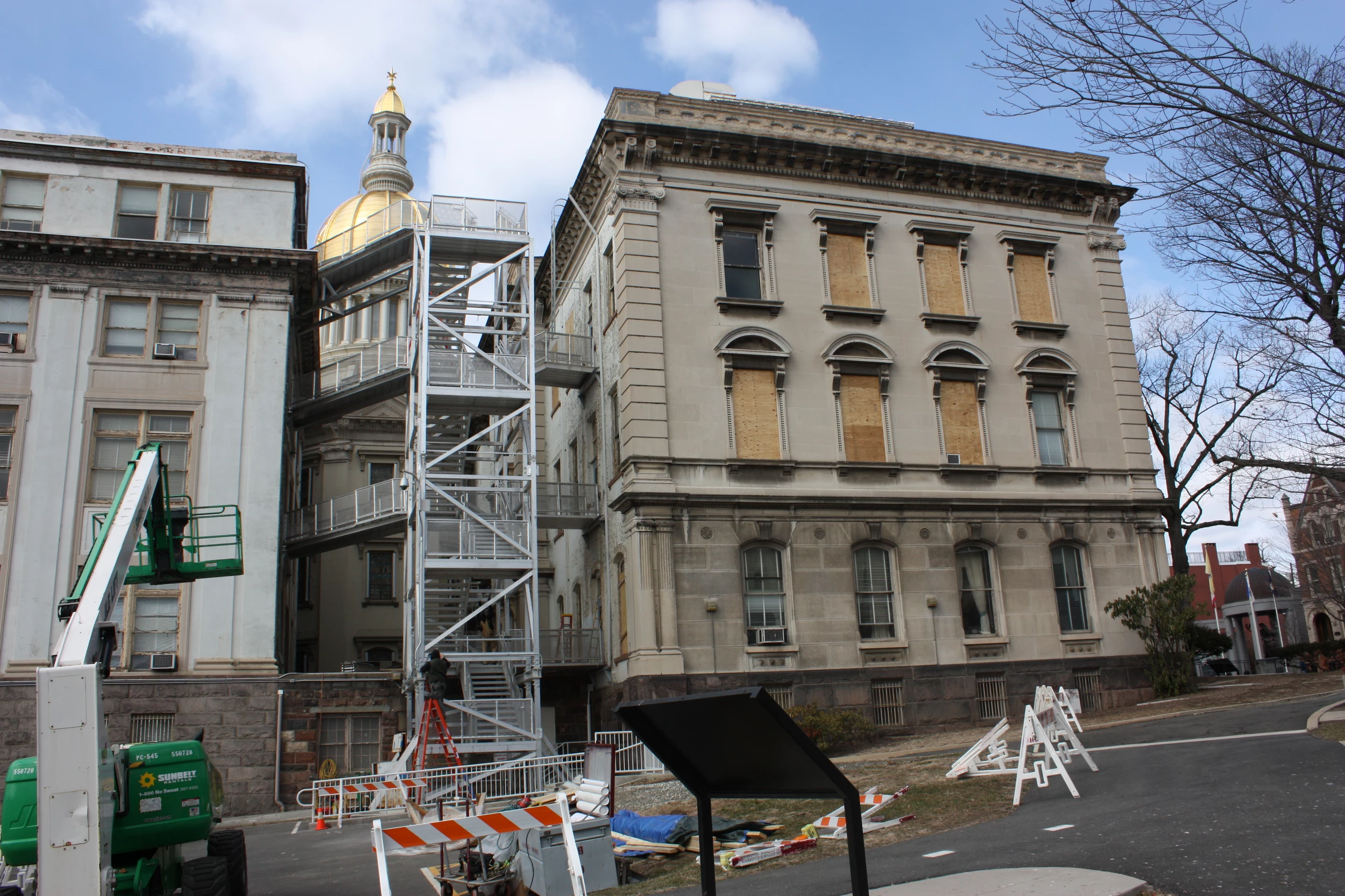
Wisniewski also says we can use $300 million from cancelling the State House renovation, but even if you agree with him that the renovation is a "extravagance," the $300 million is non-existent since the state was planning to bond that money through the EDA.

Is Wisniewski seriously saying NJ should start bonding money for K-12 operating aid?  Because his proposal to use the $300 million intended for the Statehouse Renovation is tantamount to this.   No state can stay solvent by using one-time revenue shots to fund recurring costs like K-12 spending.  

I agree with Wisniewski's proposals to increase taxes on incomes above $1 million and commend him for stating that this would only bring in $500-$600 million annually.

I also agree with Wisniewski's proposal to restore the estate tax, although I think he would find it politically difficult to restore it at the previous threshold of $675,000 since that was the country's lowest. Assuming Wisniewski could/would only restore the estate tax to $1 or $2 million, New Jersey would not recover the full amount lost.

However, by putting all of the estate tax revenue into K-12 aid (it previously went into the General Fund), Wisniewski would be taking money from one pocket and putting it into another. Since items paid out of the General Fund include non-discretionary spending categories like the Executive branch, non-TPAF pensions, and Corrections, taking this money out of the General Fund would put a lot of pressure on higher ed funding, which is technically discretionary.  But this conflicts with Wisniewski's plan to make public college "free" for students from families making under $125,000 a year.

The biggest gap in Wisniewski's proposals is his plan to fund K-12 aid by eliminating tax incentives.

If Wisniewski actually followed through on this, there would be no immediate savings since NJ cannot rescind tax credits already granted.  The theoretical savings would come from not giving out any new tax incentives, but even that assumes that the business would still relocate to New Jersey or remain in New Jersey without the incentives.
  • If the XYZ Corporation is currently located in New York and says it would locate 500 jobs to New Jersey if it gets a $20 million (cumulative) tax credit, and John Wisniewski says no to a tax credit, New Jersey hasn't gained $20 million since the XYZ Corporation still won't be paying anything to the NJ Treasury!  The business will stay put where it is in New York State or go to another state that will gladly give it a tax credit.
  • If the 321 Corporation is located in New Jersey and says it will relocate to Georgia if it doesn't get a $20 million tax subsidy, Wisniewski says no, and then the 321 Corporation really does relocate to Georgia, New Jersey still loses at least that $20 million, since the 321 Corporation no pays zero New Jersey taxes, plus tens of millions of more in spending power by the corporation itself and its employees.
  • If Big Rebuild developers propose converting a vacant office building in downtown Paterson into apartments if they get a $5 million tax subsidy and Wisniewski says no, the NJ Treasury hasn't gained either since that renovation project probably wouldn't happen without a subsidy.

So Wisniewski is blowing hot air when he says that eliminating tax incentives is a budgetary salvation for New Jersey.

The Forgotten Piece:
A major missing piece of Wisniewski's proposal is any reform of how PILOTs distort state aid.

Conclusion:
So I'm glad that John Wisniewski has come up with a plan of sorts.  I hope this encourages Phil Murphy and Jim Johnson to come up with anything too.  I hope this encourages Ray Lesniak to talk about his support for Steve Sweeney's much more mathematically-literate plan.

BUT John Wisniewski has got to go back to the drawing board.

----
See Also:

Thursday, September 15, 2016

Is Steve Sweeney Overselling His State Aid Proposal?


Readers know that I'm a fan of Steve Sweeney's "Formula4Success" proposal and, because of his stance on state aid, I'm a fan of Steve Sweeney himself.

I see Sweeney's proposal as the progressive, pragmatic, and fair plan for state aid that New Jersey needs. By combining $100 million annual boosts in K-12 education funding with at least $500 million in redistribution from overaided districts, Sweeney's plan could finally be the pathway to fair school funding that New Jersey has been waiting forty years for.  I also am thrilled that Sweeney's proposal will address the distortions of state aid that result from PILOTed property being "invisible" to the formula for state aid and amend the tax cap law too.

And yet, I worry that Steve Sweeney is slightly overselling his aid plan and that it won't bring every district up to 100% of its SFRA recommendation, nor will it end the disparities that vex the state.

To be brief, here's why:
1.  The amount of money being discussed is not enough.
2.  The aid targets may be for Capped Aid, not Uncapped Aid.

So, this is how Sweeney characterizes his plan:

That is why I joined with Senator Ruiz, Assemblywoman Joann Downey and Assemblyman Eric Houghtaling to introduce legislation to establish the State School Funding Fairness Commission.
By June, the panel will recommend revisions to the 2008 law to ensure that state aid is distributed on a fair and equitable basis to all districts, and that fast-growing school districts receive the additional funding they need to compensate for enrollment growth.
We have pledged to add $500 million in additional school aid over the next five years to guarantee that every school district receives 100 percent funding and that the commission’s recommendations are implemented.

I hate to say this, but something is wrong here. $500 million in new aid plus about about $500 million in redistributed aid is only about $1 billion.

According to data I received from the Department of Education, NJ's underaided districts have a deficit of $1,946,380,097 for 2016-17.  Since Steve Sweeney is unambiguously for redistribution, it's the net deficit that matters, which is only $1,378,606,184 (for non-vo-techs). (Hereinafter approximated at "$1.4 billion."  See the chart here to see the numbers)

So the total amount of excess aid is $567,773,913, but some of that is Interdistrict Choice money, which is not subject to redistribution under Sweeney's proposal.

However, that $1.4 billion deficit figure is a moving target since the DOE is supposed to make periodic inflation adjustments to districts' Base Per Pupil amounts, ie, their aid targets.  Although the Christie administration hasn't made these adjustments, the next Democratic Department of Education may do so.  As inflationary adjustments are made, the deficit will grow and the amount of Adjustment Aid to redistribute will (usually) shrink, since the Adequacy Budgets of Adjustment Aid districts will grow.

In any case, $568 million in excess aid, even with another $500 million thrown in, is less than $1.4 billion, even before inflationary increases are factored in and even before excesses from Interdistrict Choice are roped off from redistribution.

So what are Steve Sweeney and his coauthors talking about when they say "100 percent funding"?

The cap is 10% if the district is above Adequacy or
20% if the district is below Adequacy.
It appears they are talking about Capped Aid, with which NJ has a deficit of about $1 billion ($864 million according to Senator Ruiz) and Capped Aid full funding is not real full funding and the distribution of aid under full Capped Aid would still be unfair.

Capped Aid and Uncapped Aid are not aid streams like Equalization Aid, Special Education Aid, and Adjustment Aid are; Capped Aid and Uncapped Aid are aid amounts.

Capped Aid is just an incremental step on the way to Uncapped Aid.

Capped Aid's origins are in SFRA itself:

For the 2009-2010 school year and thereafter, total stabilized aid shall include Equalization aid, Special Education categorical aid, Security Aid, and Transportation aid. 
d. For the purposes of this section, “State aid growth limit” means 10% in the case of a district spending above adequacy and 20% in the case of a district spending below adequacy. 

SFRA also contains a section here ordering the Commission to "adjust" (ie, cut) a district's aid if it somehow exceeded the State Aid Growth Limit.

a. Notwithstanding any provision of this Act to the contrary, the total stabilized aid for each district shall not be increased by more than the district’s State aid growth limit. In the event that total stabilized aid exceeds the prebudget year total by a rate greater than the State aid growth limit, the commissioner shall adjust the components of total stabilized aid so that they total exactly the prebudget year total increased by the State aid growth limit.

So, if a district was getting $50 million pre-SFRA (ie, 2007-08) and SFRA said it should get $90 million (ie, $90 million is its Uncapped Aid),the biggest boost the district would get is 10% or 20% of what it got previously, so $5 or $10 million, depending on whether or not the budget was above or below Adequacy.

So calling "Capped Aid" "100 percent funding" is inaccurate.

SFRA never envisioned that districts would lose aid in the Great Recession, so the calculation of Capped Aid is now very opaque, but the basic point is that Capped Aid is tied to what a district got in the past and its own spending relative to Adequacy, not what a district's economic-demographic needs are at the present.

(See Also:
"The Long Wait for Full Funding Under Capped Aid")


Steve Sweeney knows the difference between Capped Aid and Uncapped Aid and his proposal has always contained a clause to correct the unfairness of Capped Aid, but Capped Aid targets appear on the Formula4Success website. (see Edison for example)


If a district is brought up to its Capped Aid the gain is often just trivial.  For Edison to gain only $2.5 million over five years is pathetic.  Edison has a $226 million operating budget, so $2.5 million is 1% of that.  Edison already increases taxes by $5-$10 million per year, so what does an additional $2.5 million do?  

$2.5 million is only $160 per student for Edison.  

What's even more annoying is that since SFRA sets increases according to a percentage of what a district got previously, and not a set amount per student, a high-aid/moderately underaided district would gain more than a low-aid/severely underaided district.

Compare Newark and Red Bank Boro.  Red Bank Boro is underaided by almost $5000 per student.  Newark is underaided by $1800 per student, but Newark would gain the full $1800 (since its existing aid is $14,700 per student) whereas Red Bank Boro would gain not even $400 per student, since its existing aid is only $2100 per student.  

People have brought up the problems of Capped Aid versus Uncapped Aid and the legislation may have been changed to directly the Commissioners to consider Uncapped Aid needs.  

Originally the legislation said:

2. a. It shall be the duty of the commission to study: (1) the adjustment aid and State aid growth limit provisions of the “School Funding Reform Act of 2008” (SFRA), P.L.2007, c.260 (C.18A:7F-43 et al.), to determine recommendations for revising those provisions in order to bring all school districts to their adequacy budgets as calculated pursuant to section 9 of that act over a period of five school years; 


     (1)   the impact of the adjustment aid and State aid growth limit provisions of the “School Funding Reform Act of 2008” (SFRA), P.L.2007, c.260 (C.18A:7F-43 et al.), on the fairness of the school funding formula, to make recommendations for revising those provisions in order to provide full funding of the “School Funding Reform Act of 2008” over a five-year period, and to bring fair and equitable funding to all school districts for enrollment growth over a multi-year period;

"Fair and equitable manner" can mean absolutely anything, but it is an addition to the text and the Commissioners could read it to prioritize districts with the largest deficits relative to Uncapped Aid.

And even if Sweeney's plan is affirmed by the legislature in 2017 and Christie signs it, an additional problem with Sweeney's approach is that it depends on NJ's next governor being pro-reform.

Chris Christie has proven that a governor can ignore the state's funding law if he doesn't like it and the state's revenue is adequate.  If NJ's next governor doesn't like redistribution, wants to do something outside of SFRA, such as give extra aid to charterized districts, or conflates being below Adequacy with being underaided, he can ignore NJ's new state aid law and allow more aid hoarding.

NJ's overaided districts have been passive so far in the face of losing state aid, but once it actually begins to happen and their taxes increase way beyond inflation, they'll howl.

Steve Sweeney or a pro-reform Republican like Jack Ciattarelli may be NJ's next governor, but the governor could also be Phil Murphy or Steve Fulop.

State aid is not a priority for Phil Murphy and Steve Fulop.  They rarely comment on aid to begin with, but when they do, their views are uninformed.  Phil Murphy says he wants to "implement that formula," but is evasive on the subject of redistributing state aid, has made billions in non-education promises, takes inaccurate cheap shots at Chris Christie, and does not recognize that fully funding SFRA without redistribution would cost $2 billion a year.  Steve Fulop is even worse.  He has never admitted the unfairness of Jersey City's state aid level and his strenuous opposition to a tax reval for Jersey City indicates a contempt to fair taxation altogether.

Yet, Steve Sweeney is still just a politician and he has exaggerated what his plan would do.  I still support Sweeney's plan and like Steve Sweeney very much, but aid-activists should clarify with Steve Sweeney about the need to focus on Uncapped Aid, not Capped Aid.  Journalists should also investigate what the true costs to fully fund SFRA would be.


Thursday, June 23, 2016

Sweeney, Prieto Condemn Christie Proposal; Murphy, Fulop Silent

Update: This post was accurate when written.  Phil Murphy has now tweeted criticisms of Christie's unfair aid plan.


Senate President Steve Sweeney and Assembly Speaker Vincent Prieto both immediately criticized Chris Christie's proposal to redistribute state aid so that every district receives an equal $6500 per student.

Here's Steve Sweeney, speaking with fellow state aid reformer Teresa Ruiz:

“The governor’s proposal is a direct attack on the core principles of equality for all of New Jersey’s communities, denying too many schoolchildren the opportunity for an equal education. “This plan is unfair, it is unjust and it is blatantly unconstitutional. “It is a maneuver that discriminates against the most vulnerable students and would systematically deny children an equal opportunity to achieve the American Dream.

Children do not choose their zip codes, and this proposal decimates educational opportunity, resulting in more poverty and increased income inequality. It is a divisive plan that’s not fit for New Jersey. “Which is why the school funding proposal we sponsored recognizes the values of this state, the values the people of New Jersey committed to in the 1947 Constitution.

We believe in those values and we know the people of New Jersey do as well. We want to pursue excellence in education, not limit it to those who already possess the advantages. We don’t want to give up on the families throughout the state who look to educational opportunity as the equalizer that can help their children succeed in the rapidly-evolving economy.”
Ok, good.

Vincent Prieto also condemned Christie's proposal, although he came out with a call to fully fund SFRA that I see as hopelessly unrealistic:

“Gov. Christie’s idea is unconstitutional and harmful to our most vulnerable children. Gov. Christie has been in office for more than six years and not once has he fully funded the school funding formula that would provide increased aid and property tax relief to school districts throughout New Jersey. In fact, he even vetoed a Democratic initiative (A4203 in 2011) to accomplish that goal. If Gov. Christie truly wants to undo the damage caused by his policies, he must acknowledge his responsibility by working with legislators to finally fully fund the existing – and constitutional - school funding formula.”
I'm not going to get into why NJ can't fully fund SFRA, but at least Prieto is right that Christie's proposal is "harmful to our most vulnerable children."

What's disappointing is that it's now over 48 hours after Christie made his state aid proposal and Steve Fulop and Phil Murphy have been totally silent.

Steve Fulop's not shy about criticizing Christie, but he initially refused to comment until he sees the official proposal.  Doesn't he know enough about state aid to know that equal funding per student is nonsense?  Doesn't he know enough about Jersey City to know that it receives substantially more than $6500 per student and would be a massive aid loser?   

Apparently Fulop knows enough about state aid to forward a reporter a condemnation the Education Law Center wrote, but he doesn't care enough to write something himself.  

Phil Murphy is showing the same silence, even though Murphy is usually more aggressive in attacking Christie than Fulop is.  
I appreciate Phil Murphy's stances on gun control, but being governor involves more than just signing gun control legislation.  

Fulop and Murphy's Facebook pages are equally silent.  

Are Murphy and Fulop ceding state aid as a political issue to Sweeney?  

It's not like a Tweet takes long to compose.  It's literally the least they could do.   

UPDATE: 
Phil Murphy Tweets three days later about Christie's proposal in response to a press release from Ras Baraka.

https://twitter.com/PhilMurphyNJ/status/746427805915807744

Thursday, June 2, 2016

Why the 2010 Aid Cuts were Unavoidable

Economic Stagnation is the
Root Cause of NJ's Fiscal
and State Aid Crises
Phil Murphy is the first of the Democrats officially out of the starting gate for the 2017 gubernatorial campaign.  He's hosting town halls, making appearances at public events, and has an active and open internet campaign.

A few weeks ago Phil Murphy did a Facebook town hall in which he took questions from the public.  The questions were submitted ahead of time and were read (and condensed) by Phil Murphy's campaign manager.

There were a number of questions about state aid and Phil Murphy did try to answer a question about what he wanted to do with K-12 state aid.

See Minute 42:50 of Video


Murphy didn't directly say what he would do about education aid so much as condemn what Chris Christie did do, specifically, "gutting" education aid. While Murphy's statement is technically factual, it is so devoid of context as to be misleading.

Murphy blamed Chris Christie for underfunding the formula by (a cumulative) $7 billion and said Christie had "gutted education."  He did not discuss the unevenness of NJ's aid distribution nor use terms like "SFRA" or "Abbott."

Murphy juxtaposed NJ's cumulative underaiding with the amount of corporate subsidies and incentives given out under Christie.  These tax incentives coincidentally have a cumulative value of about $7 billion and Murphy said said money ought to be used to fully fund education aid.

In case Phil Murphy himself reads this or his campaign does, here's some context on NJ's recent state aid history.

1.  Christie Inherited an Unsustainable School Spending Level That Had Been Paid for with $1 Billion in Federal Money


This is the defense of himself that Chris Christie gave in his confrontation with teacher-blogger Marie Corfield and he's factually right.

This is how the Corzine Administration itself described its plans for ARRA money:

Approximately $1.057 billion will be used to implement the new school funding formula enacted by the School Funding Reform Act of 2008 (SFRA). About $70.8 million is allocated to higher education. These funds will be used to restore cuts for higher education that were included in the proposed budget for FY 2010. These cuts will be restored if certain conditions, including limits on tuition increase, are met. Furthermore, the increase in funding for Tuition Aid Grants (TAG) proposed in the Governor’s FY 2010 budget will be supported with SFSF dollars.

If you look at the pension chart below, Jon Corzine also slashed contributions and part of the "savings" went into education aid.  Corzine had hit $1 billion two years in a row, but in 2009 he let contributions fall precipitously in order to sustain school aid.

I Love The 90s!
It's Easy to Fund Education When You're
Abandoning Pension Payments!

So Chris Christie didn't so much as "gut state aid," he "lost federal aid" and couldn't lower pension contributions below $0.

Christie vetoed a renewal the Corzine-era "millionaire's tax" and that certainly deprived the state of much money, but there were multiple versions of "millionaires' taxes" passed for various purposes (like seniors and tax rebates) and I don't believe anyone can claim that all of that money would have gone to schools.

Moreover, virtually every state cut education spending in 2009-2011 as the economy nosedived.

What is awful about Christie's cuts is that he made the same cut equal to 5% of budget for every district, from the most overaided to the most underaided.  This means that Hoboken was treated the same as Clifton until in gross legal amorality and irresponsibility, Justice Jaynee LaVecchia ordered the state to increase Abbott spending by $500 million which "gave back" $1.7 million to Hoboken.  

2.  New Jersey has been underfunding its aid formula since Forever, not since Chris Christie became governor.  
Ok, not forever, but ever since the Public School Education Act passed in 1975.

As New Jersey School Boards Association spokesman Frank Belluscio said in 1989  "The formula has been fully funded maybe three times since the law was enacted in 1975."

3.  New Jersey is Increasing "Education Spending" but the New Money is Mostly Going to Pensions & Debt

I think this is self-explanatory.

NJ only increased total state spending by $1 billion for FY2017.   $544 million of that went to education-related spending, but of that $544 million, only $94 million (17%) went to K-12 education aid.


To paraphrase James Carville, "It's the Pension Crisis Stupid!"

4.  New Jersey's aid for non-Abbotts has been stagnant since 2002.

The forerunner to SFRA was CEIFA,, the "Comprehensive Education Improvement and Financing Act" of 1996

CEIFA didnt' have a long run either.  Aid increased dramatically in the late 1990s, but because the economy was doing well then and NJ was in the process of zero'ing its pension payments.

Yet, starting in 2002 aid was basically frozen for all non-Abbotts.

The Department of Education admitted this very frankly in 2007 when SFRA was unveiled.


5.  New Jersey's Economy is Stagnant and Thus So Is Our Revenue

NJ's economic growth has lagged the nation's since 1990 and been particularly bad since around 2001.  Since 2004, NJ's average compound growth in GDP has only been 0.4% versus a national average of 1.3%.  NJ has only recovered 90% of the jobs it lost during the Great Recession, again, lagging the nation.

So the people who say that Christie gutted education aid are factually right, but not contextually, since any governor would have had to do the same thing.  Maybe if Jon Corzine had won reelection the cuts wouldn't have been as deep, maybe they would have been made more fairly and spared underaided districts, but Christie, along with Democratic counterparts in many other states, had to cut education funding.

By condemning Chris Christie for what he had to do back in 2010, Phil Murphy tells us nothing about what he would do.

See Also: 

The Phantom Budgetary Salvation: Cutting Tax Incentives
Dear Phil Murphy, Massachusetts Doesn't Have High Taxes

Wednesday, January 20, 2016

Sweeney Says that Property Taxes will be a Priority, Says "Adjustment Aid" Should be Eliminated!

The Asbury Park Press has now written an article about their interview with Steve Sweeney.

In the article Steven Sweeney says "property taxes will be a priority" and says that he and Jennifer Beck are working on a more equitable distribution of state aid by eliminating the "hold harmless" provisions in SFRA, ie, eliminate "Adjustment Aid."

Sweeney, D-Gloucester, told the Asbury Park Press editorial board that lowering the property tax burden requires good decisions about sharing services by counties, municipalities and school districts and that the state’s affordability issues are broader than property taxes.

But he said that property taxes, which rose by a statewide average of 2.4 percent last year, the fastest growth since 2011, will be a priority.

“I absolutely intend to. Look, I have never not focused on that,” Sweeney said. “But my point is you have to do a lot of these things. Look, (exempting more seniors’ income from taxation) will help seniors be here some more, too. We have to fix property taxes. There’s no argument on that.”

“Property taxes are right up there. They’re right at the top, and fixing the school funding formula or at least redistributing the aid will assist in that,” Sweeney said.

More than 14,000 New Jerseyans signed an Asbury Park Press petition calling on state lawmakers to reduce property taxes, for long the No. 1 issue in the state, according to opinion polls.

Sweeney said he’s been talking with Sen. Jennifer Beck, R-Monmouth, about a more equitable school funding plan. One change he envisions: eliminating the so-called “hold harmless” provision that protects some districts from having their aid cuts — even if enrollments decline. [my note: "Hold Harmless aid is Adjustment Aid. It also should be noted that Adjustment Aid protects districts from aid losses even if the district's wealth increases enormously.]
Sweeney, however, acknowledges how difficult state aid reform is politically.
The challenge in making that change is that the change costs districts funds their hometown lawmakers won’t endorse. Hoboken could be cut by $1.8 million, Phillipsburg by $4 million, Jersey City by $48 million.

“This is one of those issues that it’s going to be very hard to get 21 and 41,” Sweeney said, referring to the number of votes a bill needs to pass the Senate and Assembly, “but there’s a fairness issue. Our school funding formula worked. One of the big problems was the hold-harmless clause.”
Sweeney of course is correct about the difficulty of getting legislative majorities for aid reform, but there are some non-legislative opponents of reform he doesn't address.  The Education Law Center has come out staunchly in favor of Adjustment Aid as well.  The ELC's report on Adjustment Aid, is highly misleading, as I've written about here and here.
Click for a higher resolution.

Again, Steve Sweeney is the only Democratic gubernatorial  talking about property taxes and state aid fairness.  Sen. Ray Lesniak, in listing "10 Traits Needed By NJ's Next Governor," didn't mention anything even remotely relating to taxes.  Phil Murphy, whose "New Way for NJ" has a nine-part agenda and whose "New Start New Jersey" has a separate, overlapping agenda, also doesn't even mention anything relating to taxes.  Mayor Steven Fulop, also skips mentioning taxes, and since he cancelled Jersey City's tax reassessment, opposes even the basic principle of fair taxation.

Sweeney, even recently, has proposed very expensive measures like expanded Pre-K and fully funding pensions (which is economic suicide), but through his support for state aid reform, he recognizes that the problem with New Jersey's property taxes isn't just the level, but the unevenness.  Sweeney also doesn't indicate that he thinks NJ's other taxes have reached crisis levels.

(As a minor note, I do not think the numbers Sweeney and Michael Symons give for overaiding are correct.  The APP gives $1.8 million in excess for Hoboken, $4 million for Phillipsburg, and $48 million for Jersey City.

According to data from the Department of Education, those districts are overaided by $4.8 million, $2.6 million, and $111 million, respectively.)

Anyway, reforming state aid is a very heavy political lift, but I am grateful to Steve Sweeney (and Jennifer Beck) for trying.


Tuesday, January 19, 2016

Steve Sweeney Again Acknowledges Need to Redistribute Aid


Steven Sweeney did an interview with the Asbury Park Press editorial page today.

The APP is sow far only sharing the interview via Twitter (specifically reporter Mike Davis' feed), so I'm only getting tantalizing bits of what Sweeney said, but the Twitter feed does indicate that Sweeney is supporting the redistribution of state aid!!!


Sweeney talking ins and outs of school funding: "If you take $ from a dist that's over 100% funded, the call is 'You're raising my taxes.'"
Sweeney: We're working on legislation to address overfunding of school districts, working with @jenbecknj
"You deal with the supt's, asking 'Why is this district getting more than what's seen as adequate funding while I'm less than half?'"
Sweeney tells APP's edit board issue of equitable school funding will be addressed by Legislature. Says he's working with Sen. Beck on it. 
Sweeney: "There's going to be winners & losers. If you're a loser you're not going to be happy. But we have to look at fairness of funding."

I think that compared to Steve Fulop and Phil Murphy, Sweeney is the gubernatorial candidate with political courage. I don't agree with Sweeney's constitutional amendment on pensions nor Pre-K fixation, but I respect Sweeney for having the guts to address New Jersey's toughest issues.

I await more news about the legislation Sweeney is referring to.  As of now I've read nothing.

----
Update:  More information is available from the Asbury Park Press!

My blog follow up.

Monday, November 30, 2015

Jersey City's Property Taxes are State's Most Unfair (Is anyone surprised?)

All along, I've had a feeling that Jersey City's property tax apportionment would be New Jersey's most inequitable, based on the 27 year lapse since Jersey City's last reassessment and the fact that parts of Jersey City have seen a resurgence while other parts have been relatively stalled.  What I didn't know until recently is that there is a statistical measure of unfairness in tax apportionment called a "Coefficient of Deviation."

A General Coefficient of Deviation is a measure of variation, i.e. the average deviation of individual Assessment-Sales Ratios from the overall average Assessment-Sales Ratio of all sales in a taxing district expressed as a percent. About 25 years ago a 20 percent General Coefficient of Deviation was considered a good degree of uniformity, the current acceptable figure for Coefficients of Deviation is 15 percent, although some authorities advocate 10 percent in light of improved assessment practices and computerization. A Coefficient of Deviation greater than 15 per-cent indicates a significant lack of uniformity within a municipality and the need for revaluation.
Like a Correlation Coefficient, the Coefficient of Deviation is a measure of the tightness of a cluster.  The tighter the cluster, the more fair the existing property assessment is, since every's property diverges from official valuation by the same ratio.  The looser the cluster, the less fair the existing property assessment is, since different property owners have properties of very different ratios from assessed value and yet all property owners pay taxes on the same outdated assessment.

The Department of the Treasury's guideline is that any a town with a Coefficient of Deviation greater than 15% should reassess.  Jersey City's Coefficient of Deviation is 39%, this is the highest in the state of New Jersey, and is virtually an outlier.   The town with the next most unbalanced tax assessment, Newark,  has a Coefficient of Deviation of 35.39% and there is not a third New Jersey town with a Coefficient of Deviation above 30%.  Counting Jersey City and Newark, there are only 27 towns (out of over 560) with Coefficients of Deviation above 20%.

(Source, Department of the Treasury, MEASURES OF PROPERTY ASSESSMENT UNIFORMITY IN NEW JERSEY TAXING DISTRICTS)


Jersey City isn't the only town in New Jersey to have not reassessed since the 1980s and there are some who haven't reassessed since the 1970s.  Although Jersey City has New Jersey's highest Coefficient of Deviation, Jersey City's General Assessment compared to its Equalized Valuation is only the twelfth lowest in New Jersey:


(Source, Table of Equalized Valuations 2016)

However, most of the other towns who are badly underassessed usually do not have high Coefficients of Deviation.  This is because the other non-reassessing towns have seen more uniform growth, with each neighborhood essentially on the same real estate trajectory.  Thus, although several other towns haven't reassessed in decades, their growth has been very uniform and very few taxpayers are being taxed unfairly.  


It's easy for a smaller town to have consistent and fair variations, but New Jersey's other largest cities do not show the same shockingly high variation in prices vs assessments that Jersey City has.  


Paterson's recent reassessment offers some hints of what is in store for Jersey City.  

When Paterson reassessed in 2014-15 it had not reassessed since 2007 and had a Coefficient of Deviation of 23.04.  


More than 11,000 Paterson homeowners are paying lower property taxes as a result of this year’s revaluation, according to a report issued this week by city officials.

On the other hand, 5,500 homeowners saw their property tax bills increase because of the new assessments, the report showed.

The disparities of the impact of the revaluation in some instances are substantial. For example, 152 homeowners were hit with annualized tax increases of more than $5,000, while 385 homeowners enjoyed reductions of more than $5,000, the report said.

Many of the people who had the biggest increases in Paterson were people who had filed successful tax appeals.  Many of the people who saw the biggest drops in their property taxes were people who had never filed tax appeals.  

Commercial property in Paterson ended up paying a high share of property taxes after Paterson's reassessment.  It is unclear if that would apply in Jersey City as well.

The Fulop Doctrine:  "If an area was once poor and is now affluent,
that area should continue to pay property taxes as if it were still poor
until I am no longer mayor."
Steve Fulop justified cancelling Jersey City's reassessment this way, "I will not allow this back-door tax hike planned by the Healy administration to take place," although Fulop also accused the reassessment firm (Realty Appraisal Co. of West New York) of using backroom dealing to get the reassessment contract, even though Realty Appraisal had submitted the lowest of four bids.

Steve Fulop himself lives in a house which is more under assessed than average for Jersey City and thus is likely to see a large increase in his personal taxes. 

Fulop's house in the Heights is assessed at $104,000. Thus, at Jersey City's 7.434 tax rate (2014), Steve Fulop pays about $7,700 in property taxes.  However, Fulop bought his house in 2015 for $845,000. If Mayor Fulop's own house is reassessed at its $845,000 market value as part of a city-wide reassessment and Jersey City's official tax rate equaled its Effective Tax Rate (aka, Equalized Tax Rate) of 2.219, then Steve Fulop would pay at least $19,300, an increase of almost $12,000.  ($19,300 = 2.219% of $845,000.)

$19,300 a year in in property taxes may sound like a lot, but people living in most other New Jersey towns - including most other Abbotts - would pay much more than that.  Someone living in a $845,000 house in Bayonne would pay $27,000.

Fulop's cancellation of Jersey City's long-planned reassessment worries me because it is part of a pattern of tax unfairness.  Fulop has continued his predecessors' aggressive policy of granting PILOTs, even though PILOT residents are allowed to pay $0 to the Jersey City Public Schools.  Also, if Fulop opposed reassessment because it would increase taxes for downtown and waterfront property owners, then, by the same logic, he could oppose redistributing state aid because that would mean increased taxes for aid-losing districts.  

As Mayor of Jersey City, Steve Fulop is supposed to govern in the interest of the entire city, but in cancelling reassessment Fulop was governing in the interest of downtown and the waterfront.  I do not think this bodes well for Fulop being a fair-minded, impartial governor.  


Tuesday, September 29, 2015

Gubernatorial Hopeful Phil Murphy Raises Profile

Update: This post was accurate at the time it was written. 

Aside from that, since 2015 my opinion of Phil Murphy has cooled.  I've written a series correcting deceptive and inaccurate things he has said.


  • Phil Murphy Doesn't Understand State Aid
  • Why the 2010 Aid Cuts Were Unavoidable
  • The Phantom Budgetary Salvation: Cutting Tax Incentives
  • Dear Phil Murphy, Massachusetts Doesn't Have High Taxes
  • Phil Murphy Overpromises


  • Former Goldman Sachs executive and Ambassador to Germany Phil Murphy is raising his profile for an anticipated gubernatorial run.

    Murphy's vehicle for his campaign is "New Start New Jersey," an organization committed to the progressive vision, with many references to New Jersey's middle class

    New Start New Jersey has two sections which relate to education; first on "Free Community College," next on "Early Childhood Education."

    Murphy is wading carefully into the jungle of K-12 education.  His website does not address controversial topics in education like testing, charter schools, teacher tenure, or state aid.

    However, the section on Early Childhood Education (not written by Murphy personally) has a factually correct history of Abbott decisions and SFRA.


    In 2008, New Jersey adopted the School Funding Reform Act (SFRA), which removed the non-Abbott designations, essentially combining the ECPA and Abbott pre-K programs. The SFRA would phase-in an expansion of the Abbott preschool program to all three- and four-year-olds in another 84 high-poverty districts and to all low-income children in the remaining districts statewide. When fully enacted, over 30,000 additional students would enroll. Unfortunately, the recent financial crisis has undercut the resources available for education. While Governor Christie has sustained funding for existing preschool programs, with $655.5 million designated in the proposed FY 2016 Budget, the expansion of pre-K dictated by the SFRA has not occurred.

    The above is all factually correct. I appreciate that Murphy cites the financial crisis for underfunding SFRA and Pre-K, in contrast to how many people and groups cite Chris Christie personally.  The Education Law Center, for instance, does not even acknowledge New Jersey has had a recession.

    Murphy also recognizes that the state's financial possibilities are very constrained.

    As indicated, resource constraints have forestalled the expansion of pre-K in New Jersey to date. With over $600 million dedicated annually to preschool and with full SFRA activation estimated at another $400 million [correction, it's closer to $700 million], the costs present a challenge in the current fiscal climate. The federal government has outlined its intention to aid states in offering preschool to four-year-olds through the Obama Administration’s $75-billion, ten-year “Preschool for All” proposal. Projections indicate New Jersey would receive around $50 million in the first year, a fraction of the state’s overall expenditure.19 Even so, the accompanying legislation – The Strong Start for America’s Children Act (HR 3461/S1697) – did not advance in the last Congress. 
    However unlikely the circumstances cast the expansion of preschool to a wider range of New Jersey’s families, discarding entirely such an aspiration would seem myopic. The state’s success in this area should lead to amplification and, in fact, has prompted suggestions for extension to all children, even if only for one year at age four.20 Continuing to secure funding for the existing pre-K model stands as the priority, closely followed by meeting the SFRA requirements. Discovering how to enlarge the policy to include more middle-class citizens also should not be overlooked.
      
    This is a great contrast to NJ's "Pre-K Our Way," which pays no consideration at all to the costs of Pre-K.

    New Start NJ also cites studies that purport to show Pre-K's benefits, but also some (briefer) discussion of how those benefits peter out as kids age.  

    Overall I am impressed by Phil Murphy and New Start New Jersey's honesty regarding Pre-K and SFRA funding but that doesn't change the fact that there is no money for expanding Pre-K.

    Murphy's positioning for the Democratic race is interesting.  Unlike Steve Sweeney, he has no history of deals with Chris Christie to taint him in the eyes of Democratic interest groups.  Unlike Steve Fulop, he has no history of exploiting the rest of the state for his own constituents' gain nor cronyism.

    Most very wealthy business people have something in their record that can be criticized.  I would not be surprised if something relating to Phil Murphy's time at Goldman Sachs surfaces, but how could Steve Fulop attack Murphy for anything Murphy did at Goldman when Steve Fulop worked at Goldman too?  

    Monday, September 14, 2015

    "10 Traits New Jersey’s Next Governor Needs, According to Sen. Lesniak" - No refs to taxpayers


    Gubernatorial candidiate Ray Lesniak lists "10 Traits New Jersey's Next Governor Needs," forgets anything having to do with taxpayers.

    1. To be more interested in New Jersey than “his own political ambitions.” 
    2. A governor who will give N.J.’s teachers “a hug and a thank you.” 
    3. Someone who will “stand up to ExxonMobil.” 
    4. Who listens to questions from residents and “doesn’t tell them to sit down and shut up.” 
    5. Who will “stand up against animal cruelty.” 
    6. Someone who ensures pensions for employees 
    7. Who will support Obamacare. 
    8. Who focuses on treatment of addiction before incarceration. 
    9. Who demands equal pay for women and stands up for Planned Parenthood. 
    10. Who pushes for universal background checks for firearms and a ban on assault rifles. 

    Thanks Senator Lesniak for thinking of us taxpayers!

    February 2017 Update:

    Ray Lesniak did vote for Sen. Steve Sweeney's state aid reform package, so he is the only one of the three Democratic candidates who supports state aid redistribution.