Showing posts with label Steve Fulop. Show all posts

Saturday, January 19, 2019

In Five Years Jersey City Will Be Ineligible for Equalization Aid


Over the last 10-15 years, the only part of New Jersey that has outperformed the national economy has been Hudson County, especially Jersey City.

Jersey City's growth is impressive by whatever metric you want to use, from overall jobs to population growth to income growth to real estate valuation.


When Steve Fulop calls Jersey City New Jersey's "economic powerhouse" he isn't exaggerating.

Jersey City and Adjustment Aid:

Jersey City was already overaided by $111 million in 2008 when the School Funding Reform Act became law, but since then Jersey City's wealth growth has made already substantial overaiding enormous, to the point where despite cuts to Adjustment Aid in 2012-13, 2017-18, and 2018-19, Jersey City's Adjustment Aid grew to $170 million.

This growth in wealth created an embarrassment of riches for Jersey City and eventually led to the passage of S2, which intends to phase-out all of Jersey City's Adjustment Aid at the 2018-19 level.

The Jersey City political establishment originally fought very hard against phasing-out Adjustment Aid by hiring lobbyists, getting Vincent Prieto to block reform, getting the Education Law Center to write a disgracefully out-of-context report about Jersey City's Adjustment Aid, and blatantly playing the Race Card, but eventually Jersey City yielded.  One of Jersey City's State Senators, Sandra Cunningham was actually constructive in the passage of S2 and even was listed briefly as a co-sponsor. For their parts, the other Jersey City reps were passive.

In April 2017 Steve Fulop declared that in the future Jersey City will share PILOT revenue with the school district.  In November 2018 Jersey City City Council passed a 1% payroll tax that is expected to provide $70 million to the Jersey City Public Schools.

Jersey City and Equalization Aid:

Amidst the battle over Jersey City's Adjustment Aid, something that has not been commented on is that Jersey City's tax base growth is strong enough that it is on its way to not even qualifying for Equalization Aid. Jersey City media and political class seem to understand that Jersey City is going to lose Adjustment Aid in five years, but there is no recognition that beyond that Jersey City is going to eventually lose another $191 million.

The reason for this looming loss is that Equalization Aid is a dynamic stream of aid that brings a district's spending up to whatever its Adequacy Budget is under the simple formula:

Adequacy Budget - Local Fair Share = Equalization Aid 


So, if a district's Adequacy Budget grows due to enrollment growth, Equalization Aid grows.  If a district's tax base decreases, then Equalization Aid grows too.

Conversely, if a district's Local Fair Share becomes larger than its Adequacy Budget, its Equalization Aid becomes $0.  260 districts in NJ are already ineligible for Equalization Aid.

For Jersey City, the 2018-19 Equalization Aid arithmetic is:

$590,163,255 - $398,895,043 = $191,268,212 

What these numbers mean is that when Jersey City's Local Fair Share equals $590,163,255, its Equalization Aid becomes $0.

For 2018-19, Jersey City's Adjustment Aid is $170 million.  S2 already establishes a phase-out of this. Assuming Jersey City's tax base grows, Jersey City will have to raise its tax levy by another $191 million after that.

The $191 million in Equalization Aid is down from $277.6 million in 2008-09.   Due to the constant growth of Jersey City's Local Fair Share, this Equalization Aid will soon go to $0.

How Quickly is Jersey City's Local Fair Share Growing?

Local Fair Share is determined by the following formula:

0.7% of Equalized Valuation + 2.3% of Aggregate Income

(note, the multipliers are tweaked annually)

As you can see below, both components of Local Fair Share are showing rapid growth in Jersey City, especially in the last few years.

Unfortunately Aggregate Income is not released publicly. I've gotten Aggregate Income for the 2016-17 to 2018-19 School Years via OPRA requests.
Also, note that a district's Equalized Valuation is from the previous year and Aggregate Income is from two
previous years.  The Local Fair Share for 2018-19 is based on
EV calculations done in 2016-2017 and Tax Year's 2015 Aggregate Income

As you can see, there has been an acceleration of Local Fair Share growth in Jersey City.  From 2008-09 to 2016-17, Jersey City's Local Fair Share only grew from $196 million to $336 million, but in 2017-18 it rocketed to $370 million and in 2018-19 $399 million.

However, growth continues to accelerate.  In the last year Jersey City gained $5.6 billion in Equalized Valuation ($28,418,886,079 to $34,014,551,210).  That $5.6 billion in growth will translate into an an increase of $39 million in Jersey City's Local Fair Share, plus whatever increases comes from growth in Aggregate Income.

Even conservatively projected, Jersey City's Equalized Valuation will reach $50 billion in a few
99 Hudson Street alone may add $1 billion to
Jersey City's Equalized Valuation and $10-$20
million to the Local Fair Share.
years
, even disregarding the expiration of PILOTs.
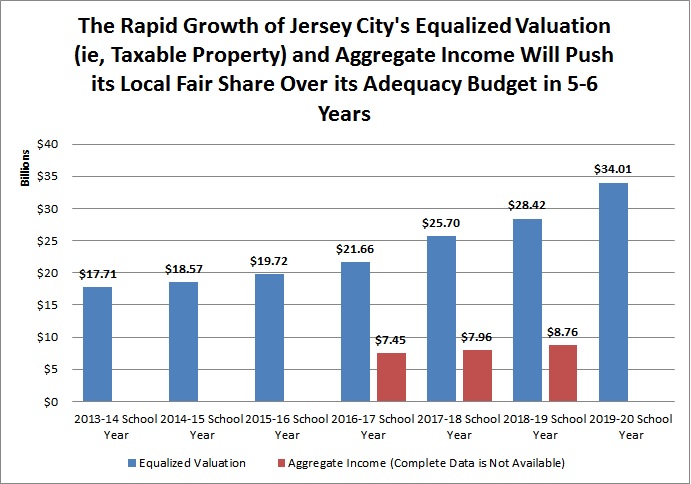
If Jersey City continues to gain an average of $2.7 billion per year in Equalized Valuation and $655 million a year in Aggregate Income, it will translate into a growth of $34 million annually in Local Fair Share, since $2.7 billion in Equalized Valuation equals $19 million in additional Local Fair Share and $655 million equals $15 million a year in additional Local Fair Share.

Combined, that's $34 million a year in additional Local Fair Share, which would be a 5-6 year phase-out of Jersey City's Equalization Aid.

Assuming that there is at least a $20 million gain from the growth of Aggregate Income, Jersey City might be looking at a 3-4 year elimination of its Equalization Aid.

Since Jersey City's 2018-19 Equalization Aid is $190 million and the Adequacy Budget is unlikely to grow faster than inflation (from 2017-18 to 2018-19 Jersey City's only Adequacy Budget grew from $584,758,085 to only to $590,163,255, it will probably take 5 years for the Local Fair Share to equal the Adequacy Budget and for Equalization Aid to be $0.  (See note after the conclusion about the definition of "Adequacy Budget.")

At that point, Jersey City will be in the same club as New Jersey's middle-class & affluent suburbs, as well as Secaucus, Hoboken, and Weehawken.  

The distribution of wealth in the 1980s, where the suburbs were affluent and the cities poor, will be inverted as far as Hudson County goes.

Although the upcoming tax increases will cause Jersey City people some anxiety, the underlying cause is Jersey City's success.  Although Jersey City's tax levy will have to quintuple, the assumption behind these calculations is that Jersey City's Equalized Valuation will soon reach $50-$55 billion.

Once Jersey City's Equalization Aid is $0, there are no further state aid cuts that will occur, and any growth in the Equalized Valuation will  just cause the tax rate to fall further.

When Jersey City's Local Fair Share reaches about $600 million, on a $50-$55 billion Equalized Valuation, it will be a school tax rate of 1.2%-1.1%, which is below NJ's average.

------

Note on Adequacy Budget Definition:

In the context of SFRA, an Adequacy Budget is the amount of money a school district is supposed to have in order to deliver a "thorough and efficient education."

A district's Adequacy Budget depends on its enrollment, the number of FRL eligible students it has, the number of ESL-students it has, and the average costs of its county.

What is confusing is that SFRA actually has two concepts known as an "Adequacy Budget."

The first concept is the "Adequacy Budget for Equalization Aid," which is used in conjunction with Local Fair Share to determine if a district gets Equalization Aid and then how much.

For 2018-19 Jersey City's Adequacy Budget for Equalization Aid is $590 million.

The second concept is "Adequacy Budget for Cap Comparison," which has now become obsolete, but was used in the pre-S2 version of SFRA to determine if an underaided district was eligible for a 10% aid increase or a 20% aid increase.

The "Adequacy Budget for Cap Comparison" includes some spending categories that are not included in the "Adequacy Budget for Equalization Aid."  It is usually 7% higher than the "Adequacy Budget for Equalization Aid."

If you see that JErsey City's Adequacy Budget is $630 million, that is Jersey City's Adequacy Budget for Cap Comparison.

In the context of calculating Equalization Aid, only the Adequacy Budget for Equalization Aid" is relevant.


Saturday, May 6, 2017

Most of the Abbotts are Now Underaided


When Steve Fulop of Jersey City spoke in February 2017 against any redistribution of state aid the worst lie he told was:


Wealth should determine state aid, not race, but even if race is your criterion, most of the districts in New Jersey that will lose aid are rural and Jersey Shore districts, who are majority white.

Contrary to Fulop's idiocy, the biggest gainers of aid redistribution are heavily minority.  Bound Brook is underaided by $10,596 per student and is 83% black and Latino.  Freehold Boro is underaided by  $8,484 per student and is 83% black and Latino.  Manchester Regional is underaided by $7,563 per student and is 77% black and Latino, plus many of the students there classified as "white" are Middle Eastern immigrants.  Fairview is underaided by $8,204 per student and is 82% black and Latino.

Fulop's own aid-gaining neighbors, like Bayonne, North Bergen, Kearny, and East Newark are heavily Latino.

And what is Jersey City?  Its schools are only 67% black and Latino.

Perhaps Fulop conflated "Abbott" with "heavily minority," but not all of the Abbotts are heavily minority anyway.   Pemberton is an Abbott and was the second most overaided district in New Jersey for 2016-17, but is 56% white.  Phillipsburg, another overaided Abbott from 2016-17, is 59% white.

Hoboken is technically 44% Latino, but the Latinos of Hoboken are almost never from Spanish-speaking homes and are not as poor as the Latinos of towns like Dover, Red Bank Boro, Belleville etc etc etc.  Many of Union City's Latinos are Cuban who look "white" to me.

Anyway, in 2016-17 only half of the Abbotts were overaided at all, but for 2017-18 only 14 out of 31 are.

Of the fourteen overaided Abbotts three are overaided by less than $1,000 per student (Millville, Burlington City, Salem City).  Hoboken is overaided by $7.5 million, or $2,895 per student (part of which is Interdistrict Choice), but Hoboken's Local Fair Share is $205 million and it can easily make up for the lost state aid.

Vineland is overaided by $10.3 million, or $1,024 per student, but it has $38 million in untapped Local Fair Share too.


The other seventeen Abbott


Thursday, March 9, 2017

Jersey City's Tax Abatements Hurt Jersey City Too


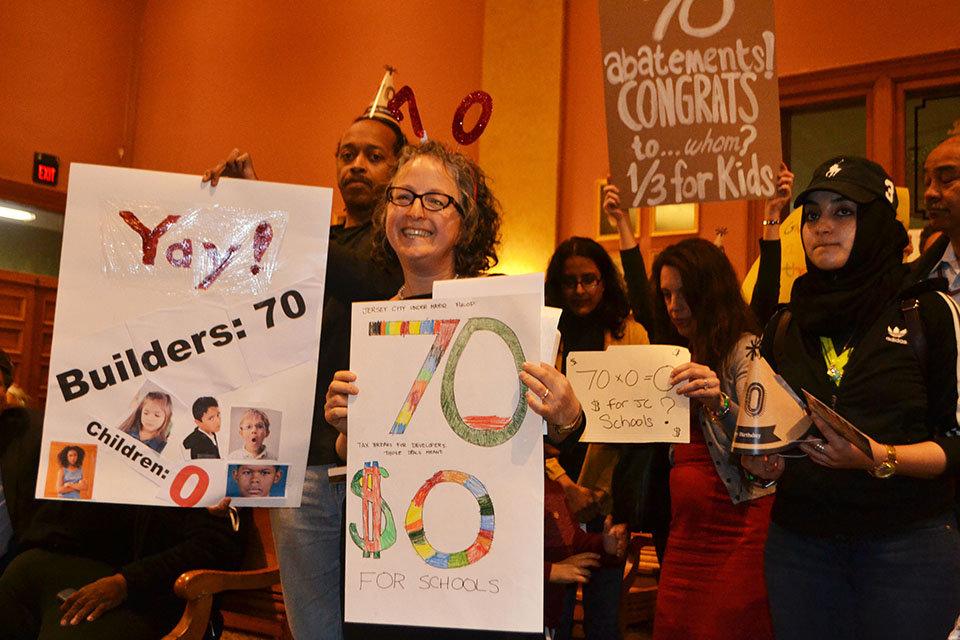
The March 8th Jersey City City Council meeting was one of the most "festive" in recent memory as over 20 Jersey Cityans came to the meeting to throw a party in honor of the 70th PILOT of Steve Fulop's term.  (see this for a video story)

March 8th Protest, Jersey City
The party featured hats, balloons, brightly painted signs that said "Builders:70, Children:0," and even an "Abatement Cake of Shame." Along with the mock giddiness, there was a real message: Steve Fulop was ripping off the school system.

In response to protest, Jersey City's City Council members made several defenses of their pro-abatement policy, such as that development would not occur in the poorer sections of Jersey City without abatements and that the abatements were usually only for five years only.

I don't necessarily disagree with those arguments, but Councilwoman (and Fulop ally) Candice Osborne made an argument that Jersey City actually came out ahead in tax abatement deals. Osborne even said she had a "mathematical model" to prove it.  (See 2:49:30)

When it comes to the funding for schools. I have gone though the numbers multiple times and I've said this many times...The math to me makes sense for both the people getting the abatement as well as traditional taxpayers - because of the state aid. 
I have a model. I would love for someone to tell me I'm wrong. Point out where I'm wrong. When I look at it, it makes sense for us to give the abatements. Financially.

Though Osborne never got around to explaining her "mathematical model" at that meeting, on other occasions she and other Jersey City politicians have made the argument that PILOTs are a net-positive for Jersey City, so I know what the argument is supposed to be.  The argument is that 95% share of the PILOT fee for municipality means that municipality would have more money than it would through through normal taxation, even though the PILOT fee is less than normal taxes would be.

But this is such an incomplete look at Jersey City's taxation that it's wrong because Jersey Cityans have to make up for all of the lost school and 36% of the lost county taxes.

Unless the abatement fee exceeds 86.1% of what a development would pay under regular taxation or the abatement truly is a "but for" component of financing for the development, Jersey City's taxpayers are net losers in any abatement deal, even under the state aid status quo.  (the math is below)

And since Jersey City's PILOTed buildings only pay 60% of regular taxes ($127.8 mil out of $212 mil), they are coming out behind.

Here's why: 

Based on what other Jersey City politicians have said, this is what Osborne's argument probably is.  

In Jersey City under normal taxation, the municipality gets 49.1% of the money, the school board gets 25.8%, and Hudson County gets 25.1%.  

Under (long-term) PILOT fees, however, the municipality gets 95% of revenue, the school board gets 0%, and Hudson County gets 5%.

Since the municipality gets such a higher percentage of PILOT fees than regular taxes, it's possible to structure a PILOT deal so that the municipality alone comes out with more money than it would otherwise have.

Since Jersey City's municipal government "only" gets 49.1% of regular taxes, if the PILOT fee exceeds 51.7% of regular taxation, the municipal government comes out ahead, since 95% of 51.7% equals Jersey City's normal 49.1% share of taxation.

(Jersey City's county taxes would also be offset slightly by the 5% to the county, but I have not considered that here.)


But municipal taxes aren't the only taxes that Jersey City taxpayers pay.

Like everyone else, they pay school taxes and county taxes.

And since the school district and Hudson County get so much less money than they would under normal taxation, other Jersey City taxpayers have to take up the slack.

The direct and clearer loss to Jersey City taxpayers is through the complete loss of school taxes, but, as we will see, there is also a substantial loss of County taxes that Jersey Cityans have to make up for.  

FIRST, for school taxes, since the Jersey City BOE gets 25.8% of total taxation, the combined municipal+school tax share in Jersey City is 74.9% (49.1% + 25.8%).

So, before we even consider the loss of county taxes, the threshold that a PILOT fee would have to clear to be net positive is 78.9% (74.9 = 95% of 78.9)

78.9% of regular taxes is much higher than Jersey City's average PILOT arrangement, and even this raw calculation excludes the impact of the new residents, students, or workers at the PILOTed property.  I assume the marginal costs to the municipal government are low, but the costs aren't zero either. I don't know how many K-12 kids would be in a residential PILOTed building, but likewise, it isn't zero.

SECOND, even that 78.9% amount excludes the loss of Hudson County taxes, for which other Jersey City taxpayers have to make up 36% of the losses.

This is a more complex assessment, but what Osborne is ignoring is that Jersey City taxpayers pay 36% of Hudson County taxes (based on JC's having $25.7 billion in Equalized Valuation against $71.4 billion for all of Hudson County).

So any exclusion of property from county taxation has to be made up for by other Hudson County taxpayers and 36% of Hudson County's money comes from Jersey City anyway.  True, people elsewhere in Hudson County pay the majority of Hudson County taxes, but Jersey City's share is substantial and must be factored into any assessment of the net-fiscal benefits of PILOTs.

In other words, for every $1 million in taxes that Hudson County loses to PILOTing, Jersey Cityans themselves would make up for $360,000 of that loss.

The Jersey City City Council evidently thinks that ripping off Hudson County is good for it because instead of sending 25.1% of tax revenue to Hudson County it only has to send 5% of PILOT revenue, but  36% of the 20.1% of lost county taxes is paid for by Jersey City anyway.

Since 36% of 20.1% is 7.2%, it's necessary to add another 7.2% to the 78.9% municipal+school break-even point, bringing us up to an 86.1% break-even threshold.

An Example

To give an example, if a property would pay $5 million in taxes, normally Jersey City municipality would get $2,455,000, the school district would get $1,290,000, and Hudson County would get $1,255,000.

So, of this amount, Jersey City taxpayers would directly get $3,745,000 offset from their school and municipal taxes.

Jersey City doesn't get the whole benefit of the $1,255,000 offset to Hudson County taxes, but it gets 36% of that, or $451,800.

$3,745,000+$451,800 = $4,196,800.

Now let's compare this to the same property but has a PILOT deal that requires it to pay 85% of regular taxes, or $4,250,000, which is extremely close to the 86.1% break-even point.

Of that $4,250,000 amount, the municipality gets 95%, or $4,037,500 and Hudson County gets 5%, or $212,500. The offset to Jersey City's county taxes is 36% of that $212,500 PILOT fee, or $76,500, so Jersey City's net benefit is $4,114,000

That's a substantial amount, but $4,114,000 is less than the $4,196,800 benefit it would have gotten from full taxation.  

So even at 85% of regular taxation and neglecting the costs of new residents/workers/students, Jersey City loses.

Jersey City Thinks that Since Hudson County is Hurt More than Jersey City, that Jersey City Isn't Hurting Itself Too

Right now Jersey City's PILOTs are (estimated) 14% of Hudson County's official Equalized Valuation ($11.6 billion out of the $71.4 billion total), so every Jersey City taxpayer's county taxes are 14% higher than they would otherwise be due to so much Jersey City property being PILOTed.)

Does Osborne consider this?  14% is not a trivial increase.  It means $50 million in higher county taxes for everyone in Hudson County, a significant share of which comes from Jersey City itself.


The Exceptions to PILOTs Hurting Taxpayers

The only time I think a PILOT would be a real fiscal benefit to a town is if the abatement is a truly a "but-for" component of financing. If a development honestly wouldn't get built without the tax abatement, then the PILOT deal would be a net positive, since the PILOT fee of the new, larger building would likely exceed the taxes paid by the existing, smaller building.

HOWEVER, even this "but-for" argument is time-sensitive. Perhaps a development project wouldn't "pencil" now, but perhaps it would in five years? Journal Square might have been economically marginal for developers a few years ago, but is it now? I think not.  Although a but-for PILOTed development might accelerate growth, it's possible that that growth would arrive without abatements if the neighborhood had a few years.

Also, there might be non-quantifiable benefits in granting a PILOT if it enables some kind of historical preservation, superior architectural quality, or other services from the developer.

So, unless the abatement truly is a but-for factor, or if the building is an architectural treasure, Jersey City's PILOT addiction causes other Jersey City taxpayers to pay higher taxes than they would otherwise or not get any positive externality either.

The Spectre of State Aid Redistribution

If SFRA is followed, the flat aid will last forever,
not just for a few years. (The chart refers to 2015 because
I'm recycling this graph from a previous post.)
HOWEVER, the above calculations don't factor in state aid and fact that even if Adjustment Aid is preserved, Jersey City will not gain any state aid for decades and therefore have to pay for an increasing share of its school budget through local taxation.

The Jersey City Public Schools have a Total Operating Budget is $570 million (for K12).

 Since education inflation is 2-3% a year, the school budget should increase by $11-$17 million per year to avoid cuts.

Since Jersey City is already overaided, it will never gain state aid, so that whole $11-$17 million increase has to come from Jersey City's own taxpayers.  Since Jersey City's school levy is only $114 million, that means that Jersey City has to accept 10-15% tax increases, even though over a third of Jersey City's property won't pay a cent since the property is PILOTed.

Also, there is the likelihood that Jersey City will lose its Adjustment Aid.

In the scenario of lost Adjustment Aid, Jersey City's City Council might support PILOTing because they think that a PILOTed property is "invisible" to the formula for Equalization Aid, but this is only half right.

Only a non-residential PILOTed property is invisible to the formula for Equalization Aid; a residential PILOTed building is only "half-invisible" to the formula for Equalization Aid, since Local Fair Share is based partly on Aggregate Income and the incomes of PILOT residents count towards Aggregate Income.

So, let's say that a PILOTed luxury residential building has 1,000 adults living there. Can you make a guess what  Aggregate Income would be? It could be $100 million.

Since the formula for Local Fair Share requires towns to pay 2.3% of income in school taxes, that means that for every $100 million of income by PILOT residents, Jersey City's Local Fair Share increases by $2.3 million. (FYI: for formula for Local Fair Share in 2016-17 2.3% of Aggregate Income plus .65% of Equalization Valuation).

Lost State Aid = High School Taxes for the Owners of Non-PILOTed Property

Right now Jersey City gets about 150% of its recommended SFRA funding, but if the state started to give Jersey City only 100% of funding, it would lose state aid every time it PILOTs a building. The loss of state aid would not be as great as the loss would be if the project were unPILOTed, but at least an unPILOTed building would pay school taxes and a PILOTed building right now pays $0.

Jersey City's Boom is Real
See:
http://bit.ly/2dw1M9u
Candice Osborne evidently believes that Jersey City's state aid will never be redistributed, despite its undeniable increase in wealth.  Given gubernatorial frontrunner Phil Murphy's refusal to even mention Adjustment Aid, she might be correct, although also on March 8th Osborne and the whole Jersey City City Council unanimously voted to spend $75,000 to hire a law firm to defend Adjustment Aid, something they never thought necessary before.

March 8th, Clifton Protest
On the Same Day Osborne Acted as if Jersey
City's state aid would never be cut, 300 Clifton
Students Demanded Justice.

Whatever Murphy wants, Chris Christie is still the governor for another nine months and Christie is open to eliminating Adjustment Aid. The only thing standing between Jersey City and the elimination of Adjustment Aid might be Vincent Prieto, the NJEA, (and Christie's own overreach.)

And awareness of the savage inequalities of New Jersey's aid distribution has never been higher.  At the same time that Jersey City was odiously hiring a law firm to keep its Adjustment Aid, students in Clifton were demanding state aid justice.  Kingsway Regional's lawsuit to have Adjustment Aid declared unconstitutional also continues.

Jersey City's Board of Ed Must Raise Taxes Too

I have respect for the tax abatement protesters at last night's meeting, but technically, tax abatements hurt the taxpayers, not the school system.

This is because a Board of Education sets a tax levy, not a tax rate, and whatever tax levy it sets it automatically gets.

So if Jersey City never PILOTed anything it wouldn't mean that the Board of Ed had a cent of additional money unless the Board of Ed made the decision to increase taxes beyond 2% a year, which it hasn't done, despite the gigantic increase in Jersey City's non-PILOTed tax base.

If none of Jersey City's development was PILOTed, what would happen is that everyone else's taxes would be offset.  Non-PILOTed development anywhere doesn't automatically have any fiscal benefit to the schools.

So I'm glad to hear about the protest at the City Council meeting, but for the school system to have more money, people have to protest at the Board of Ed too and demand a higher tax levy.

(See, "Why Jersey City's new unPILOTed Skyscraper Will Help Taxpayers, Not Necessarily the Public Schools")

---

See Also:


Why Jersey City's Lawsuit Against Redistribution is a Good Sign

Mayor Steve Fulop and the Jersey City City Council have announced that Jersey City is going to hire
Up Until Now, Fulop has relied on Vincent Prieto
to block state aid redistribution.
a law firm to fight off any attempt to redistribute Jersey City's $420 million in state aid.

Before I get into why this is a good sign, let's have some backstory about Steve Fulop and state aid.

After state aid redistribution became a possibility in early 2016, Steve Fulop refused to discuss the subject in a serious way.


Fulop showed his immaturity in a series of petty attacks on Jack Ciattarelli, where when Ciattarelli said that Jersey City's economic growth indicated that its state aid needed to be redistributed, Fulop returned fire by bragging about Jersey City's economic growth.

“It’s easy for local policy makers to achieve tax reductions when the state subsidizes their services,” said the Assemblyman. “The fact is, fiscally speaking, we’re experiencing a very painful squeeze or crowding out effect with our state budget. Overly generous property tax abatements are one of the reasons why. These abatement are not only an exploitation of our state school funding formula, they are an injustice to property owners in places like Jersey City. In trying to solve the state’s problems, we need policy makers at all levels of government to take these issues seriously. In that respect, the statement issued by the Fulop camp is an embarrassment and a disservice – a disservice to the taxpayers of this state who fund Fulop’s school system.”

To which Fulop responded in a way that proved Ciattarelli's point:

“Jersey City had a tax reduction last year and just today we will adopt a budget without a tax increase. Jersey City has led the state in job creation just as we had a credit upgrade last year.

After that, Fulop switched tacks to refusing to say anything in public about state aid, but using his control over Assembly Speaker Vincent Prieto to block reform.

His comments at this point were few and far between. By September 2016, according to Jersey Journal reporter Terrence McDonald, "Mayor Steve Fulop has declined several times to comment on Christie's and Sweeney's plans" other than to say it was a " long road" to reform becoming a reality and then another ignorant statement on how SFRA works "Urban education is very complex. I don't think in certain areas parents and cities have the same means to pay as in some of the suburban areas."

Which of course is an untruth regarding Jersey City. For 2016-17 Jersey City's school tax rate was 0.47, less than half of New Jersey's 1.3 average, so certainly Jersey City can pay more than that.

Over the next few months Fulop was again silent, but he used his clout with Assembly Speaker Vincent Prieto to block state aid reform.  (even though Prieto actually represents several of New Jersey's most underaided districts)

Yet by February 2017 state aid reform had enough momentum that Fulop decided he had to say something and what he said was bullshit, claiming state aid redistribution was “clearly an attack on poorer, primarily African American, Latino and minority districts.” Fulop also gave a two-faced argument where he claimed that only Jersey City's waterfront is doing well (even though Jersey City is a single-entity from the point of view of taxation), even though Fulop constantly claims to Jersey City audiences that the whole city is thriving.

Anyway, after Steve Sweeney tore apart Fulop's arguments and Fulop's distortions were exposed again Fulop decided that what Jersey City needed to do was hire a law firm for $75,000 to fight off the redistribution of Adjustment Aid.

As Fulop spokesperson Jennifer Morrill said: "Our plan is to continue to fight for Jersey City students and residents every step of the way."

Or in other words, "if it's good for Jersey City, then screw everyone else."

Public Opposition is a Good Sign!

While many people are angry about Jersey City's litigation and blatant indifference to the fate of the rest of New Jersey, I think the litigation itself is a good sign.

Fulop never took state aid reform seriously prior to this winter.  Presumably he knew Prieto would block it.

But now that Fulop is actually speaking out against redistribution and wasting $75,000 of Jersey City's money on a law firm it means that Fulop has a fear of redistribution that he didn't have before.

We in the public have never been privy to what conversations Steve Fulop and Vincent Prieto have.  All we know is that Fulop is against state aid redistribution and he boasts "I have significant clout with the Speaker."

But if Fulop is now hiring a law firm, that means that either his control over Vincent Prieto is loosening or Prieto has told him that he isn't going to be able to block state aid redistribution much longer.

So while it's infuriating that Fulop and the City Council have this unbelievably self-interested mentality (they all purport to be progressives), the fact that they finally feel they have to fight for Adjustment Aid means that they finally take seriously the prospect of its elimination.

Jersey City City Council:
If It's Good for Jersey City,
Then Screw Everyone Else


Thursday, March 2, 2017

Jersey City PILOTed Property is Worth $11.6 Billion

FYI, this article by Terrence McDonald of the Jersey Journal about Jersey City PILOTs is worth reading for several reasons, but I wanted to point out something from the conclusion of the article:

Last year Jersey City's PILOT program took in $127,800,476 from tax-abated properties. If all these properties were taxed conventionally, the total would be $211,967,791.
None of This Pays Any
School Taxes
(The relevance of this to state aid is that PILOTed property is "invisible" to the formula for Equalization Aid, thereby sustaining an artificially high state aid package for Jersey City.)

The State of New Jersey has no comprehensive database on how much property towns have in PILOT status, but the publication of  what Jersey City's PILOTed properties would pay if they were subject normal taxation allows one to calculate what the PILOTed properties are worth.

Jersey City's all-in tax rate is only 1.826%.

If Jersey City's PILOTed properties would pay $211,967,791 in taxes, that means that their full valuation is $11.6 BILLION.

$211,967,791 / .01826 = $11,608,312,760.10

This is up substantially from 2015, when Jersey City's PILOTed properties were only worth $8.6 billion.

$11.6 billion is a gigantic amount, it is equal to 45% of Jersey City's $25.7 billion in taxable property.

If Jersey City's PILOTed properties were an independent city, their Equalized Valuation would be the seventh largest in New Jersey.

Here are the top Equalized Valuations in New Jersey:

  1. Jersey City's (taxable) $25.7 billion
  2. Edison $15.8 billion
  3. Toms River $15.167 billion
  4. Hoboken $15.128 billion
  5. Newark $13.8 billion
  6. Ocean City $12 billion
  7. Jersey City's PILOTed $11.6 billion
  8. Middletown $10.6 billion
  9. Woodbridge $10.5 billion

At Jersey City's tiny 0.471% (Equalized) school tax rate, those PILOTed properties should be paying $54,675,153.10.

The $11.6 billion is also equal to 16% of Hudson County's $71 billion in Equalized Valuation.  At Hudson County's 0.458% tax rate, that means that that PILOTed property should be paying $53 million in county taxes.

Hence, the distortion of Hudson County's taxation cannot be ignored any more than the distortion of school taxes and school aid can be.

This means that taxpayers in Hudson County's several severely underaided school districts - like Bayonne, Guttenberg, East Newark, North Bergen, and Kearny - are victimized twice by Jersey City; first as state taxpayers who must subsidize Jersey City's schools, second as Hudson County taxpayers who must subsidize Jersey City's county services.

As Jersey City blogger CivicParent has documented, when Steve Fulop of Jersey City campaigned in 2013 for mayor, he attacked the incumbent (Jerramiah Healy) for granting PILOTs, saying PILOTs "robbed the schools."

If elected, Fulop swore he would share PILOT revenue with the Board of Education.

HOWEVER, after he won the election, Fulop immediately forgot that promise.

Although there has been an attempt to reduce downtown tax abatements - Fulop should get credit for not PILOTing the supertall skyscraper 99 Hudson Street - since Fulop became mayor Jersey City has given out 70 PILOT agreements, presumably worth billions.

Although the primary thrust of Steve Sweeney's state aid reform fight is to eliminate Adjustment Aid, Sweeney's effort to end the distortion of state aid that results from PILOTing cannot be ignored either.


----
See Also


Saturday, January 14, 2017

Dear NJ Journalists, Vincent Prieto DOESN'T Represent Jersey City (He just acts like he does)

I was bemused by a recent story on PolitickerNJ by JT Aregood about the the politics of state aid reform. The article contrasted Steve Sweeney's plan, which is prescriptive and is clearly an attempt to redistribute Adjustment Aid to underaided districts, with Speaker Vincent Prieto's vague plan for yet another legislative committee "without predetermined outcomes or politics."

In attempting to explain Prieto's frosty attitude towards redistributing state aid, the article made a very telling, very blatant error.

Prieto, whose home district encompasses Jersey City, opposes Sweeney’s plan. 
Jersey City and other districts in Hudson County would stand to lose under Sweeney’s plan to phase out state Adjustment Aid and funding caps for districts with significant enrollment changes over five years. 
Those protections for individual districts were put in place in 2008, the last time lawmakers revised the school funding formula. Sweeney holds that removing Adjustment Aid and funding caps would bring every district in the state to 88 percent funding.
John Reitmeyer made the same error in a piece on NJ Spotlight:
But so far, Prieto is not onboard with Sweeney’s proposal, which could significantly cut funding for school districts in some of the communities Prieto represents, including Jersey City.
wrong Wrong WRONG!!!


Vincent Prieto does NOT represent Jersey City!
Vincent Prieto represents District 32, which includes East Newark, Edgewater, Fairview, Guttenberg, Harrison, Kearny, North Bergen, Secaucus, and West New York.


Jersey City is in legislative Districts 31 and 33. Its Assembly members are Nicholas Chiaravalloti, Angela McKnight, Annette Chaparro, and Raj Mukherji, NOT  Vincent Prieto.

Every single district in District 32 is underaided, with East Newark, Fairview, Guttenberg, and Kearny being severely so.

East Newark, in fact, is the third most underaided district in New Jersey, with an aid deficit of $7782 per student.  East Newark's school spending is barely $10,000 per student and its students attend school built in the 1890s.

Fairview is NJ's fifth most underaided district too, with a deficit of $7,118 per student.

(See: "Will Vincent Prieto Put Hudson County First")


I wouldn't be surprised if Jersey City's four Assemblymembers are urging Prieto to preserve Legalized Aid Hoarding "Adjustment Aid."  Raj Mukherji, for one, has made public statements defending Jersey City's state aid.  But, Vincent Prieto does not have a single Jersey Cityan or Hobokener among his actual constituents.

Then again, maybe Vincent Prieto's most important constituent is just Jersey City Mayor Steve Fulop?

It was Steve Fulop himself who told PolitickerNJ:

“We’re lucky to have the speaker here,” he said, a reference to Assembly Speaker Vinny Prieto (D-32). “I have significant clout with Speaker Prieto.”
Indeed. Steve Fulop has tipped off his influence over Prieto and the Assembly in his statement it would be a "long road" before any state aid changes happened.

Based on Prieto own constituents' interests as well as the state-interests he is supposed to act in as Speaker of the Assembly, Speaker Prieto should be in the vanguard of state aid reform.  His indifference to this issue and clear attempts at stalling reform is hard to understand unless it is an attempt to benefit Jersey City, Weehawken, Hoboken, and Jersey City's mayor, Steve Fulop, at the expense of poor districts.

Why is this?

The 8th Congressional
district does include the
Gold Coast.

Agusten Torres reports that Vincent Prieto wants to represent the 8th Congressional district, after Rep. Albio Sires retires, and the 8th district does include Jersey City and Hoboken.

Prieto's residence in Secaucus is not in the 8th district, but since Prieto is originally from Union City, his personal relocation to a town in the 8th district would not be a major move.

If Prieto does have designs on Sires' seat, then Steve Fulop's support would be critical in the Democratic Party.

-----------

Finally:

Not Everyone from Jersey City is Against Justice

I do not think that every Jersey City politician is opposed to state aid reform.

Sens Sandra Cunningham and Brian Stack actually abstained from voting on Steve Sweeney's aid bill. Councilman Michael Yun has said Jersey City's state aid "doesn't make sense."  Mayoral challenger Bill Matsikoudis seems resigned to, not opposed to, having Jersey City's state aid cut, a position I believe a few Jersey City BOE members also share.

There are also many ordinary Jersey Cityans who recognize that Jersey City has become wealthier and can pay for more than 17% of its school budget.  Many Jersey Cityans warn City Hall to reduce its promiscuous PILOTing due to the inevitability of state aid losses.

The people in Jersey City who are operating contrary to progressive values are Steve Fulop and a clique around him.


Thursday, June 23, 2016

Sweeney, Prieto Condemn Christie Proposal; Murphy, Fulop Silent

Update: This post was accurate when written.  Phil Murphy has now tweeted criticisms of Christie's unfair aid plan.


Senate President Steve Sweeney and Assembly Speaker Vincent Prieto both immediately criticized Chris Christie's proposal to redistribute state aid so that every district receives an equal $6500 per student.

Here's Steve Sweeney, speaking with fellow state aid reformer Teresa Ruiz:

“The governor’s proposal is a direct attack on the core principles of equality for all of New Jersey’s communities, denying too many schoolchildren the opportunity for an equal education. “This plan is unfair, it is unjust and it is blatantly unconstitutional. “It is a maneuver that discriminates against the most vulnerable students and would systematically deny children an equal opportunity to achieve the American Dream.

Children do not choose their zip codes, and this proposal decimates educational opportunity, resulting in more poverty and increased income inequality. It is a divisive plan that’s not fit for New Jersey. “Which is why the school funding proposal we sponsored recognizes the values of this state, the values the people of New Jersey committed to in the 1947 Constitution.

We believe in those values and we know the people of New Jersey do as well. We want to pursue excellence in education, not limit it to those who already possess the advantages. We don’t want to give up on the families throughout the state who look to educational opportunity as the equalizer that can help their children succeed in the rapidly-evolving economy.”
Ok, good.

Vincent Prieto also condemned Christie's proposal, although he came out with a call to fully fund SFRA that I see as hopelessly unrealistic:

“Gov. Christie’s idea is unconstitutional and harmful to our most vulnerable children. Gov. Christie has been in office for more than six years and not once has he fully funded the school funding formula that would provide increased aid and property tax relief to school districts throughout New Jersey. In fact, he even vetoed a Democratic initiative (A4203 in 2011) to accomplish that goal. If Gov. Christie truly wants to undo the damage caused by his policies, he must acknowledge his responsibility by working with legislators to finally fully fund the existing – and constitutional - school funding formula.”
I'm not going to get into why NJ can't fully fund SFRA, but at least Prieto is right that Christie's proposal is "harmful to our most vulnerable children."

What's disappointing is that it's now over 48 hours after Christie made his state aid proposal and Steve Fulop and Phil Murphy have been totally silent.

Steve Fulop's not shy about criticizing Christie, but he initially refused to comment until he sees the official proposal.  Doesn't he know enough about state aid to know that equal funding per student is nonsense?  Doesn't he know enough about Jersey City to know that it receives substantially more than $6500 per student and would be a massive aid loser?   

Apparently Fulop knows enough about state aid to forward a reporter a condemnation the Education Law Center wrote, but he doesn't care enough to write something himself.  

Phil Murphy is showing the same silence, even though Murphy is usually more aggressive in attacking Christie than Fulop is.  
I appreciate Phil Murphy's stances on gun control, but being governor involves more than just signing gun control legislation.  

Fulop and Murphy's Facebook pages are equally silent.  

Are Murphy and Fulop ceding state aid as a political issue to Sweeney?  

It's not like a Tweet takes long to compose.  It's literally the least they could do.   

UPDATE: 
Phil Murphy Tweets three days later about Christie's proposal in response to a press release from Ras Baraka.

https://twitter.com/PhilMurphyNJ/status/746427805915807744

Thursday, April 7, 2016

Will Vincent Prieto Put Hudson County First?

The only ray of light on the landscape of New Jersey school aid is the long-incubating, still-unreleased aid reform bill that Senate President Stephen Sweeney and Senator Jennifer Beck are working on.

Given that Sweeney is the Senate President and Beck is a respected Republican, the bill's chances in the State Senate are fairly strong. Chris Christie will have the final say on whether this bill becomes law, but even before the bill gets to Christie the bill would have to pass through the State Assembly where the political calculations are much less certain.

Even before any vote takes place, this may come down to Assembly Speaker Vincent Prieto.

Prieto's own constituents are severely underaided and he should be spearheading aid reform (more below), but he has a close relationship with Jersey City Mayor Steve Fulop.  Prieto is a backer of Fulop for governor and is not inclined to do Steve Sweeney any favors.

Star-Ledger columnist Agusten Torres says the the Fulop-Sweeney-Prieto dynamic goes like this:

Prieto is the counterbalance in the state Legislature to Senate President Steve Sweeney, who is considered a major Fulop rival for governor. If Sweeney tries to get legislation approved that would enhance his political stature or hamper Fulop's, Prieto is there to "fix" the situation or seek a compromise. I am not insinuating that their actions would hurt the state or its residents – you're thinking those thoughts. A classic example is the battle with Sweeney over competing legislation for adding two new casinos in New Jersey.
The Assembly Speaker's loyalty could well be rewarded when it is time to find a seamless replacement for U.S. Rep. Albio Sires of West New York, who is like Prieto, a Cuban-American out of North Hudson. A possible Gov. Fulop's endorsement would boost a Prieto run for Congress in 2018.
I wouldn't go as far as Christie went about Fulop being Prieto's boss, but the close relationship is there.  Fulop himself has said "I have significant clout with Speaker Preito."


Prieto himself is the chairman of the Hudson County Democratic Organization. As chairman, Prieto has made strengthening the Hudson County Democratic Organization a priority, saying "The (Hudson County) Democratic organization has always been renowned across the state. It's something everyone always talks about. We want to restore it to what it has been."

Since redistributing state aid would offend the Hudson County Gold Coast aid hoarders, Prieto may be reluctant to allow a vote to even take place.  Mayor Steve Fulop's strong opposition to a property tax revaluation for Jersey City indicates that he would oppose even more strongly the redistribution of state aid, since that would cause money to leave Jersey City instead of just be redistributed within Jersey City.

Christie and Zimmer
(This was pre-Hurricane Sandy)
Nor would Fulop be the only alienated Gold Coast politician. Among just the Gold Coasters who have been vocal about maintaining aid levels, Jersey City/Hoboken Assemblyman Raj Mukerji who defended Jersey City's state aid, saying critics of it "don't get the challenges of urban education,"   Jersey City/Bayonne State Senator Sandra Cunningham, who voted against SFRA in the first place, Assemblyman Ruben Ramos of Hoboken who had no qualms about demanding 100% state-funding for construction in Hoboken despite Hoboken's astronomical tax base and desperation elsewhere.  Mayor Dawn Zimmer of Hoboken has been more of a passive exploiter of the rest of the state, but she puts low taxes as a major priority and while clearly a Democrat endorsed Chris Christie in 2013 (well before Hurricane Sandy), saying "he had been good for Hoboken."

A greater difficulty of prediction is that Prieto is not an education legislator by any stretch.  At his 2016 swearing in as Assembly Speaker his only remark on education was a platitude that he wanted "Quality of education for all children."

Although Prieto voted for SFRA, his statements on education funding are few and far between. What few stances he does take on education funding are restricted trying to get more money to vocational education and Pre-K, although he never proposes any offset to pay for either. The education funding legislation Prieto has sponsored has included every kind of education other than K-12; he has sponsored money for vo-tech, adult education, county colleges, a NJ version of the Dream Act, aid for nursing students, and $110 million for Pre-K but nothing for K-12 in at least the last two legislative sessions.

In fact, Prieto seems to think that the education-world talks about funding too much.

Prieto's points about how little attention vo-tech gets in contrast to K-12. In an interview Prieto said “[Vo-tech] one component in education that’s often neglected. We always talk about K through 12 and higher education."

Prieto is right about vo-tech, but do we really "always" talk about K-12?

The vo-tech bill, which Prieto has authored in multiple legislative sessions, is telling because it would give additional state aid to vo-techs whose student populations have gained 10%. Why Prieto does not author a parallel bill for K-12 districts whose populations have grown by 10% is beyond me.

What is shocking about Prieto's lack of interest in education funding is that Prieto's constituents are among the most underaided in New Jersey.

And who are his constituents?

Despite his deep involvement with Hudson County politics, Prieto does not, in fact, represent "Hudson County."

Prieto's constituents are the residents of a legislative district known as "District 32," consisting of East Newark, Edgewater, Fairview, Guttenberg, Harrison, Kearny, North Bergen, Secaucus, and West New York. He does not represent Jersey City (overaided by $130 million or $4,272 per student, plus Pre-K), Hoboken (Officially overaided by $7.5 million or $2,887 (but I believe Hoboken's SFRA aid target is too high given its wealth), plus Pre-K), or Weehawken (overaided by $1 million or $773 per student).  District 32 touches the Hudson River, but the Hudson River towns of District 32 aren't prime "Gold Coast" real estate (yet).

And Fairview and Edgewater are in Bergen County too.

All of the school districts of District 32 are underaided, sometimes severely so.  East Newark is NJ's third most underaided and is farther below Adequacy than any other district.   Fairview is the fifth most underaided and is the lowest spending district in New Jersey.  Guttenberg is the 10th most underaided district in New Jersey.


The cumulative aid deficit for District 32 is $103 million. Since the total deficit for all 380 underaided districts (not counting vo-techs) is $-1,871,376,087, District 32 alone represents 5.5% of the state's total aid deficit.


District 32's cumulative deficit has to be one of the largest of any legislative district in New Jersey.

When I Googled Prieto and "SFRA," "state aid," etc I get nothing substantive. In Prieto's Twitter and Facebook feed references to education are almost nonexistent and I went back years. There are no photos of Prieto visiting schools that many other politicians like to share.

When Christie came out with his FY2017 budget, Prieto ignored the underfunding of SFRA and the unfair distribution within the amount that was disbursed.


Governor Christie gave his annual budget address to the legislature today and he continued to mislead on several of our...
Posted by Assembly Speaker Vincent Prieto on Tuesday, February 16, 2016
Prieto is a progressive and supports important parts of the progressive agenda, especially measures to alleviate poverty, but on education funding there is nothing there.

Prieto's constituents are uniquely underaided, but Prieto is not unique in indifference to education funding or prioritization of pensions and the Transportation Trust Fund.  However, most other legislators from underaided districts don't depend on politicians from NJ's most overaided districts for political support nor want the mayor of NJ's most overaided city to become governor.

In contrast to Prieto is District 32's State Senator, Nicholas Sacco (also mayor of North Bergen). While I haven't heard Sacco call for redistribution, Sacco is fired up about state aid unfairness. Sacco called the Abbott district list "totally artificial" and says "tell me the difference between North Bergen, Union City, and West New York in the real sense of the children?"  "Because of the state’s bizarre interpretation of the funding formulas, districts like North Bergen, that are not wealthy and don’t receive Abbott funding, are hurt the worst."

(Sacco overstates the similarities, but his basic point is correct.)

Redistribution has to Happen

It's 2016 and New Jersey's economy remains below where it was pre-Recession.  Whereas the country has recovered 154% of the jobs lost in the Recession, we have recovered on 87% and in January and February 2016 New Jersey had  a net loss of jobs.  The state's debts are more intractable than ever.  Moody's has cut our outlook from "Stable" to "Negative."  The pension funds lost over 6% of value in the twelve months preceding February 2016.   If NJ loses Berg v Christie (over COLA suspension) the state's obligation will increase by $500 million.  Even without COLAs, NJ's unfunded pension obligations increased by over $2 billion last year.

There's always going to be another recession, but even before the next one arrives, New Jersey is not going to be able to fully fund SFRA even if the next governor is willing to raise taxes.   I don't even think the current $8 billion distribution is sustainable.

Although redistribution wouldn't come close to bringing all underaided districts up to their SFRA targets, it would be more than enough to bring severely underaided districts up to less-awful deficits and among those severely underaided districts are several in District 32.  Hoboken/Jersey City Assemblyman Raj Mukerji said that critics of Jersey City's state aid "don't get the challenges of urban education," but he's flat out wrong.  The critics do get the challenges, but see identical or more severe challenges outside of Jersey City, know the state's finances are limited, and know that Jersey City's $22 billion tax base is capable of paying more than $112 million in school taxes.

Given who is real constituents are in District 32, Prieto should be leading the charge for fair aid on his own, but because of a personal lack of interest and political conflicts of interest with Gold Coast politicians, Prieto has done nothing.

Now the question is what will happen when the Sweeney/Beck bill forces Vincent Prieto to take a stand on education funding and the acceptability of redistribution.  If so, Prieto will have to choose whether his aspiration is to serve his own constituents or his "friends" in Jersey City and Hoboken.


Prieto with the Gold Coast Team:
L-R: Hoboken Mayor Dawn Zimmer, Hoboken/JC Assemblywoman Annette Chaparro, Hoboken/JC Assemblyman Raj Mukherji, Jersey City Mayor Steve Fulop, Vincent Prieto.


See Also:

Monday, April 4, 2016

State Orders Jersey City Reval

The State Department of the Treasury has announced that it will order Jersey City, Elizabeth, and Dunellen to conduct revals to be completed by November 2017.

Jersey City's property taxes are the state's most unfair.  Whereas most towns have Coefficients of Deviation below 15% and only 27 even have Coefficients of Deviation above 20%, Jersey City's is an ever-climbing 39%.  This effectively means that some Jersey City taxpayers in ungentrified sections of Jersey City are paying triple what they should pay whereas Jersey City taxpayers who live in gentrfied sections are paying a third.

Although Dunellen and Elizabeth have also gone decades without doing revals, their Coefficients of Deviation are not even close to Jersey City's and while their assessments are out of date, they are much less unfair.

"In the Marines we had a saying 'Never Reapportion
Property Taxes, Never Redistribute State Aid.'"
Steve Fulop's years-long opposition to a reval shows an indifference to fair taxation and basic good government.  His attack on a reval as motivated "purely by hatred of me" is delusional and is just a cover of the real reason, ie, he doesn't want gentrified parts of Jersey City to pay their fair share.

Now Jersey City's FY2018 will be CHAOS as taxpayers experience immense swings in property assessment, taxation, and even the value of their homes.  The changes in property value themselves will inspire thousands of tax appeals from people whose houses now have higher tax burdens.

Since Jersey City's last reval was in 1988, chaos was inevitable, but by delaying the reval for four years as mayor, Steve Fulop has made it worse.

Woe to fair aid and New Jersey's underaided districts if Fulop were to become governor and employ the same logic he used to to block redistributing state aid.

Update:   Steve Fulop said on his Facebook page that the state's attempt to make Jersey City tax itself fairly is bullying:

As a city, we aren't going to let a bully pick on Jersey City without calling him out. We will do the reval when the same rules apply to the other 30 municipalities in the state. We will do the reval fairly and properly in order to protect residents, but not in a format dictated by Governor Christie's politics. 
We didn't create this problem but the Governor has a long track record of using government resources to push around political opponents and we will call it out when we see it.
http://www.nj.com/politics/index.ssf/2016/04/nj_to_order_revaluations_in_3_municipalities.html#incart_river_index

http://njeducationaid.blogspot.com/2015/11/jersey-citys-property-taxes-are-states.html

Monday, November 30, 2015

Jersey City's Property Taxes are State's Most Unfair (Is anyone surprised?)

All along, I've had a feeling that Jersey City's property tax apportionment would be New Jersey's most inequitable, based on the 27 year lapse since Jersey City's last reassessment and the fact that parts of Jersey City have seen a resurgence while other parts have been relatively stalled.  What I didn't know until recently is that there is a statistical measure of unfairness in tax apportionment called a "Coefficient of Deviation."

A General Coefficient of Deviation is a measure of variation, i.e. the average deviation of individual Assessment-Sales Ratios from the overall average Assessment-Sales Ratio of all sales in a taxing district expressed as a percent. About 25 years ago a 20 percent General Coefficient of Deviation was considered a good degree of uniformity, the current acceptable figure for Coefficients of Deviation is 15 percent, although some authorities advocate 10 percent in light of improved assessment practices and computerization. A Coefficient of Deviation greater than 15 per-cent indicates a significant lack of uniformity within a municipality and the need for revaluation.
Like a Correlation Coefficient, the Coefficient of Deviation is a measure of the tightness of a cluster.  The tighter the cluster, the more fair the existing property assessment is, since every's property diverges from official valuation by the same ratio.  The looser the cluster, the less fair the existing property assessment is, since different property owners have properties of very different ratios from assessed value and yet all property owners pay taxes on the same outdated assessment.

The Department of the Treasury's guideline is that any a town with a Coefficient of Deviation greater than 15% should reassess.  Jersey City's Coefficient of Deviation is 39%, this is the highest in the state of New Jersey, and is virtually an outlier.   The town with the next most unbalanced tax assessment, Newark,  has a Coefficient of Deviation of 35.39% and there is not a third New Jersey town with a Coefficient of Deviation above 30%.  Counting Jersey City and Newark, there are only 27 towns (out of over 560) with Coefficients of Deviation above 20%.

(Source, Department of the Treasury, MEASURES OF PROPERTY ASSESSMENT UNIFORMITY IN NEW JERSEY TAXING DISTRICTS)


Jersey City isn't the only town in New Jersey to have not reassessed since the 1980s and there are some who haven't reassessed since the 1970s.  Although Jersey City has New Jersey's highest Coefficient of Deviation, Jersey City's General Assessment compared to its Equalized Valuation is only the twelfth lowest in New Jersey:


(Source, Table of Equalized Valuations 2016)

However, most of the other towns who are badly underassessed usually do not have high Coefficients of Deviation.  This is because the other non-reassessing towns have seen more uniform growth, with each neighborhood essentially on the same real estate trajectory.  Thus, although several other towns haven't reassessed in decades, their growth has been very uniform and very few taxpayers are being taxed unfairly.  


It's easy for a smaller town to have consistent and fair variations, but New Jersey's other largest cities do not show the same shockingly high variation in prices vs assessments that Jersey City has.  


Paterson's recent reassessment offers some hints of what is in store for Jersey City.  

When Paterson reassessed in 2014-15 it had not reassessed since 2007 and had a Coefficient of Deviation of 23.04.  


More than 11,000 Paterson homeowners are paying lower property taxes as a result of this year’s revaluation, according to a report issued this week by city officials.

On the other hand, 5,500 homeowners saw their property tax bills increase because of the new assessments, the report showed.

The disparities of the impact of the revaluation in some instances are substantial. For example, 152 homeowners were hit with annualized tax increases of more than $5,000, while 385 homeowners enjoyed reductions of more than $5,000, the report said.

Many of the people who had the biggest increases in Paterson were people who had filed successful tax appeals.  Many of the people who saw the biggest drops in their property taxes were people who had never filed tax appeals.  

Commercial property in Paterson ended up paying a high share of property taxes after Paterson's reassessment.  It is unclear if that would apply in Jersey City as well.

The Fulop Doctrine:  "If an area was once poor and is now affluent,
that area should continue to pay property taxes as if it were still poor
until I am no longer mayor."
Steve Fulop justified cancelling Jersey City's reassessment this way, "I will not allow this back-door tax hike planned by the Healy administration to take place," although Fulop also accused the reassessment firm (Realty Appraisal Co. of West New York) of using backroom dealing to get the reassessment contract, even though Realty Appraisal had submitted the lowest of four bids.

Steve Fulop himself lives in a house which is more under assessed than average for Jersey City and thus is likely to see a large increase in his personal taxes. 

Fulop's house in the Heights is assessed at $104,000. Thus, at Jersey City's 7.434 tax rate (2014), Steve Fulop pays about $7,700 in property taxes.  However, Fulop bought his house in 2015 for $845,000. If Mayor Fulop's own house is reassessed at its $845,000 market value as part of a city-wide reassessment and Jersey City's official tax rate equaled its Effective Tax Rate (aka, Equalized Tax Rate) of 2.219, then Steve Fulop would pay at least $19,300, an increase of almost $12,000.  ($19,300 = 2.219% of $845,000.)

$19,300 a year in in property taxes may sound like a lot, but people living in most other New Jersey towns - including most other Abbotts - would pay much more than that.  Someone living in a $845,000 house in Bayonne would pay $27,000.

Fulop's cancellation of Jersey City's long-planned reassessment worries me because it is part of a pattern of tax unfairness.  Fulop has continued his predecessors' aggressive policy of granting PILOTs, even though PILOT residents are allowed to pay $0 to the Jersey City Public Schools.  Also, if Fulop opposed reassessment because it would increase taxes for downtown and waterfront property owners, then, by the same logic, he could oppose redistributing state aid because that would mean increased taxes for aid-losing districts.  

As Mayor of Jersey City, Steve Fulop is supposed to govern in the interest of the entire city, but in cancelling reassessment Fulop was governing in the interest of downtown and the waterfront.  I do not think this bodes well for Fulop being a fair-minded, impartial governor.