Showing posts with label 2016-17 state aid. Show all posts

Thursday, April 14, 2016

State Aid Dominates Senate Budget Hearing


"They're bursting at the seams. We've got kids being taught in the hallway, on stages, wherever they can find room, and they can't do it anymore. We have to redistribute the state aid."

Senator Jennifer Beck on Freehold Boro:

Finally, the New Jersey State Senate is addressing the savage inequalities that entrap tens of thousands of New Jersey school children in schools nowhere near adequately staffed or equipped and tens of thousands of taxpayers shouldering tax burdens that are beyond the point of fairness.

At a Senate hearing, in front of over 50 community members from Red Bank Boro and Freehold Boro, the Senate Budget committee discussed ways to address the desperate need of some of New Jersey's neediest school districts.

According to the reporting I've read, Senator Jennifer Beck (Red Bank Boro's and Freehold Boro's Senator) was the leading spirit in pushing for a fairer distribution of school aid.

Beck said when [SFRA] first passed, districts poised to lose aid were held harmless and allowed to keep funding that would have otherwise been lost. That aid, meant as a short-term concession, continues even though other districts remain cash-strapped. 
Beck said 111 school districts are considered "over-adequacy" and still receive about $175 million in “hold harmless” aid. Her proposal aims to redistribute these dollars to the districts that need it.

Although it appears that the state will keep Adjustment Aid in overaided districts that are below Adequacy and thus leave over $300 million in excess aid untouched, even $175 million going to the neediest districts in New Jersey is a huge boost compared to what they have gotten in the last five years.  

Senator Paul Sarlo (D, Bergen) spoke in favor of redistribution as a concept. "I don’t think there’s a Republican or a Democrat who disagrees. We have to find some fairness here on this particular issue,” Importantly, Senator Jeff Van Drew (D, Cape May, Cumberland, Atlantic) spoke of redistribution in a balanced way and warned of anger among his constituents, "there are many folks, many constituents, many parents of children, who are going to say that they’re losing out now because there’s been a change obviously. And you know there’s going to be a lot of gnashing of teeth and crying," but stopped short of saying that he would oppose redistribution.


Once the formula stops running, districts that rely on the formula for increased enrollments or increases in the special populations funded in the formula, are treated unfairly... They cannot provide the quality education these other districts can without putting their local taxpayers into an almost impossible situation.”

However, not everyone at the meeting was sympathetic or willing to look at the statewide picture.  Senator Paul Oroho (R, Sussex) talked about "fairness" for districts that had lost enrollment.

We need a new funding formula that would be significantly fairer and more accountable for those specific areas where you have declining enrollment.
Also, if the Christie administration is open to redistribution, why is it waiting for legislation?  The Christie Administration did not wait for legislation to create PARCC Readiness Aid, Student Growth Aid, Professional Community Aid, or, the worst, "Additional Adjustment Aid."  The governor already has the de facto power to ignore SFRA and yet it has preserved the aid packages of overaided districts.

Apparently the aid of under Adequacy/overaided districts will be left in place for the time being, but Jersey City, the poster child for a district that undertaxes so much that it is under Adequacy despite being overaided by $4,272 per student.

Something I was pleased to see is that Senator Beck gets it that some districts are above Adequacy just because they pay high taxes:

One complication is that the amount a district spends is based on both local school tax collections and state aid. Beck and other officials said they want to be careful not to penalize districts that use local taxes, rather than state monies, to fund their schools at close to or higher than the state recommendation. 
“We want to make sure the changes we make don’t have unintended consequences,” Beck said. “There are some districts that are over adequacy, but it very well may be because their local property taxpayers chose to provide additional funding to the district, not that the state is giving them too much money.”

However, if the Sweeney/Beck legislation only takes Adjustment Aid away from districts who are above Adequacy than the amount of money that could possibly be redistributed is nowhere near the $550 million amount that the state distributes in Adjustment Aid. Beck herself gives a figure of $175 million.

The $175 million figure appears to come from the (partly erroneous) Education Law Center Policy Brief on Adjustment Aid, but the ELC was not saying that Adjustment Aid districts were $175 million above Adequacy.  The ELC was saying that districts that were above Adequacy got $175 million in Adjustment Aid.  

This is significant because many Adjustment Aid districts that are above Adequacy still undertax and therefore their "Adequacy Surplus" is less than their Adjustment Aid. For instance, even though Pemberton gets $32 million in Adjustment Aid, it is only above Adequacy by $14 million and many more over-Adequacy Adjustment Aid districts are like Pemberton.

It looks like this round of redistribution will skip Jersey City because Jersey City is under Adequacy (due to undertaxing), but Jersey City did come up and Sen. Sandra Cunningham makes a specious argument in favor of sustaining JC's aid.

[Beck] said the state also needs to account for towns that do not contribute enough in local property-tax revenues to the schools, but still receive adjustment aid. The poster child for that phenomenon is Jersey City, which is “slightly” under adequacy, according to commissioner of education David Hespe. The district receives $114.5 million in adjustment aid, in addition to other education aid, but contributes $224 million less in local taxes than it should according to the state’s “fair share” calculation, Beck said.
“Jersey City has had enrollment growth, but I think some of us would argue that they’re locally not doing what they’re supposed to do to help fund the cost of that enrollment growth -- which is counter to a lot of our other school districts, like Freehold Borough,” she said.
 Jersey City is not contributing enough in part because of its frequent use of municipal tax abatements, which spur development but have the effect of shifting more of the burden for school funding to the state, Beck said.
To the suggestion that Jersey City wasn't paying enough in local school taxes, Senator Sandra Cunningham shot back:

“When we think of Jersey City we think of the tall buildings, the glass buildings, the Citi Bike and all the other crazy things that you see when you hear Jersey City,” she said. “What you don’t see in Jersey City is … most of these minority children who are growing up in crime-ridden areas, they’re growing up in drug-ridden areas, they’re growing up in areas in which some of their schools have been there since Abraham Lincoln. Let’s keep in perspective where the people really are that are really using this money, and it’s not downtown.”

Senator Cunningham was against SFRA in the first place in 2008, even though she also represents Bayonne.

Ok, we all know that JC's student population isn't representative of JC's population at large, but this is irrelevant in discussing Jersey City's aid.  There are parts of many towns, from Cherry Hill to West Orange, and even Summit which have very poor sections, but no one says that Cherry Hill, West Orange, and Summit should get massive amounts of aid.  The common sense reason for this is because it's the overall financial picture which matters.

Here we go again.

What is relevant for state aid is the (weighted) student enrollment compared to the tax base.

So, Jersey City's student population is 70% FRL eligible, but it's a proportionally small population.  Jersey City only has 34,000 students compared to an overall population of ~275,000.   Jersey City's population is almost the same size as Newark's now, but Newark has almost 20,000 more kids.  Jersey City has 120,000 more people than Paterson, but Jersey City only has about 6,000 more students and since Paterson's FRL-eligibility is higher, Paterson actually has more FRL-eligible kids.
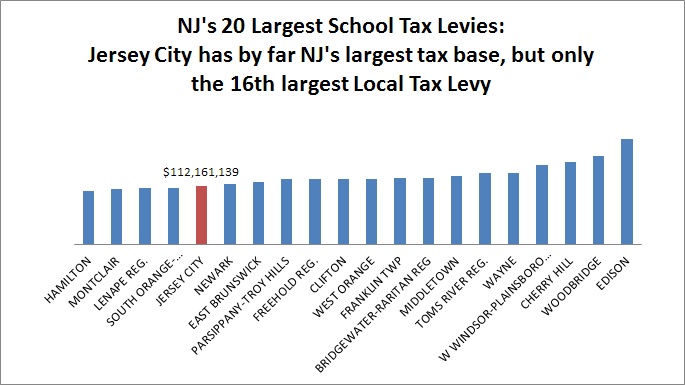


More importantly, Jersey City's Equalized Valuation is $21.3 billion, which, combined with Jersey City's Aggregate Income, comes to $330 million in Local Fair Share.  JC's tax base would be at least $9 billion larger if its PILOTed property were included.  Divide that Local Fair Share by the number of students in Jersey City and you get $10,196 per student; an amount which is slightly below NJ's median, but above districts like Bloomfield ($9,366 per student) and almost double higher than what some poor non-Abbotts like Dover ($5,576)  and Manchester Regional ($5,226) have.

In fact, Jersey City's Equalized Valuation is increasing so rapidly that its Effective (aka "Equalized") Tax Rate is dropping:


So Sandra Cunningham's resistance to doing anything that would raise Jersey City's taxes is indefensible.

Sometimes I feel like I write too much about Jersey City on this blog, but its emblematic of the problems of school finance in New Jersey and if the legislature and Christie refuse to redistribute aid out of Jersey City the amount of aid to be transferred is going to be limited.

Again, I'm encouraged by what I've read of the Senate Budget Committee hearing, even though I worry about that the amount to be redistributed will be very limited.  Anyway, I look forward to the Assembly hearing which will take place on Wednesday, April 20th.


Wednesday, March 9, 2016

Beyond the Point of Fairness: NJ's Most Overtaxed School Districts

Everyone in NJ thinks that their property taxes are brutal, but just because NJ's average property taxes are the country's highest doesn't mean that everyone's burden is equally excruciating.  This post is going to be about the school districts where taxpayers truly have the worst school taxes by the standards of New Jersey.

Although there are different ways to assess tax burdens, this will use the 2016-17 Local Fair Share.

Basic Facts on NJ School Tax Burdens:

  • The median district's 2015-16 tax levy was equal to 102% of its 2016-17 Local Fair Share. 
  • There are 306 districts that pay 100% or more of their Local Fair Share.
  • There are 17 districts that pay 150% or more of their Local Fair Share.
  • There are 284 districts that pay 99.9% or less of their Local Fair Share.
  • There are 55 districts that pay 49.9% or less of their Local Fair Share.

What is Local Fair Share?
(Readers who understand how SFRA is supposed to work can skip this section.)

Local Fair Share is a measurement of a district's ability to pay taxes.  It is a hybrid calculation that depends on Equalized Valuation (ie, market value of a town's taxable real estate) and on Aggregate Income.

The formula for Local Fair Share for 2016-17 is:

(Equalized Valuation x 0.013156218 + Aggregate Income x 0.046185507)/2

Where Equalized Valuation is from 2015 (for FY2016) and Aggregate Income is from 2013.

The formula for Local Fair Share might look wild, but all it says is that a district's fair share of taxes equals 0.65% of Equalized Valuation (1.3% / 2) plus 2.3% of income (4.6% /2 ).

So, to use South Orange-Maplewood as an example, its Equalized Valuation is $6,118,482,231 and its Aggregate Income for 2013 was $2,414,402,178.

Thus, when you plug those values into the formula you get South Orange-Maplewood's Local Fair Share of $96,003,237.

Local Fair Share is half of the calculation of Equalization Aid, the state's most important aid stream.

Equalization Aid is calculated by determining a district's Adequacy Budget (using population and various at-risk weights) and then subtracting Local Fair Share. So, South Orange-Maplewood's Adequacy Budget is $104,753,980 and its Local Fair Share is $96,003,237, therefore it would get $8,750,743 in Equalization Aid if SFRA were followed.

Of course, SFRA is NOT followed and South Orange-Maplewood gets $0 (ZERO) in Equalization Aid.

If a district's Local Fair Share is greater than its Adequacy Budget it does not get Equalization Aid. A third of NJ's districts do not qualify for Equalization Aid.

(It might seem inappropriate to some readers that I am using the 2015-16 tax levy and comparing it to the 2016-17 Local Fair Share, but Local Fair Share is (unavoidably) is calculated during the previous school year anyway and uses lagging data.  Thus, comparing the previous year's tax levy to the next year's Local Fair Share is a legitimate way to assess relative tax burdens.)

NJ's Most Overtaxed


Manchester Regional really stands out here for exceptionally bad taxes.  Manchester Regional's taxes are so incredible because of the new and unique tax apportionment arrangement Prospect Park, Haledon, and North Haledon have where North Haledon (a middle class district) pays taxes to Manchester Regional based 50% on Equalized Valuation and 50% on the percentage of students there who are from North Haledon. It must be known that most of Manchester Regional's taxes are paid by Prospect Park and Haledon.

Even though Manchester Regional is only a grades 9-12 district, even if you combined its taxes with the taxes of Haledon and Prospect Park, the resulting tax levies would still be exceptional for those two towns.  Prospect Park/Manchester Regional's combined tax levy would be 173% of Local Fair Share. (see graphic.)  Haledon/MR's combined tax levy would be 167% of Local Fair Share.  North Haledon, on the other hand, would have taxes that are slightly below LFS.

For some districts the high tax burden is something they found themselves in because their tax levies stayed constant (or increased) as their tax bases declined.  Atlantic City is the ideal example of a  district like this.  In 2008 when Atlantic City's Equalized Valuation was $22.2 billion, its $109 million school tax levy was easily affordable, now that Atlantic City's Equalized Valuation is about $8 billion, a $100+million tax levy is a huge challenge for a district whose income is as low as Atlantic City's is.

Linden, Lodi, and Newton have also had substantial losses to their Equalized Valuations.

Although Manchester Regional and a few other high-tax districts like Linden, Lodi, Woodlynne, West Orange, are severely underaided, the highest-taxed districts are overall a mix of districts that are overaided and underaided.  The underaided, high-tax districts can be seen as trying to make up for a lack of state aid; the overaided, high-tax districts can be seen as trying to spend more to improve educational quality.


Several of NJ's other severely underaided districts, such as Bound Brook, East Newark, and Freehold Boro, have tax burdens which are closer to their Local Fair Shares or even below their Local Fair Shares.

On the other hand, most of the districts whose districts whose taxes exceed Local Fair Share the most in absolute terms are indeed underaided.


Some of NJ's most overtaxed districts do well in state aid and should be considered voluntary overtaxers who; other overtaxers get a pittance for state aid and are essentially being forced to overtax themselves or else sacrifice their children.  If Manchester Regional taxed at its Local Fair Share ($4.7 million) instead of its actual $10.7 million levy, Manchester Regional would have $6 million less, or $6400 less per student.  Since Manchester Regional's total budget is about $18 million ($13300 per student), this would be a gigantic setback that would make Manchester Regional easily New Jersey's lowest spending school district.

All of the other overtaxed/underaided districts here tax themselves thousands of dollars in excess of their Local Fair Shares.

Some inequity in taxation is unavoidable because some districts (like Jersey Shore microdistricts) have more property wealth per student than others, but what is infuriating and unacceptable is how NJ's unfair distribution of state aid (where 199 districts get 100% or more of their uncapped aid) exacerbates these "natural" inequities.  Jersey City's school taxes are so low because it gets $130 million in K-12 aid in excess of what SFRA recommends.

What is also maddening is how little known all of these inequities are because the Department of Education does not publicize Local Fair Share data.

Both the Democrats and Republicans fail New Jersey's working class districts and poor non-Abbotts.  Republicans fail NJ's working class districts and poor non-Abbott districts through their opposition to any income tax increase whose proceeds could relieve property tax burdens; Democrats fail NJ's working class and poor non-Abbotts through their favoritism towards their urban (Abbott) base, lack of realism on pensions. and general non-prioritization of K-12 school funding.

Will help ever come for districts like Linden, Lodi, and Manchester Regional?  Not unless these districts can successfully make the case that they are truly victimized by the state and they can inform the public that not everyone's tax burden is equally heavy.

---

PS  The towns with the highest all-in (county, school, and municipal) Equalized tax rates are in this chart.

These data do not take income into account residential income.  I also excluded Winfield because its Equalized tax rate seems to be 18%, a figure I find unbelievable without further corroboration.

Source: http://www.state.nj.us/dca/divisions/dlgs/resources/property_tax.html#1


---

See Also:

Helping the Needless: New Jersey's Richest Districts and Their State Aid

The Robbers and the Robbed: State Aid Disparities for 2016-17

Choice Districts, Charterized Districts Are Big Winners for 2016-17 State Aid

More on 2016-17 State Aid: Where the Money's Going

Thursday, March 3, 2016

Help for the Needless: New Jersey's Richest Districts and Their State Aid


This post is the first in a series where I examine tax and Local Fair Share data for 2016-17.  This post will identify New Jersey's richest school districts, based on total Local Fair Share and Local Fair Share per student and demonstrate that most of these districts receive considerable state aid that they have no economic need for.  The conclusion is that these ultra-high resource districts' aid should be redistributed to truly disadvantaged districts.

Local Fair Share is the state's way of evaluating what taxes a district should be capable of paying in order to support its schools.  Local Fair Share is half of the calculation of Equalization Aid, the state's major stream of aid.

The formula for Local Fair Share depends on Equalized Valuation and on Aggregate Income.

The exact formula for 2016-17 is:

(Equalized Valuation x 0.013156218 + Aggregate Income x 0.046185507)/2

Equalized Valuation is the market value of all the taxable real property in a town.  Aggregate Income is the total income of the residents, although there is a three year lag in what year aggregate income is from.  For FY2017 the state is using Aggregate Income from 2013.

Local Fair Share is not confidential, but it is not published either.  I got these data by making an OPRA request of the DOE.

The definition of "richest" I am using in this post is "tax base per student." These districts do not have New Jersey's highest average incomes, nor lowest FRL-eligible rates, nor highest school spending.  By using the word "richest," I'm intentionally being provocative, but it's high time that some high-FRL districts like Hoboken accept that they are in fact rich on a per student basis.

New Jersey's highest-resource districts tend to be demographically unusual places like Hoboken and Jersey Shore microdistricts that have very high property valuations and very few children.  The few conventionally affluent districts among the richest are Alpine, Harding, and Bedminster.

As usual, I will look at state aid for these districts and show that state aid for these districts is unneeded and must be redistributed in the era of the pension crisis.

Without further ado, here goes:

These 38 districts are all the districts with more than $35,000 in Local Fair Share per student.

The Red column is the actual Local Tax Levy.

Avalon Boro, with $1.3 million in Local Fair Share per student, is the highest resource in New Jersey.  It taxes itself at 6% of Local Fair Share, but still yields over $70,000 per student.

If you examine the chart, you'll see that these are mostly tiny districts.  Of these districts, only Franklin Lakes (1,083 students), Ocean City (1,447), and Hoboken (2,596) have more than 1,000 students.  According to the figures I got from the Department of Education for estimated 2016 population, these 38 districts in total only have 12,258 students.


Helping the Needless

Unevenness of economic resources is to be expected, but what is outrageous about the situation in New Jersey is that these ultra-high resource districts get considerable state aid. The 38 richest districts get $28,555,176 in K-12 state aid, plus another $11.3 million for Pre-K in Hoboken.

23 of NJ's 38 districts with more than $35,000 per student in Local Fair Share get over $1,000 per student.

Seven of NJ's districts with more than $35,000 in Local Fair Share per student get over $3,646 per student state aid median.


I've said numerous times on this blog that New Jersey must redistribute Adjustment Aid.  I believe that the fairest method to redistribute aid is to take Adjustment Aid from overaided districts, and I make no exceptions for overaided districts with high FRL-eligibility, such as Jersey City, Pemberton, and Asbury Park.

However, another source of aid to responsibly redistribute is to take all aid away from New Jersey's wealthiest districts.  The amount of aid NJ's highest-resource districts get is in the tens of millions of dollars.  When for 2016-17 the state can only find an additional $19 million for Equalization Aid we have to look at the money the least-needy districts are getting and put it where the need is the most acute and it will do the most good.

---

See Also:


Helping the Needless: New Jersey's Richest Districts and Their State Aid

The Robbers and the Robbed: State Aid Disparities for 2016-17

Choice Districts, Charterized Districts Are Big Winners for 2016-17 State Aid

More on 2016-17 State Aid: Where the Money's Going


Monday, February 29, 2016

Choice Districts, Charterized Districts Are Big Winners for 2016-17 State Aid

For the sixth year in a row, the disproportionate gainers in K-12 aid are districts that participate in Interdistrict Choice.

Interdistrict Choice, to simplify, is a relatively new program where state taxpayers pay school districts to accept students who live outside that school district.

The average state payment is nearly $11,000 per Choice student, an amount far in excess of the marginal costs to a district of accepting additional students.

After three years of blistering, unlimited cost growth (from $9 million in 2010 to $49 million in 2013-14), the Christie Administration tried to freeze Interdistrict Choice and only allowed limited growth.

For 2016-17 the Christie Administration is only increasing Interdistrict Choice spending by $1.2 million, but even that small amount is enough to provide disproportionate gains to Choice districts.

http://www.nj.gov/education/finance/fp/ufb/2015/reports/29/0230/UFB16_0230.pdf
http://www.nj.gov/education/finance/fp/ufb/2015/reports/25/4360/UFB16_4360.pdf
Note: The photos are not from Beach Haven and Red Bank Boro.  I used
them for illustrative purposes.


The following districts are all of the districts in New Jersey that are gaining more than $80 per student.  (NJ's median increase is $19 per student.)

Please notice how many are gaining most of their aid primarily through Interdistrict Choice.


(Some Choice districts who are among the biggest gainers in overall aid are seeing their Choice aid stay flat.  Atlantic City is in this category.  If a Choice district is gaining more from formula aid than Choice Aid it appears in blue as a regular district.)

Click to enlarge.

Or, to put it in table format.

Please also notice that these big gainers are only rarely among the most underaided in New Jersey and seven of them in fact got more money than SFRA says they economically and demographically need!  (and remember, SFRA's funding targets are extremely high for any district where a majority of students are at-risk.)


DistrictTotal Per Student Increase for 2016-172015-16 Underaiding or Overaiding Relative to Uncapped AidChoice Aid Percentage of Total IncreaseHost District Aid Percentage of Total IncreaseNoteAid Per Student in 2015-16
WEST CAPE MAY BORO$1,880-$60199%NAChoice$7,816
NEWARK$528-$2,600NA82%Abbott/Host District$14,119
HAMPTON BORO$499$3,95798%NAChoice$9,146
BLOOMSBURY BORO$335-$66782%NAChoice$7,694
BROOKLAWN BORO$307-$2,50969%NAChoice$12,077
PLAINFIELD CITY$272-$4,106NA66%Abbott/Host District$12,668
CALIFON BORO$262$1,70096%NAChoice$3,263
QUINTON TWP$167-$70271%NAChoice$9,190
WILDWOOD CREST BORO$162$72188%NAChoice$2,352
LOWER CAPE MAY REG.$161$4,60794%NAChoice$7,174
ATLANTIC CITY$151-$4,526NA (lost Choice Aid)81%Choice (but lost Choice money)$2,635
PORT REPUBLIC CITY$149-$27572%NAChoice$5,598
FOLSOM BORO$145-$2,26655%NAChoice$11,776
MINE HILL TWP$131-$2,40971%NAChoice$5,455
SOUTH HARRISON TWP$128-$70458%NAChoice$4,139
OXFORD TWP$127-$1,60173%NAChoice$6,666
IRVINGTON $126-$348NA89%Abbott/Host District$15,331
ALEXANDRIA TWP$124$1,41592%NAChoice$3,589
NEW BRUNSWICK $118-$4,056NA15%Abbott/Host District (is among NJ's most rapidly growing districts)$12,805
MANCHESTER REG$115-$10,73751%NAChoice (but most underaided district in NJ)$7,271
BRIDGETON CITY$114-$4,033NA8%$13,968
SOMERDALE BORO$113-$3,72149%NAChoice$6,163
ELSINBORO TWP$110-$2,53965%NAChoice$6,523
ORANGE$108-$3,045NA6%$13,973
ELIZABETH CITY$105-$2,586NANAAbbott$14,484
FAIRFIELD TWP$101-$1,785NA14%$10,720
WOODLYNNE BORO$101-$5,982NANA$12,281
PAULSBORO BORO$101-$2,8679%NAChoice$11,624
OLDMANS TWP$100-$1,51057%NAChoice$6,100
WEST NEW YORK$99-$3,1970%NAAbbott$12,207
DEAL BORO$98NA66%NAChoice$10,796
PINE HILL BORO$98-$2,81819%NAChoice$9,959
ROOSEVELT BORO$97$57290%NAChoice$8,524
UNION CITY$97-$3,3320%NAAbbott$14,490
CLAYTON BORO$95-$5,02734%1%Choice$7,165
WHARTON BORO$95-$5,38547%NAChoice$5,025
ELMER BORO$92-$583NANA$9,070
FRENCHTOWN BORO$88$1,72589%NAChoice$5,930
EGG HARBOR CITY$86-$2,453NANA$10,791
NORTH HANOVER TWP$85-$3,108NANA$10,722
PENNS GRV-CARNEY'S PT REG$84-$4,059NANA$10,394
BERLIN TWP$82-$1,06050%2%Choice$6,836
LINDENWOLD$81-$5,885-14%6%$9,084
PROSPECT PARK$81-$5,896NANA$8,915
LAWRENCE TWP$80-$2,618NA5%Choice$10,078
MEDIAN NJ DISTRICT$19

Notice who isn't on the list: FREEHOLD BORO, New Jersey's most stricken and overcrowded district.  Freehold Boro is only gaining $100,770, or $58 per student.

NJ's other most underaided districts are doing similarly badly. Fairview is getting $59 per student. Guttenberg is getting $49 per student. Manville is getting $37 per student. Lodi is getting $41 per student. Bound Brook, with a -$9,176 deficit the most underaided for 2016-17, is getting another $59 per student. East Newark is doing comparatively well, getting another $74 per student.

Granted, some of the Interdistrict Choice districts are severely underaided too, including Manchester Regional, New Jersey's most underaided district for 2015-16.

It's good Manchester Regional is getting additional state aid through Interdistrict Choice, but Manchester Regional is the exception that proves the rule.  Manchester Regional is only able to accept Choice students because so many North Haledon children do not attend Manchester Regional.  Most other underaided districts, like Freehold Boro, have bad crowding problems and could not participate in Interdistrict Choice even if they wanted to.

However, for almost all of these underaided Choice districts, including Manchester Regional, the gain from new Interdistrict Choice money exceeds their gains from other aids.  If it weren't for Interdistrict Choice money, Manchester Regional would only gain $56 per student.

West Cape May: The Biggest Aid Thief of 2016-17

Newark might be getting the most new money in absolute terms for 2016-17, but West Cape May is getting the biggest increase in dollars per student: an unbelievable gain of $1880 per student.  (over $100,000 for a district the DOE considers to have 65 students (See how Professional Community Development Aid is $650.  $650 = 65 students)

What is West Cape May that makes it so worthy?

It is a microdistrict with 97 students on roll and $2,555,658 in Local Fair Share, or $26,346 per student.

When West Cape May has so much wealth and conditions in the rest of New Jersey are so desperate, the State should be trying to ease aid out of West Cape May, not funnel more into it.

Deal Steals Again

Deal has a phenomenally high tax base: $17.2 million in Local Fair Share for 176 students (counting Choice students), or $97,800 per student.

Like Hoboken, Allenhurst, Alpine and a few other ultra-high resource districts, Deal has no need for any state aid.  Given its minute size, Deal should not even be an independent district.

And yet because of Interdistrict Choice Deal will gain another $17,000 in Choice Aid next year, bringing Deal's total aid up to $2.1 million.  The $17,000 might not sound like a lot, but when the state can only find $100,000 for Freehold Boro and when Deal is so rich and already aided at $10,700 per student , Deal's $17,000 is unacceptable.  

Host District Support Aid (ie, Bucks for Charters)

The other class of districts getting big gains in aid per pupil are districts getting money from Chris Christie's new "Host District Support Aid."

Host District Support Aid is concentrated in Newark. Of the $26 million the state is distributing through this new aid stream, Newark is getting $22 million.

Plainfield, Irvington, New Brunswick, and Atlantic City are the only other districts in NJ to get over $100,000 through Host District Support Aid. Several districts with high charter transfers, such as Paterson ($34.6 mil in charter transfers), Trenton ($35 mil), Camden ($57 mil), Jersey City ($58 mil) are getting nothing.

Host District Support Aid is pass-through money for charters. The children in the traditional Newark Public Schools will not directly benefit from this money.  The creation of Host District Support aid is more a sign of Newark/charter political power than Chris Christie fairly and consistently responding to a school funding problem.

The increase in aid for the Newark Public Schools is $4.7 million, or $92 per student.

Another Unfair Year

The real culprit of underaiding is New Jersey's stagnant economy and need to increase pension and debt payments, however, the problem isn't only the pitiful amount of new aid, it's how the new aid is distributed.

The Christie Administration only increased Equalization Aid by $19 million. from $6,070,003,740 to $6,088,956,541)

That $19 million was all there was available to help NJ's most acutely underaided districts.

For 2016-17, the 199 overaided districts got $567,773,913 more than SFRA said they demographically and economically needed.  If Chris Christie had been willing to redistribute only 10% of this money (~$57 million) and had not created the $10 per student Professional Development Aid (~$11 million) it would have made possible an increase of $68 million for Equalization Aid - more than three times more than was actually made available.

---

See Also:


Helping the Needless: New Jersey's Richest Districts and Their State Aid

The Robbers and the Robbed: State Aid Disparities for 2016-17

Choice Districts, Charterized Districts Are Big Winners for 2016-17 State Aid

More on 2016-17 State Aid: Where the Money's Going